Showing posts with label Johnny Depp. Show all posts

Monday, May 29, 2017

Pirates of the Caribbean: Dead Men Tell No Tales (2017)

Here’s the thing about Pirates of the Caribbean: Dead Men Tell No Tales: for all that critics have contorted themselves to work the film’s subtitle into some kind of indictment of whether this particular tale should have been told, it is for all intents and purposes Pirates of the Caribbean 5, resurrecting plotlines from past films and trotting them out again for more high-seas adventure. So if you’re already weary of Captain Jack Sparrow and his ilk, this one won’t win you over. For those of us dyed-in-the-wool landlubbers, though, it’s more of the same good fun.

Captain Jack Sparrow (Johnny Depp) is down on his luck when he learns that the ghostly pirate Captain Salazar (Javier Bardem) is coming for him and the rest of the pirates on the seas, including the lucre-laden Hector Barbossa (Geoffrey Rush). Meanwhile, Henry Turner (Brenton Thwaites) needs Jack’s help to seek out the Trident of Poseidon to free his father Will Turner (Orlando Bloom) from the curse of the Flying Dutchman, while horologist Carina Smyth (Kaya Scodelario) knows how to read the map to find it.

I was struck by how many parts of Dead Men felt familiar, almost like clues along a treasure map that loyal fans know how to read. I first caught it when I noticed that the romantic theme from At World’s End was repurposed for an action cue involving Henry Turner; I chalked it up to new composer Geoff Zanelli slyly remastering Hans Zimmer’s superlative earlier score, but then the similarities really started manifesting. There’s a curse, and Jack’s responsible; there’s a mystical artifact buried on an island to which the compass points; there’s a witch and a crew of inhuman pirates with a decaying ship; we’ve got a chase through cobblestone streets and an execution sequence that doesn’t quite go as planned; and there’s a well-intentioned pretty boy paired off with an unconventional woman. I would go so far as to hazard a guess that every scene in Dead Men involves a callback to another moment in the franchise.

What I can’t determine, doubtless because I am too uncritical a critic in my appreciation for a film series that’s been a favorite for nearly half my life, is whether this is for better or worse. Put another way, I’m not sure if the franchise has run out of ideas or if the crew of Dead Men, like Roald Dahl on You Only Live Twice (itself a fifth film in a franchise), have taken stock of the preceding films and attempted to canonize the rules and tropes that govern such a movie, for there does seem to be a sense that Dead Men is going back to square one for a kind of velvety-soft reboot and revivification. I did not, however, feel that On Stranger Tides strayed too far from the Pirates brand and indeed appreciated the new corner it carved out in the universe. Dead Men does, then, feel a bit like playing it safe, not unlike the ship at the film’s climax which risks falling into an immense cavern (though I never perceived that metaphorical cavern).

What Dead Men does contribute is a deeper sense of the mythology of the universe, just ahead of what might be an extension of the franchise (and yes, the post-credits scene is, as ever in these movies, pivotal). We’ve got flashbacks and “secret origins” and retroactive continuity vis-à-vis the curse of the Dutchman, as well as an expanded family tree that Geoffrey Rush has compared (spoilers in the link) to a Dickens novel, an assessment with which I’d have to agree; Dead Men feels very much like “the next chapter,” perhaps more than On Stranger Tides did.

But for all the critical hemming and hawing over whether this is a fresh or stale “next chapter,” I have to say that it’s a fun one, and I think one’s overall take on this Pirates film has very much to do with the degree to which one has ever enjoyed a Pirates film. As before, you’ve got spooky villains with quirky gimmicks, which are animated with grisly compelling detail, and you’ve got the trademark Pirates brand of humor on display, from an uproarious bank heist that goes awry in the strangest way to hilarious confusion over the precise meaning of the word “horologist.” But there are no false notes, no moments where one might tweet out #NotMyPirates. There’s continuity here, not unlike the devoted patience one affords the Marvel Cinematic Universe, which is thrice as long.

In short, dead men tell no tales, but franchise newcomers Joachim Rønning and Espen Sandberg have directed a safe yet entertaining one that makes me equally, not less, enthusiastic about the prospect of a sixth Pirates film. (Remember, Penelope Cruz’s Angelica is still out there somewhere...) Dead Men is a useful primer on what the Pirates franchise has done, and here’s hoping that a sixth will demonstrate what it can do.

Pirates of the Caribbean: Dead Men Tell No Tales is rated PG-13 for “sequences of adventure violence, and some suggestive content.” Directed by Joachim Rønning and Espen Sandberg. Written by Jeff Nathanson and Terry Rossio. Starring Johnny Depp, Javier Bardem, Geoffrey Rush, Brenton Thwaites, and Kaya Scodelario.

Monday, January 19, 2015

Into the Woods (2014)

I had so desperately wanted to begin this review with the fabulous line given to Little Red Riding Hood:  “Nice is different than good.”  Unfortunately for the sake of the pun, Into the Woods is both nice and good, a fine close to what has been another good year for Disney and perhaps the more sober alternative to the relentless cheeriness of the nation’s current Frozen mania.

The film’s opener sets the stage best:  “Once upon a time in a far-off kingdom there lay a small village at the edge of the woods, and in this village lived a young maiden (Anna Kendrick as Cinderella), a carefree young lad (Daniel Huttlestone as the bean-stalked Jack), and a childless baker (James Corden) with his wife (Emily Blunt).”  The curse of a witch (Meryl Streep) sets these characters into a quest through the woods, where they cross paths with Little Red Riding Hood (Lilla Crawford), a pair of narcissistic princes (Chris Pine and Billy Magnussen), and a Big Bad Wolf (Johnny Depp).

As someone unfamiliar with the stage play – and deliberately so, in order to take the film on its own terms – I can’t help but see Into the Woods as another fabulous step forward for Disney in its current phase of self-reflexive reinvention.  Those who don’t know the play might be surprised, as I was, by the film’s clever fake-out climax which delivers the “happily ever after” about forty minutes too early and then dissects just how untenable that ending would have been – warts, discontents, and unfinished business.  It’s smart stuff, the kind of revisionist fairy tale that we’re seeing played out in stuff like the Fables comics and, more closely to Into the Woods, the true-love fallacies of Frozen and Brave.

As for the lyrical elephant in the room, Stephen Sondheim’s trademark syncopated style of “talk singing” isn’t for everyone, and even folks who liked Tim Burton’s Sweeney Todd adaptation from a few years back will find Into the Woods somewhat less melodic, governed more by motifs than catchy tunes.  For me, I liked the music enough to go out in search of the soundtrack, if only for the tour de force “Prologue,” a fifteen-minute introduction to all the characters and major plots that also gives us the whimsical eponymous chorus “Into the woods / It’s time to go...”

I like the music, but I’m sure it’s because the performers are all quite charismatic.  I can’t think of many actresses who could sell a line like “I caught him in the autumn in my garden one night!” – but, as the oft-quoted line from Modern Family goes, “Meryl Streep could play Batman and be the right choice.”  Streep, who did Mamma Mia! with more class than anyone expected, lends the Witch an equal dose of class, and she does wonders with the maternal scenes with Rapunzel as well as absolutely killing it in the witchier bits.  I honestly don’t have a bad word about any of the aforementioned cast, although I’ll throw in the two-cents that I really could have used more Johnny Depp.  Touted as a centerpiece of the ensemble cast, Depp only appears for about five minutes – which are captivating, don’t get me wrong, with his vaguely pedophilic Wolf devouring scenery and children in one fell gulp.

I think the reason I fell so fast in love with Into the Woods, aside from the equally captive audience sharing the theater with me, is that the characters are very well-crafted and – tragically, a rarity these days – eminently likeable.  Everyone, from the Baker and his wife to Red Riding Hood, has a story arc, compelling motivations, and at least one ingenious turn of phrase (either by smart rhyme or admirable manipulation of rhythm).  When things don’t go well for them, the audience feels it; when the characters triumph, we feel it even more.  This is a musical adaptation that remembers those of us who don’t already love the story, so director Rob Marshall works extra hard to get all of us swept away by the once-upon-a-times.

And while I’m on the subject of the captive audience, Into the Woods is an effortless crowd pleaser, even amid a somewhat gloomy ending.  There’s something for everyone in here, plenty of year-end spectacle and spectacular performances:  “It Takes Two” is a catchy and slyly romantic duet, where “Agony” is the musical number that’ll elicit the most laughs as the Princes compare male-privilege sorrows.  Into the Woods manages to be self-reflexive without being overtly cynical – “Careful the tale you tell” seems to be the moral of this story, and it’s evident that the filmmakers have been very careful indeed.  What more can I say?  I had an infectiously good time, escapism layered with enough narrative criticality not to feel like a brain-drain.  I’d happily go back into the woods once more.

Into the Woods is rated PG for “thematic elements, fantasy action and peril, and some suggestive material.”  There’s fairy-tale discussion of curses and creatures, though the film darkens considerably in the second half when a giantess walks the earth and several characters die in emotionally-charged sequences.  The Wolf is played as a metaphor for sexual awakening with pedophilic overtones, while the Prince’s philandering ways lead to serious questions about seduction and fidelity.  All told, though, this is no less appropriate than most of, say, Disney’s late-90s offerings.

Monday, April 21, 2014

Transcendence (2014)

While I spend a lot of time on this blog heralding the innovative vision of Christopher Nolan, I’ve never mentioned the name Wally Pfister, Nolan’s chief cinematographer and a key guiding hand in the creation of that aforementioned vision.  The shadow of Nolan looms large over Pfister’s directorial debut Transcendence, though the end result feels more like the work of an impressionist than a disciple.

Transcendence stars Johnny Depp as Dr. Will Caster, an artificial-intelligence scientist shot with a radiation-laced bullet by anti-tech terrorists.  During his last weeks, Will’s wife Evelyn (Rebecca Hall) works to digitize and upload her husband’s consciousness, to the dismay of their friend Max Waters (Paul Bettany).  Max fears that the program Evelyn activates isn’t really Will, fears that take on weight when “Will” quickly advances beyond the realm of the possible.

Transcendence clearly rides the post-Inception wave of high-concept science fiction, a wave dominated by the technical achievement of Gravity.  With Transcendence, Pfister and screenwriter Jack Paglen tackle the issue of the singularity, a post-human digital environment epitomized by the idea of “living long enough to upload.”  The film poses a number of important questions about this technology – how much of a personality is changed during the dehumanizing process of uploading?  What are the upward limits of “transcendence”?  And at what point does AI surpass our understanding of conventional morality?

Unfortunately, Transcendence never really answers those questions, stopping short at presenting them.  What’s frustrating, though, is that the film presents these questions as though they will become important plot points, as when anxiety arises about whether “Will” is really Will; though at least one scene teases an answer to the question, it’s never revisited until the conclusion, which takes the answer for granted.  To be fair, this is Paglen’s film debut as well as Pfister’s, and he’s already offered something smarter than most science fiction does, but it is only half the battle.

Just as the script only takes us halfway there, the rest of the film never quite emotionally engages.  Depp and Hall have genuine chemistry together, playing the quirky-scientist-couple brilliantly in the one scene they have together before Will is shot, and Hall proves herself the actual star of the show with a commanding lead as the increasingly-distraught Evelyn.  As for Depp, he acquits himself rather well, playing a subdued performance that you won’t believe comes from the same man as last summer’s Tonto.  The rest of the cast, though – Morgan Freeman and Cillian Murphy among them – are basically interchangeable, which is a shame given the range they’ve displayed elsewhere (and largely in Nolan films).

This, then, is the larger weakness of Transcendence – its inability to pass the Plinkett test,1 which requires characters to be distinct beyond physical appearance and function to the plot.  Will and Evelyn for all intents and purposes pass the test, though none of the other characters do.  The result is a fairly uneven film, in which two out of three running plotlines proceed purely on the requirements of the narrative itself.  The film needs an antagonist for its central AI-based protagonist, so a thinly characterized terrorist group (RIFT) is created, with oblique gestures at their motives.  Common sense suggests that the US government might object to the existence of “Will” on their soil, so a team of government agents chases the plot wherever it goes.

I’ve never fully understood why some moviegoers have difficulty connecting emotionally to Christopher Nolan’s work.  Despite the overtly cerebral nature of his films, they’re anchored by very human stories, such that the very ending of Inception cares more for how its protagonist acts than whether what’s happening is actually real.  (The same can’t be said for twist-ending flicks like The Sixth Sense, where the revelation is all.)  With Transcendence, though, I feel like I’ve approximated that sensation; Will and Evelyn aside, I couldn’t engage emotionally with any of the characters on screen and indeed found several of their decisions – mostly shifts in allegiance – to be baffling beyond the necessity of the plot.  I have no idea, for example, how Freeman’s character goes from desk-jockey scientist to FBI analyst, or why (potential spoilers ahead) Paul Bettany’s character joins up with RIFT – beyond, that is, the need for characters in a film to move toward the conclusion of the plot.

At the core of Transcendence is a very moving, very meaningful science-fictional take on a hetero-organic marriage between a woman and her computer – the dark response, I suppose, to Spike Jonze’s Her.  Orbiting that compelling story, though, is a series of narrative false steps and mechanical storytelling that make Transcendence more of a disappointment than Pfister’s promising career to date would have foretold.  One wonders what would have come of “Christopher Nolan’s Transcendence” had a more deft filmmaker been at the helm.  Transcendence is just shy of a failure, feeling more like the training wheels on Pfister’s bike were taken off a bit too soon.

Transcendence is rated PG-13 for “sci-fi action and violence, some bloody images, brief strong language and sensuality.”  There are a few shootings with a fair amount of blood (mostly seen as bloodstains on clothing), and some viewers might be ooked out by the moments when machines augment human bodies via healing or implantation.


1 Plinkett dismantles the Star Wars prequels in a series of YouTube videos for many reasons, most prominently its failure to create characters as rich as the ones from the original trilogy. A focus group in his Phantom Menace review is able to describe with great precision the personalities of Han Solo and C-3PO but is unable to do the same for Qui-Gon Jinn and Queen Amidala.↩

Monday, July 8, 2013

The Lone Ranger (2013)

Although it’s not a catastrophe by any stretch of the imagination, the biggest problem with Gore Verbinski’s The Lone Ranger isn’t the perceived cultural insensitivity of the “redface” casting of Johnny Depp as Tonto.  It’s that the film is longer than it needs to be and short on that relentless charm that made the Pirates of the Caribbean franchise such a winner.

Following the death of his brother and given a second chance at life, whitebread lawyer John Reid (Armie Hammer) dons a mask and a badge to become “The Lone Ranger.”  He teams with offbeat Cherokee Tonto (Depp) to apprehend the outlaw Butch Cavendish (William Fichtner) while railroad tycoon Latham Cole (Tom Wilkinson) works to complete his cross-country line.

With Pirates, Verbinski and Depp distilled a pitch-perfect blend of high-octane action and quirky character comedy (I’m on record as being of the opinion that the franchise has done no wrong).  A kind of revival of the Indiana Jones brand of action/comedy, Pirates also launched Depp into the household imagination as “he of the strange faces.”  But it’s a long shadow into which The Lone Ranger rides, which means the film’s shortcomings are either the result of detrimentally heightened expectations or simply a case of a film not living up to its predecessors.

The Lone Ranger has been called “bloated” by more than one critic, which accurately describes (but maybe embellishes) the principal problem with the film, which is one of length and pacing.  At 2:29, the film is longer than The Curse of the Black Pearl, and it takes even longer to get started; scene three of Pearl introduces us to Captain Jack Sparrow in one of cinema’s best introductions, yet it takes nearly an hour for Armie Hammer to don the mask.  And while Hammer is a good fit for the milquetoast pacifist Reid, charismatic he’s not, which forces the film to be Tonto’s.  Indeed, the film is often confused about who the star is; Depp’s name is above the title, but Hammer is the eponymous Ranger, though Depp headlines a (largely unnecessary) frame story.

Let’s back up and clarify here.  Hammer and Depp are fine choices for their respective roles.  Though one suspects this won’t be the start of the franchise Disney may have wanted, the two have good chemistry together, and the begrudging partnership that forms would make for interesting sequels that deconstruct the idealized 1950s partnership.  (If anything, the frame narrative sets this up as the “true” account of The Lone Ranger.)  Hammer is good at repressing his personality when he’s riding into battle atop Silver (here, a “spirit horse” with intractable charm in the vein of Fritz from Django Unchained).  As for Depp, this is “strange character #43” in his repertoire, albeit with more depth thanks to a surprisingly nuanced script that goes places of which the marketing campaign seemed blissfully unaware (and which those crying “racism” – at least, those who’ve seen it – seem willfully to ignore).

And the villains of the piece are delightfully hammy; classic bandit Fichtner snarls it up and isn’t apologetic about eating human hearts, a far cry from his blue-collar bank managers in Heat and The Dark Knight.  And I don’t need to tell you that Wilkinson is as always a treat, pouring the syrup on the scenery in lieu of twirling a mustache; you know he’s evil the moment you see him, though the inevitable revelation is played off with an additional, unexpected twist.

So with all these ingredients – including a near-cameo by Helena Bonham Carter as a one-legged brothel madam – what is it that doesn’t hit it for The Lone Ranger?  In large part, it’s an issue of length; like Pirates, there are several action set pieces, and the plot becomes quite complicated as the disparate story elements entangle themselves.  But unlike Pirates, Verbinski and company seem to have, sadly, listened to those who bemoaned that Pirates was too confusing; consequently, plot twists are recapped to death, and the status quo is reevaluated at the end of each.

When the film’s on, though, it’s on.  The action scenes are Pirates quality – particularly a harrowing canyon ambush, a barnyard shootout, and a horse-vs.-train duel set to a rousing reinterpretation of the William Tell Overture – and the performances, as I’ve said, are reliable.  In the end, The Lone Ranger is a bit like walking a mile when a run would do; you’ll get to the same place and feel about as good, but darned if it doesn’t take longer than need be.

The Lone Ranger is rated PG-13 “for sequences of intense action and violence, and some suggestive material.”  There’s some blood here and there, but most action sequences are bloodless and more exciting than gruesome.  A bandit speaks provocatively about a woman, while other men visit a brothel (which looks like a Disneyfied Moulin Rouge).

Loyal readers:  be sure to come back on Thursday for The Cinema King's take on World War Z!

Tuesday, December 18, 2012

Top 10 Christmas Season Movies - #8-7

This week, in anticipation of the Christmas season, we at The Cinema King would like to bring you more than just your usual share of recommendations.  So we present to you:  this week’s Top 10 list.  More specifically “The Top 10 Christmas Season Movies.”  Rather than fill the list with “obvious” choices of Christmas-y movies, there are a few “alternative” choices on the list – the overarching determining criterion is whether or not this is a movie that I will watch beginning to end, especially during (but not limited to) the Christmas season.

#8 – Edward Scissorhands (1990) 
Tim Burton’s fourth film is a solid choice for Christmas and a bit of a gimme for this list, but it’s one that doesn’t insist upon itself as a holiday film because of the absence of snow.  Ever the imaginative one, Burton sets the film in snowless suburbia, letting the spirit of the story take center stage.  And what a sweet story it is, a contemporary fairy tale with that Burton edge; Johnny Depp is iconic as the titular silent protagonist, nonthreatening despite his bladed fingers.  His romance with Winona Ryder covers the sentimental requirement, and Burton’s trademark sly sarcasm toward the cookie-cutter neighborhood makes this a year-round treat.  But lest you forget why Edward Scissorhands makes this list, keep your eyes peeled for the ubiquitous Christmas lights and reindeer decorations, and the fabulist explication for why it snows during the frame story is as touching as they come.

#7 – Goodfellas (1990) 
I’ve already lavished praise on this film, one of Martin Scorsese’s gangster epics and quite possibly one of the greatest films of all time.  It’s sharp, it’s witty, it’s thrilling, and it’s downright entertaining, cementing Robert De Niro’s reputation and forging one for Ray Liotta and Joe Pesci.  But what’s it doing on a Christmas list?  It’s not exactly a festive film, what with the strong bloody violence and general criminality.  After the film’s major “Lufthansa heist” segment, in which the mobsters successfully pull off the score of their lifetime, they celebrate with – what else? – an office Christmas party, all set to The Ronettes’ “Frosty the Snowman.”  Though the décor is festive, the demeanor of Jimmy Conway (De Niro) is anything but; in fact, he’s downright Grinchy as he demands that his goons take back the mink coats and Cadillacs they’ve bought with their share of the loot.  You could even argue that this Christmas scene is the pivotal turning point of the film, for when the soundtrack shifts to Cream’s “Sunshine of Your Love,” you know that scowl on Jimmy’s face bodes ill for his little elves.

Come back tomorrow for #6-5!

Monday, July 2, 2012

Monday at the Movies - July 2, 2012

Welcome to Week Twenty-Four of “Monday at the Movies,” in which I tie up a few loose ends on movie series whose final installments haven’t been reviewed yet on this site.

Hulk (2003) – If I’m not yet on record as saying that Mark Ruffalo is the definitive Hulk actor, quote me on that because I’ve just rewatched Ang Lee’s Hulk, starring Eric Bana as the jade giant and don’t have a lot of good things to say about it.  For one, the plot is overfilled with antagonists with competing interests; consequently, none of them (save, maybe, Nick Nolte as Bruce Banner’s evil father) becomes terribly compelling – not Josh Lucas as a cutthroat corporate scientist, nor Sam Elliott as General “Thunderbolt” Ross.  What we do get is the curious directorial choice to drain the film of any positive emotion; all the characters are either broken or emotionless (or both), which allows some of the acting to walk the line between nuance and flatness.  Unfortunately, Jennifer Connelly as Betty Ross is the worst offender here; at moments, her affection for Bruce is touching, but at others she looks like she’s staring at cue cards written in a foreign language.  But the film’s worst offense isn’t its emotional flatness or sense of bleak despair, but rather it tampers with Bruce Banner’s canonical origin in a way that fundamentally alters the character.  I can pardon the 2008 film’s link to the Captain America super-soldier serum as an exercise in world-building, but the connection to the father is purely imagined and ultimately unfulfilling since it never quite makes sense – especially at the end when a deus ex militia ends a major fight that, once again, is more about which can be out-angst the other than it is about superheroic adventuring.  I wanted to like this, but it fell flat and ranks below the Norton interpretation.  Long live Ruffalo.

Pirates of the Caribbean: On Stranger Tides (2011) – It’s no secret to readers of this blog that I’m a huge fan of the Pirates of the Caribbean franchise, and for my money the series goes four for four with this soft reboot, which finds Captains Jack Sparrow (Johnny Depp) and Barbossa (Geoffrey Rush) in a quest to find the Fountain of Youth – or at least prevent the dread pirate Blackbeard (Ian McShane) and his shifty daughter Angelica (Penélope Cruz) from reaching it.  The film is instantly accessible, building a new world without relying on or scrapping entirely the preceding trilogy.  Instead, the series goes off in an exciting new direction, promising a healthy spirit of competition between Jack and Barbossa for future films.  One of the highlights of At World’s End was seeing Depp and Rush out-pirate each other, a plot element that recurs here to great success.  What’s more, personal favorite McShane is delightfully menacing, unequivocally embracing his character and reveling in his mischief; think of the unswerving evil and odd syntax Al Swearengen of Deadwood, but with an enormous smoldering beard and far fewer F-bombs.  And Cruz’s Angelica brings a fun new character to the franchise, carrying on impressive repartee and even occasionally matching Depp, who brings his A-game as always.  Indeed, if I have complaints, it’s that Hans Zimmer’s soundtrack is more recycled than original, and Judi Dench has far too small a cameo role as a royal lady wooed by Captain Jack.  Though it didn’t receive much critical love, On Stranger Tides is more than satisfying, and its box-office receipts thankfully made a fifth film (allegedly in the works) a viable prospect.

Superman IV: The Quest for Peace (1987) – While the fourth Pirates film proved the franchise still had steam, Superman IV took a critical drubbing and continues to be hammered by superhero fans who regard its very name as shorthand for the worst in the genre.  But when I finally watched it this week, to my surprise there’s actually a lot in the film that works, making me wish that had been given a bigger budget and a better script editor.  Christopher Reeve is back for his last outing as the Man of Steel, facing Gene Hackman’s Lex Luthor and evil clone Nuclear (“Nucular”) Man.  The film is incredibly brief, meaning that the story is overly compressed, with characterization shortchanged for protracted and uninspiring action pieces which often cut away from the action (the film’s only explosion happens off-screen).  The screenplay, too, is weak in places, with Superman manifesting bizarre new powers and breaking his own rules several times; the secondary villains, moguls who buy the Daily Planet, are overdrawn and poorly performed, and the filmmakers apparently forgot that humans can’t breathe in space.  But there’s a good amount of the film that does succeed; Reeve and Hackman in particular are fantastic (even if the latter is saddled with Jon Cryer for a sidekick), their performances feeding off each other and nailing the heart of their character’s relationship with expressive frowns and shrugs.  Additionally, Jackie Cooper gets a terrific character arc as Perry White, who refuses to compromise his values in the face of the changing landscape of journalism.  Though the script is excessively preachy about the woes of nuclear weaponry, I’m surprised to say that I enjoyed it more than I thought it would – at least, more than the unfortunate Superman III.

That does it for this week’s edition of “Monday at the Movies.” We’ll see you here next week!

Monday, May 21, 2012

Dark Shadows (2012)

Most of us were probably squealing with delight when we heard that Tim Burton and Johnny Depp were channeling the old Dark Shadows soap opera in an attempt to take the vampire crown back from the tweener Twilight crowd.

What we got probably won’t dethrone Edward Cullen as pop culture’s current top vampire, but it’s exactly what diehard Burton/Depp fans will enjoy.

After being cursed, vampirized, and resurrected, Barnabas Collins (Depp) awakens in 1972 to find his family’s name in danger of stasis.  Taken in by the family’s current matriarch Elizabeth (Michelle Pfeiffer) and assisted by the groundskeeper (Jackie Earle Haley), Barnabas works to rebuild his family’s fishing industry, which places him in direct competition with Angelique Bouchard (Eva Green) – the witch who cursed him 200 years ago.

Added to the mix are Elizabeth’s angsty teen daughter Carolyn (Chloe Moretz), scandal-prone uncle Roger (Jonny Lee Miller) and his ghost-plagued son David (Gulliver McGrath), Barnabas’s lover reincarnated as the family nanny (Bella Heathcote), and the alcoholic live-in psychiatrist Julia Hoffman (Burton mainstay Helena Bonham Carter).

I catalogued meticulously the ensemble cast behind Depp because this movie has no shortage of plotlines.  It seems that Burton and screenwriter Seth Grahame-Smith (late of Pride and Prejudice and Zombies fame) are trying to replicate the structure of a soap opera, in that characters and plots alternate center stage.  But it doesn’t quite work on film – as a result, great actors like Carter are underused, while clear talents like Moretz are forced to wait their turn, while others still, like Miller, never really see their moment arrive.

As a consequence of all this waiting, many of the actors seem irritated.  While all this scowling and frowning and grimacing does set a certain mood within the film, it’s a distancing mood for the audience.  When all the other characters seem impatient, I get restless too, waiting for the next scene with the actors who seem to be indulging in the spirit of what the movie ought to be.

The two talents who do shine, perhaps predictably, are Depp and Green.  Depp manages to distinguish this British character from Sweeney Todd and Captain Jack Sparrow, immersing himself in the role just as we’d expect of him; Depp is the master of the reaction shot, toeing the line between “creature of the night” and “fish out of water.”  As for Green, she makes her character’s evil infectious, giving us the sense that she’s having a tremendous amount of fun being nasty; in the hands of a less capable actress this would have been a one-note “pretty face” role, but Green creates with aplomb a memorable villain and a worthy adversary for Barnabas.

When I said that Sweeney Todd was “the movie Tim Burton’s been trying to make all his life,” I didn’t realize how sadly prophetic that statement would be.  While I contend that Sweeney Todd is Top Ten Tim, his subsequent work has been somewhat less than.  2009’s Alice in Wonderland was lackluster, and Dark Shadows isn’t quite the revelation I had hoped.  Again, it’s exactly what I expected.  What it doesn’t do is transcend those expectations.

Indeed, the film’s basic attitude can be summed up with the line, “I’m a werewolf.  Deal with it.”  Certainly we can deal with it, but I wanted a little more.  The film is exactly a werewolf, but it’s a bit declawed.  It has its strengths, and it’s another Tim Burton movie, but it didn’t blow me away.

See it, sure, but it’s no Avengers.
Dark Shadows is rated PG-13 for “comic horror violence, sexual content, some drug use, language and smoking.”  Vampires feast, but for comic effect; blood is omnipresent. Much of the film revolves around a seduction plot, again played for comic effect.  Since it’s the Seventies, there’s drinking, smoking, and pot throughout.

Monday, January 2, 2012

Monday at the Movies - January 2, 2012

Welcome to the first installment of "Monday at the Movies," the first of what should be a more frequent way of updating the blog without the time-consuming aspect of full reviews. Full reviews aren't gone by any means, but they'll be more infrequent and saved for special occasions (good or bad). Check back each Monday for a look at what The Cinema King's been up to and what he's thought during his travels.

(This post will be a bit longer than usual, since I'm playing "catch-up" on the movies I've seen in the last month or so. Christmas is a great time for the movies.)

Fail-Safe (1964) – I’ve made no secret of the fact that I’m in love with Sidney Lumet’s work, and this was a bit of an unusual choice for a New Year’s Eve movie choice. But as always with Lumet I wasn’t disappointed. The film’s treatment of measures to prevent an accidental attack on Moscow in the height of the Cold War still carries all the tension it must have fifty years ago, due in large part to Lumet’s capacity to induce anxiety via his careful manipulation of the camera. High marks also to Henry Fonda, who brings his trademark integrity and earnestness to the role of the troubled President of the United States, who has to convince the Russians that the bombers are not sanctioned while wrestling with a number of impossible moral conflicts – which are then asked of the audience at the film’s startling and alarming conclusion. While the film becomes a bit heavy-handed when the President deplores the policy of mutually assured destruction, Fonda’s intense delivery sells it in a way akin to Michael Rennie in The Day the Earth Stood Still (1951). If this film doesn’t grip you and hold on until the very end, the fault, dear Brutus, is not in our stars.

The Girl with the Dragon Tattoo (2011) – Stieg Larsson’s runaway bestseller gets a stellar treatment here in the hands of director David Fincher. The book was addicting like very few I’ve ever read, and the film doesn’t disappoint. Fincher keeps the plot moving (despite a few tweaks from the novel) in a quick and cerebrally engaging way, but the real star here is a career-making performance from Rooney Mara as the troubled hacker Lisbeth Salander, who embodies the character and all her subtle quirks opposite a typically stoic Daniel Craig. The suspects in the disappearance under investigation – Christopher Plummer, Stellan Skarsgard, Joely Richardson – all do good work, especially Skarsgard who never disappoints (see Pirates of the Caribbean, Thor, and Mamma Mia for a sense of his range). I’m willing to forgive Trent Reznor for stealing last year’s soundtrack Oscar from Hans Zimmer, because the music here is suitably unsettling, creating a mood perfectly complementary to the visuals Fincher crafts. The film might leave some cold because it’s not standard Hollywood/awards season fare, but it’s a movie which requires thoughtful engagement and a critical understanding of the “man’s inhumanity” theme that pervades the work.

Mission: Impossible - Ghost Protocol (2011) – I can’t remember the last time I saw a straight action film, one that didn’t play games with the audience or deliberately try to subvert the genre with a series of improbable twists. Pixar veteran Brad Bird (The Incredibles, Ratatouille) does a fine job with this fourth Mission: Impossible film, which fortunately doesn’t require the first three installments to make sense. The acting doesn’t accomplish much beyond providing bodies to live out the film’s action sequences; it’s impossible, for example, to forget that Tom Cruise is Tom Cruise and not Ethan Hunt. But those action sequences are something else indeed, thrilling and exciting in the best escapist tradition. Kudos to Bird for yanking the breath out of my lungs even in moments when I knew that they wouldn’t kill the star, and if the franchise continues like this (even with Jeremy Renner, who seems to be groomed for taking the reins) I may have to accept this mission.

Panic in the Streets (1950) – This, my first experience with the legendary director Elia Kazan, wasn’t a knockout. The premise is promising: investigators have 48 hours to find the murderers of a plague victim before they infect New Orleans with the disease. Richard Widmark is more than capable as a public health official, and a young Jack Palance is appropriately ominous as the murderer, but the film suffers from a split focus, never finding a balance between pursuer and pursued. There are long stretches of film where we don’t see Widmark, for example, a problem which drops a lot of the tension in the film. Compounding this problem is a dated and distracting misunderstanding of germ theory, which makes some of the film’s twists a bit, shall we say, inaccurate. Perhaps in the 50s it held up better, but as the second installment in a TCM double feature with Fail-Safe, Panic in the Streets didn’t raise much commotion for me.

Rango (2011) – I had extremely high expectations for director Gore Verbinski’s first animated film. And being a big fan of the Pirates of the Caribbean franchise, the inclusion of Johnny Depp as the star was icing on the cake. Unfortunately, I think my high expectations were insurmountable for the film, which ultimately disappointed me. The story of a thespian chameleon who becomes the sheriff of the town of Dirt, Rango flirts with the western genre without ever doing anything productive with that sporadic flirtation. Depp’s voice acting is first-rate, giving life and nuance to Rango, and the other voices (Isla Fisher, Ned Beatty, Bill Nighy, and Timothy Olyphant channeling Clint Eastwood) do good work, too. But the story is a bit weak, overladen with scatological humor and other jokes that try too hard. I’d love to have seen what the film would have looked like in the hands of a more capable screenwriter (i.e., someone from the Pixar stable).

Sherlock Holmes: A Game of Shadows (2011) – Not everyone was in love with Robert Downey Jr.’s second outing as the master detective, but I was – although not initially. Downey and Jude Law still have excellent chemistry as the eccentric Holmes and his straight-man partner Watson, but the scene stealer here is not Stephen Fry as Sherlock’s brother Mycroft (who’s quirky but doesn’t quite gel) but Jared Harris as archenemy Professor Moriarty. Harris is a calm yet psychotic counterpart to Holmes’s intellect, evenly matching our detective at every turn. While the first half of the film struggles to find its footing, the second half rebounds from the uncertainty with a compelling Holmes-v-Moriarty cerebral match that spans several nations. It might be spoiling something to say that the film adapts “The Final Problem” among others, but it’s not spoiling anything to say that director Guy Ritchie does a good job adapting the source material to his own unique style and sensibilities. The standout feature, though, is once again the vast amount of infectious fun that Robert Downey Jr. seems to be having, and I can’t wait for the next film.

That does it for this week’s edition of “Monday at the Movies.” We’ll see you here next week!

Wednesday, August 18, 2010

Pirates of the Caribbean: At World's End (2007)

Welcome to Wednesday 2, the final day of Depp Week. It's been an amazing journey, a real tour de force through the recent work of one of the greatest living actors, and I'm happy to have shared the journey with you.

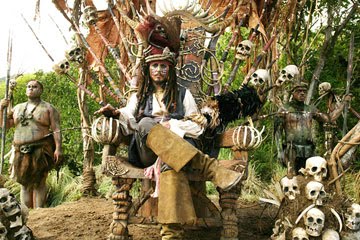
But, in the words of many a pirate, you may not survive to pass this way again, and these be the last friendly words you hear. Meaning: The following review unavoidably contains spoilers for Dead Man's Chest, as At World's End picks up right after the cliffhanger ending that preceded it. (Oh, hell; the picture kind of gives away one surprise.) So, for those uninitiated who haven't seen Dead Man's Chest but want to know more qualitatively about At World's End, let me say this for it: At World's End is my favorite of the Pirates trilogy, a restoration of the thematic balance that made The Curse of the Black Pearl so appealing which also maintains the "go bigger" attitude of Dead Man's Chest. It's also just plain fun, escapism which the increasingly heavy Hollywood offerings so desperately need to bust up the monotony.

With Captain Jack Sparrow (Johnny Depp) trapped in Davy Jones's locker after his encounter with the kraken, his former nemesis Captain Barbossa (Geoffrey Rush) - himself back from the dead - mounts a rescue effort with Will Turner (Orlando Bloom) and Elizabeth Swann (Keira Knightley). As if rescuing Jack from the land of the dead weren't hard enough, the pirate world must contend with the ever-tightening grip of Lord Cutler Beckett (Tom Hollander) and the East India Trading Company, which now controls the heart of Davy Jones (Bill Nighy).

Now this is my favorite of the Pirates films, but it's also unique because it's tonally very different from the first two films; perhaps, then, that's my main gravitation to it. Johnny Depp doesn't appear for more than half an hour into the film, allowing the movie to build up steam and firmly establish the necessity of his character to return. In some ways, this feels like a response to the critical backlash against Dead Man's Chest, as many characters run around in this film invoking the necessity of getting things back to the way they were. This film is darker - it opens with a small boy ascending the steps to the scaffold, and several very important characters are killed, brutally, on-screen - and consequently it feels more like the first than the second film, which you'll recall I critiqued for being too funny. Here the tone is one of urgent action punctuated by moments of levity (as when the crew sails over a waterfall and transports the audience, albeit briefly, to the Disneyland attraction that spawned the franchise), a return to form and a more fulfilling moviegoing experience. There are no scenes of audacious slapstick, but there are plenty of moments of entertaining comedy to keep you smiling throughout.

And where Dead Man's Chest did more of the same as far as performances go, At World's End dials it up for almost every main character. Now Jack Sparrow has a form of split-personality disorder, with "multiple Jacks" on his shoulders and in his hair, and Depp does a marvelous job at imbuing life into all the different Jacks we see on screen (at least twenty). Will has a renewed sense of purpose, and Bloom shoulders the responsibility with a grim but resigned countenance the whole way through. With a rousing speech on the nature of freedom, Elizabeth finally makes her decision between citizen and pirate, and it's a turn that feels completely natural in Knightley's hands. And it's a delight to see Rush again, who nuances his character's malicious nature by adding in a note of reformation and making it more palatable to root for the character who had previously been the villain. And Nighy continues to impress, even underneath all that CGI, by conveying through his words the anguish Davy Jones feels as a consequence of his betrayals at the hands of his lover and Cutler Beckett. Chow Yun-Fat joins the cast as Sao Feng, pirate lord of Singapore; though his character is done in broad strokes that might offend the PC crowd, Yun-Fat does an immersive job with the character, and there's a sense that all pirates are in effect stereotypes, somewhat legitimizing the Fu Manchu-esque nature of the character. And it'd be remiss of me if I didn't note that Keith Richards puts in an appearance as code-keeper Captain Teague, who shares a vitally important scene with Jack Sparrow.

The standout feature in At World's End, though, is an extended battle sequence which runs approximately forty minutes long and features the Black Pearl fighting the Flying Dutchman in the midst of a maelstrom. For most of the film, we're told that the pirates will have to face a last stand against Beckett's armada, and the subsequent battle that ensues more than lives up to the expectations raised by the rest of the film. Director Gore Verbinski (who, sadly, won't be returning for On Stranger Tides) does a masterful job of coordinating the action and keeping the action moving - even tossing an impromptu wedding into the mix. Hans Zimmer, too, is at his finest here, crafting an instrumental suite that runs for pretty much the whole length of the battle and integrates all the important themes (Jack's, Davy Jones's, Barbossa's, the love theme) from the trilogy in an expertly and elaborately written piece that you'll be humming for days. It's the kind of action sequence you can appreciate even out of context; a forty-minute combat sequence never hurt anyone, especially when it's as well-executed as this one is.

And the film brings to a satisfying conclusion the plotlines begun in the first film while still leaving open the possibility for a fourth film. The ending is remarkable in that it's sort of cliffhanger-ish, but at the same time it's the only way for these characters to end up; Will and Elizabeth are still together, despite a few obstacles, and Jack and Barbossa are still deadlocked in combat over the ownership of the Black Pearl and future treasure on the horizon. It's an immensely satisfying ending, one that validates the almost nine hours it takes to watch this epic sprawling trilogy unfold. Even taken on its own, though, At World's End is positively divine, an abundantly enjoyable flourish of a film.
Pirates of the Caribbean: At World's End is, like its predecessors, rated PG-13 "for intense sequences of action/adventure violence and some frightening images." In terms of content, there's not much different from the previous two installments, although the tone is much darker, and there's a pervading sense of danger that the more whimsical first two films lacked.

Well, folks, that's the end of Depp Week. It's been a marvelous journey, and I'm very curious to hear your thoughts on the whole affair. Would you be interested in seeing another themed week on The Cinema King (perhaps one that isn't gloriously gushing of its star)?

Tuesday, August 17, 2010

Pirates of the Caribbean: Dead Man's Chest (2006)

Welcome back to the only week with two Tuesdays in it - Depp Week. Right now we're going to set sail into the penultimate entry on the docket, the second installment of director Gore Verbinski's Pirates of the Caribbean trilogy.

Dead Man's Chest picks up a little bit after The Curse of the Black Pearl, with the wedding of Will Turner (Orlando Bloom) and Elizabeth Swann (Keira Knightley) disrupted by the arrival of the East India Trading Company's villainous representative Lord Cutler Beckett (Tom Hollander). Beckett detains Will and Elizabeth for assisting pirate Captain Jack Sparrow in the last film but later separately dispatches them to retrieve Jack's compass. But Captain Jack Sparrow (Johnny Depp) has bigger problems; the tentacled Davy Jones (Bill Nighy) holds a claim to Captain Jack's soul, owed to Davy Jones for 13 years as captain of the Black Pearl. With the land controlled by the EITC and the seas manned by Davy Jones, Jack Sparrow faces mounting challenges and learns, like Neil Gaiman's Sandman, that he must change (meaning confront his problems) or die.

I think that Dead Man's Chest is the most polarizing of the Pirates films; moviegoers are divided almost exclusively between those who love it and those who hate it. But there's room for a more honest appraisal, one (which I'll offer here) that gives credit to the film's strengths but acknowledges the fact that Dead Man's Chest is not perfect - at least, not in the sense that The Curse of the Black Pearl was.

Let's start with the bad news first. The bad news is that, as far as middle entries in trilogies go, Dead Man's Chest is no Empire Strikes Back. (Which is, I concede, a bit like criticizing water for not being cranberry juice.) Perhaps the worst thing that I can say about Dead Man's Chest is that it doesn't stand on its own very well. As a sequel, one can hardly criticize it for not restating a lot of the plot elements that were developed in the first movie - the relationship between Will and Elizabeth, the character of Jack Sparrow, the role of Weatherby Swann (Jonathan Pryce) in all this - but as a second of three, it ought to end without moviegoers feeling obligated to attend the third film in the franchise. In that respect, then, Dead Man's Chest is more Matrix Reloaded than Empire Strikes Back in the sense that the two former movies end on a cliffhanger which leaves nothing resolved. (To be fair, Empire ends on a cliffhanger, too, but it's one that goes for emotional tethers rather than plot twists.) Here, Dead Man's Chest ends with a major character deceased, another character back from the dead, major emotional connections seemingly irreparably severed, and a bevy of new characters thrown at us with no ultimate resolution on their storylines - such that one feels a bit like an empty keg of rum at the end of the picture, adrift in a sea of plotlines that, we're promised, the third movie will resolve. (It does, fortunately.)

My other major grievance with Dead Man's Chest is that it is, at its most basic, simply a turned-up-to-11 version of The Curse of the Black Pearl. With the exception of Elizabeth (and perhaps wooden-eyed Ragetti, who evinces concern for his newly-mortal soul), no returning character (or new one, for that matter) gets much depth added; Jack is still his same capricious self, Will is still that charming novice swashbuckler, and that dog still has the keys in his mouth. Even the new villains aren't very nuanced, with a mirthless one-dimensional evil separating them from Geoffrey Rush's evil-but-still-fun Barbossa. (Note that this critique of the unsubtle villains is distinct from the praise, which I'll be offering below, of Hollander and Nighy. Stay tuned.) Of course, evil villains are all well and good - in fact, they're essential - but they're contrasted with the turned-up-to-11 tone of whimsy that the picture sets up; nothing truly bad, it suggests, can happen to the characters as long as they keep us laughing. Consequently, when something truly bad does happen, it feels almost like a betrayal, a violation of some code somewhere. Then again, the first film did teach us that codes are "more like guidelines, anyway."

In sum, Dead Man's Chest doesn't engage in any emotional advancement of any character, but returning screenplayists Ted Elliott and Terry Rossio do a solid job of advancing the trilogy on a plot level, expanding the franchise's mythology and introducing a whole host of new characters - and doing so in a clear manner. As with the former film, there are complaints from the moviegoing public about a confusing aura around the film. But how the film could confound anyone is beyond me. Lunkheaded comic relief Pintel and Ragetti fill in for Navymen Murtogg and Mullroy as far as summarizing important action to each other and to the audience, and Naomie Harris joins the cast as Tia Dalma, a voodoo practitioner whose only purpose in this film, it seems, is to provide exposition on Davy Jones and the plight of Jack Sparrow. (Fortunately, she's given more to do in the final installment of the trilogy.) Again, there are many competing agendas here, but if you don't go out for a popcorn refill you should be fine. The script also does an outstanding job at building on what the first film introduces; throwaway elements like Jack's compass and his brief line "And then they made me their chief" from the first film get new meaning, making for a more comprehensive filmgoing experience. Most notably, though, Bootstrap Bill makes an appearance, portrayed by Stellan Skarsgard; if you noticed the plot hole of how the first film claimed that Bootstrap, cursed by the Aztec gold, could have drowned, the film addresses that.

And director Gore Verbinski does a firstrate job of topping a lot of the action sequences in the first film by kicking it up to 11 with swordfights on top of a spinning water wheel, a monstrous kraken attack, and a delightful re-introduction to Captain Jack Sparrow. Verbinski again keeps that sense of moving forward with sweeping shots of sailing ships and (doubtless) a little help from Hans Zimmer, who pens what might be his best film score to date in terms of listenability outside of the context of the film.

Continuing the train of good news about Dead Man's Chest, all the performers are still doing very good work. Even if they're not called on to do much more, they're still doing a good job at what they'd previously done: Depp is audaciously immersive as ever, replete with a slightly improved accent (something closer to a drunken Brit than previously), Bloom is still his charming roguish self, and Knightley is still doing a deft job at straddling that line between pirate and proper citizen (and she's probably the prettiest here of the three). Of the new cast members, all of them step into their roles like a good pair of slacks. Harris is almost unrecognizable as the grungy obeah priestess, with her blackened teeth and Jamaican dialect creating a vividly believable new character. On the side of evil, Bill Nighy is utterly engrossing as Davy Jones, lending a Scottish accent and a series of facial and verbal tics that are so human that you'll probably forget that the character is almost entirely created with CGI effects (honestly, the effects are that good). And Tom Hollander is perhaps the best villain of the series, because he's so joylessly evil that he's instantly detestable; his overconfident and avaricious qualities are brilliantly portrayed by the diminutive Hollander, who evokes Napoleon and all the worst qualities of British imperialism.

I've given what might be a mixed review of Dead Man's Chest, but I want to close with the note that this film contains my absolutely favorite shot of the entire trilogy. It's a small scene, maybe one that won't even be noticed by many audience members, but it's a pivotal one - one that is perfectly directed by Gore Verbinski and one that Jack Davenport (playing ex-Commodore Norrington) pulls off with aplomb. It's a silent scene, with only Hans Zimmer's rousing score to fill our ears, but it uses visual language like a fluent speaker uses French; with shots of only a rowboat, a swordfight, and a few finely detailed expressions from Davenport. It's a scene that says nothing and yet says everything we need to know about what's going through Norrington's head at that particular moment. It's so aesthetically effective that it, too, gives me chills.

If you've made it all the way through this review, first of all congratulations. Second, I hope the disenchantment of the earlier paragraphs has worn off. Really, this is an enjoyable movie for those of us who enjoyed the first. But my disappointment registers only because from a sequel I often expect so much more. I enjoyed this because I enjoyed the first movie, but I wish that I could have enjoyed it regardless of the first; I suppose in the end I was looking for more than more of the same. But perhaps that's just a case of my expectations being too high, in which case this is an issue I'll have to self-examine. But if you liked the first film, certainly the second is just as good (but not better).
Pirates of the Caribbean: Dead Man's Chest is - like its predecessor - rated PG-13, this time for "intense sequences of adventure violence, including frightening images." As with the first, standard pirate swashbuckling occurs. Here, though, some creatures may be more frightening than previously; Davy Jones's crew are all monstrous amalgamations of men and sea creatures, and his kraken is genuinely fearsome with tentacles and sharp fangs. Watch out for an early sequence at an island prison, which is surprisingly gruesome as ravenous birds attack caged prisoners.

Keep a weathered eye on the horizon, mates, because Wednesday we'll close out Depp Week with a look at my favorite of the Pirates films - At World's End.

Monday, August 16, 2010

Pirates of the Caribbean: The Curse of the Black Pearl (2003)

Thanks for staying with us, loyal readers. And a good, good morning to you in the wee small ones of this bright and sunshiney Monday morning. Depp Week (or rather, Depp Half-Week II) begins right now, with a look at Pirates of the Caribbean: The Curse of the Black Pearl, the film that jetted Johnny Depp to super-stardom and netted him an Oscar nomination, while simultaneously getting an entire generation of moviegoers to start asking, "Why is the rum gone?"

Depp stars as Captain Jack Sparrow, an off-kilter pirate with no ship, no crew, and no treasure. What he has are a keen wit, a poor sense of balance, a compass that doesn't point north, and improvisational skills that ought to earn him a lifetime spot on Whose Line Is It Anyway?. Captain Jack finds his way to Port Royal in search of a ship, where he's promptly locked up for piracy. Meanwhile, Captain Barbossa (Geoffrey Rush) and his undead crew of cursed pirates-turned-zombies come to Port Royal in search of blacksmith Will Turner (Orlando Bloom) - but end up abducting the governor's daughter, Elizabeth Swann (Keira Knightley), instead. Will, smitten with Elizabeth, strikes a deal to free Captain Jack in exchange for his help, but what Will doesn't know is that Captain Jack Sparrow only ever has his own best interests at heart

Developing a movie based on a low-velocity flume ride should have been an impossible feat; after all, The Country Bears and The Haunted Mansion all sank like stones when Disney unleashed them in theaters around the same time as Pirates. But what Pirates has that those movies didn't is a trifecta of what I believe are the three key components to any truly great motion picture: a charismatic and fantastically gifted cast, a solid and well-crafted screenplay, and a governing mood that combines the utmost sincerity with delightful notes of whimsy that prevent the movie from getting bogged down in its own gravitas (sorry, Quantum of Solace).

The obvious headliner here - the reason for Pirates being reviewed at this specific moment in time - is Johnny Depp, who gives a performance of a lifetime. And not just his lifetime, though Jack Sparrow certainly makes that grade; Depp's turn here is one of the greatest performances I've seen committed to film in my lifetime, right up there with Ledger's Joker and RDJ's Iron Man (perhaps it bears investigation that I've selected two comic book roles). It's immersive like diving into a swimming pool, yet so spot-on that it fits like a glove. Of Depp's role here I can only speak in superlatives, each of them deserved; there's an earnestness that goes with Jack Sparrow that goes a long way toward allowing the audience to forget "it's only a movie." Jack feels real because, in the hands of Johnny Depp, he is real. Every gesture (and there are many, from wild gesticulation to nuanced missteps), every inflection, every unfocused glance contribute to a portrait of a character larger than life and yet so unmistakably human.

Depp is backed by a wonderfully able supporting cast, the greatest of whom is Geoffrey Rush. Where Jack Sparrow is so finely crafted, Barbossa is all broad strokes, harkening back to the Errol Flynn pirate pictures where there was no question about who the bad guys were. But Rush manages to pull off the portrayal without ever feeling like he's resorting to cheap pirate stereotypes; even when he does employ those old standbys - as when he snarls the trademark pirate "Arrgh!" for no apparent reason - it feels less like a shortcut and moer like a facet of his character, who clearly enjoys theatricality. Our two romantic leads - Bloom and Knightley - do a fine job of drawing a line down the middle of the film between pirate and civilian, and their chemistry is palpable; that is, romantically, we get it between these two. (It doesn't hurt that Knightley is probably at her most attractive here, and it's no wonder that I had a major crush on her when the film first debuted in theaters.)

Of course, any talented actor will run around aimlessly without a taut script to guide him or her, and fortunately Pirates is one of the best written action films in recent memory. Credit Ted Elliott and Terry Rossio for penning a screenplay that triumphantly inverts a lot of the old pirate movie tropes - the mutiny occurs off-screen, and these pirates are returning treasure rather than taking it - while still seeming to adhere to the ideal platonic form of a pirate movie. In much the same way as the film is divided between pirate and citizen, the script is divided between action and comedy, such that I've invoked the Pirates name when talking about films that similarly split their time between comedy and action. The script is funny when it needs to be and exudes a sense of breathless urgency, such that we genuinely believe that there is a threat to the safety of the film world. In addition to being endlessly quotable, the film is also very clever with its dialogue, such that I actually got chills when a character in the film justified the audience's attachment to the pirate Jack Sparrow by saying, "Perhaps on the rare occasion pursuing the right course demands an act of piracy, piracy itself becomes can be the right course?" In addition, Elliott and Rossio do a first-rate job of keeping the disparate plot elements from becoming muddled in a tangle of plot soup. We have at least four competing agendas (five, if you count Commodore Norrington) at any given time in the film, but it's apparent who's fighting for what and - even more tricky - who's double-crossing whom. There are those who bemoan the film's confusing nature, but I feel those concerns are misguided and stem from something short of a full attention span. (For more on how clever the script is, take a look at LiveReal's take on the film.)

But the best script in the world can be tragically mismanaged, and so a hearty helping of kudos ought to go to director Gore Verbinski for making a film that's endlessly (re)watchable, which remains entertaining and nearly immortal as the film approaches the 10-year mark. If the script is a juggling act, Verbinski is the juggler who deftly keeps all the requisite plates spinning, to the perpetual amusement and amazement of the moviegoing public. What's even more remarkable is that Verbinski knows the perfect balance between action and comedy, even within the same scene - as when Jack and Barbossa duel with swords and with wordplay simultaneously. Though scenes like these are side-splitting, they're also intensely and precisely coordinated to attain that perfect edge-of-seat ratio. Doubtless this position of the audience on the precipice of their chairs (recliners, folding chairs, it doesn't matter) requires at least some small credit be given to the rousing score composed by Klaus Badelt, known disciple of Hans Zimmer (whose influence is very acutely felt); here's another Depp flick whose tune you'll be humming long after the credits roll. (Speaking of which, be sure to stick around for an after-credits treat, which actually has some bearing on the second film of the trilogy.)

I guess what I'm trying to say is that I love this movie. It's got an audaciously charismatic performance by Depp, but it's also a solid movie in and of itself. If nothing else, if you ahven't seen this movie, consider it part of a "Great Books" curriculum in which the objective is to become fluent in popular culture. If this country should ever be subject to a full-scale pirate attack, you'll at least know what to tell them so they don't kill you. (Hint: It's not parsley. Not palu-li-la-la-lulu, either.)

Pirates of the Caribbean: The Curse of the Black Pearl is, rare for a Disney flick, rated PG-13, here "for action/adventure violence." There's some typical swashbuckling swordfighting afoot, a few zombie pirates that may prove unsettling for younger viewers, and an unusual fascination with eunuchs that arises periodically throughout the trilogy.

Wednesday, August 11, 2010

Once Upon a Time in Mexico (2003)

2003 was a big year for Johnny Depp, if only because that's the year that Captain Jack Sparrow sailed into our hearts, propelling Depp to the top of the A-list. But Pirates of the Caribbean isn't until tomorrow, folks, so let's take a look at Depp's other 2003 film, Robert Rodriguez's Once Upon a Time in Mexico - which I predict will become a cult film (if it isn't one already) on the strength of Depp's performance alone.

Nominally, Once Upon a Time in Mexico is Antonio Banderas's film, the third entry in his and Rodriguez's "El Mariachi trilogy" (which began with El Mariachi and Desperado). In practice, though, it's Depp's: Depp plays CIA agent Sheldon Jeffrey Sands, who hires gunslinger El Mariachi (Banderas) to prevent General Marquez from successfully staging a coup against the Mexican president. But there are many other factors at work here: El wants revenge against Marquez for the murder of his wife Catalina (Salma Hayek), while Marquez is being paid by cartel lord Barillo (Willem Dafoe) and his henchman Billy Chambers (Mickey Rourke), and Sands is working the case from every angle - including police officer Ajedrez (Eva Mendes), one-eyed informant Bellini (Cheech Marin), and retired FBI Agent Jorge Ramirez (Ruben Blades).

If it sounds a little confusing, don't be alarmed. On first viewing, there are parts that don't immediately make sense; it's not that the film is intentionally puzzling, but the fast pace and the "crank it up to 11" sensibility toss the plot twists at the viewer faster than might be comfortable. What's more, the plot is the kind that lends itself to plot twists, with betrayals, double-crosses, and downright duplicity governing each principal character's actions; in fact, you'll have trouble enough just trying to figure out where Sands's loyalties lie (hint: like all great Depp characters, Sands is principally looking out for Number One).

But, in the opinion of this reviewer, none of the action-on-speed mentality hurts the film. Indeed, the film challenges itself to top itself, topping a rousing gun battle in the streets with an epic one in the presidential palace. Moreover, by beginning the story in media res, the film creates the suggestion that the plot is actually secondary to the exciting explosions and innovative visuals, that what these characters do is less important than how they do it.

Thank goodness Rodriguez has assembled a cast who can pull off a film that's all about flair. And rather than remain as mere straight action fare, Once Upon a Time in Mexico is often genuinely funny, adding a challenge to the actors, albeit a challenge they can all meet. Banderas is dynamite as the strong but silent type, but his character is crafted in such a way that it never feels out of place when he breaks his silence for a wry witticism. Hayek, who appears often in flashbacks and whose presence is acutely felt even though her character has technically died, is the perfect "straight man" to the occasionally ludicrous action sequences, and her screams of terror at the precarious situations Catalina finds herself in are genuine and hilarious at the same time. Of course, though, Depp steals the show (partially because it feels like he has the most screen time of any other character), because Sands is one of those ultra-compelling supporting characters that comes along once in a blue moon. As his loyalties flip and flop, there's something endearing at the heart of his character; it's quite possible that he's a bad guy (he does, after all, kill a cook simply for making a piece of slow-roasted pork that's too good), but the way Depp behaves makes us want to root for Sands, if only so we'll see him on screen more often.

This is an ensemble piece, and while the three leads are all doing fine work, they're backed up by a supporting cast that carries the rest of the film one piece at a time. Willem Dafoe is admittedly a strange choice for a Mexican drug lord, but once you see him as Barillo you'll either think, "Why didn't someone cast him as a Mexican before?" or "Well, Willem sure can act." Mickey Rourke isn't really acting so much as performing his trademark confident swagger on-camera, but his broad personality fits right in with the rest of the outlandish tone of the film. Eva Mendes finally gets to play a cop rather than a cop's love interest, and there's something compelling in that pout of hers where she's surprisingly believable as a hard-as-nails rookie. Cheech Marin floats in as embodied exposition (and recap for those who missed the other entries in the trilogy), and it's always a delight to see Danny Trejo chewing scenery as a tough guy.

One final character in the film bears mentioning - the gaudy and vibrant action sequences. There's a shootout in a marketplace, replete with exploding fruit and sudden auto collisions, that is impossible to watch without getting a little keyed up. Blame the soundtrack, too, which is filled with catchy Latino tracks that you'll be humming until you run out and grab the CD (which stands on its own very well, indeed). But even when the characters are simply sitting around and chatting - as Sands does for most of his screentime, until he picks up his guns and joins the fight against the coup (with a bonus twist, extra-cool, that it'd be criminal to spoil) - there's still a sense that firecrackers are going off. The dialogue, equal parts Rodriguez and ad-lib, positively crackles, with quirky mannerisms and stylistic turns of phrase that might make Diablo Cody sit up and take a few notes; perhaps the best of these come about due to Sands's apparent refusal to swear, substituting "screw the pooch," "sugarbutt," and "oh, gosh" at markedly incongruous moments.

But the intentional flashiness and the quest for spectacle make the film a dazzling vision that doesn't even require a viewer's cognitive powers to be switched on. Indeed, the film practically asks the viewer to switch off, kick back, and enjoy the ride. Typical rules of science no longer apply, and the film doesn't need to be understood so much as it needs to be absorbed. And that is the film's greatest strength - it's engaging, with performances and action pieces that are just plain fun.
Once Upon a Time in Mexico is, naturally, rated R "for strong violence, and for language." Most every character uses F-bombs quite liberally, in English and Spanish; you can't swing a bat without hitting some bloody violence in this film, so leave the less mature kiddies at home.

Depp Week continues into Thursday with The Cinema King's take on the role you've been looking for - Captain Jack Sparrow in 2003's Pirates of the Caribbean: The Curse of the Black Pearl (sequels to follow). Stay tuned!