Thursday, July 11, 2013

World War Z (2013)

Did anyone expect a zombie movie from the director who brought you Stranger Than Fiction (one of the best metafictional films) and Quantum of Solace (one of the less inspiring Bond films in recent memory)?  Maybe I expected a talkier film from Marc Forster, especially because of the epistolary format of the eponymous Max Brooks novel, but what I got was something more engaging – an entertaining blockbuster-lite with some thrilling zombie set pieces.

Brad Pitt stars as Gerry Lane, average joe with classified UN experience which comes in handy when teeming hordes of the undead take over Philadelphia – and, Gerry learns, most of the world.  In exchange for his family’s safety, Gerry agrees to escort a leading physician in search of a cure, a harrowing search which will take Gerry around the world and face to face with speedy, deadly zombies.

Devotees of the Brooks book will likely find fault with the fact that the film streamlines the book’s narrative, eliminating most of the political commentary and torqueing the story toward a more action-based plot.  (In fact, I suspect you could change the name of the film and those folks might like it better.)  While I miss the governmental satire Brooks brought to the genre, portraying political leaders as bumbling naysayers until it’s too late, I found the book a bit repetitive, duplication which the film eliminates by focusing on Gerry Lane and not his interviewees.

This change allows Forster to focus more on in-the-moment experiences of the zombie apocalypse rather than reflect nostalgically on the experience.  While the latter has its advantages in a literary form, it’s hard to imagine that being a compelling film (perhaps as a mockumentarian experiment?).  Instead, Forster drops us in on the day of the zombie disaster, literally in the middle of a traffic jam with only pancakes to prepare us.  Granted, this comes at the expense of character development; we don’t know much about what makes Gerry or anyone else in the film tick beyond basic survival.  Conversely, the film mercifully avoids padding out the cast with stock survivor characters (see Shaun of the Dead for a gleeful vivisection of these tropes) by following Gerry.

It’s likely Pitt’s star power that elicits the audience’s sympathies more so than the strength of the script, but Forster makes up for the script’s shortcomings (with Brooks, five writers – too many cooks?) by prizing spectacle over protagonist.  By staging a series of progressively more intricate and more terrifying zombie confrontations (I counted seven), Forster creates a deeply personal involvement with the audience, who can’t help but hold their breath once it becomes apparent that zombies react to sound.  Simultaneously, the shifting setting creates a global feel for a genre that too often has been bogged down by the stale locked-room plot (cf. Mulberry Street done wrong, Dawn of the Dead done right).

Want zombies in the metropolis?  Sure, you’ve seen it before, but rarely with the terror-of-the-unseen rendered here.  Zombies on a plane?  (Where’s Sam Jackson when you need him?)  WWZ’s got those, too.  And if you liked those two, Forster outdoes himself with the film’s final big zombie scene, which collects all the bits the film introduces to the mythology and throws them together into a tense sequence requiring silence and sharp reflexes – almost like a video game level but without the passivity that often plagues such moments.  Here especially, Forster knows when to go for the jugular and when to pause for a moment of levity (thank God for Pepsi, that’s all I’ll say).

Taken holistically, World War Z isn’t the “complete package” that zombie aficionados might expect from the genre, but what WWZ lacks in innovation it atones for with execution.  With those house lights dimmed and nothing between moviegoers and the screen, the bumps in the dark create an effective cinematic experience that ends up being more fun than I expected.

World War Z is rated PG-13 “for intense frightening zombie sequences, violence and disturbing images.”  The zombies are pretty freaky – pale veiny skin with translucent eyes, snarls and gnashing teeth with dried flecks of blood.  The blood doesn’t flow as freely as elsewhere in the genre, but plenty of bodies are felled by biting, gunfire, and blunt force trauma; in an intense but brisk moment, a hand is amputated.

Monday, July 8, 2013

The Lone Ranger (2013)

Although it’s not a catastrophe by any stretch of the imagination, the biggest problem with Gore Verbinski’s The Lone Ranger isn’t the perceived cultural insensitivity of the “redface” casting of Johnny Depp as Tonto.  It’s that the film is longer than it needs to be and short on that relentless charm that made the Pirates of the Caribbean franchise such a winner.

Following the death of his brother and given a second chance at life, whitebread lawyer John Reid (Armie Hammer) dons a mask and a badge to become “The Lone Ranger.”  He teams with offbeat Cherokee Tonto (Depp) to apprehend the outlaw Butch Cavendish (William Fichtner) while railroad tycoon Latham Cole (Tom Wilkinson) works to complete his cross-country line.

With Pirates, Verbinski and Depp distilled a pitch-perfect blend of high-octane action and quirky character comedy (I’m on record as being of the opinion that the franchise has done no wrong).  A kind of revival of the Indiana Jones brand of action/comedy, Pirates also launched Depp into the household imagination as “he of the strange faces.”  But it’s a long shadow into which The Lone Ranger rides, which means the film’s shortcomings are either the result of detrimentally heightened expectations or simply a case of a film not living up to its predecessors.

The Lone Ranger has been called “bloated” by more than one critic, which accurately describes (but maybe embellishes) the principal problem with the film, which is one of length and pacing.  At 2:29, the film is longer than The Curse of the Black Pearl, and it takes even longer to get started; scene three of Pearl introduces us to Captain Jack Sparrow in one of cinema’s best introductions, yet it takes nearly an hour for Armie Hammer to don the mask.  And while Hammer is a good fit for the milquetoast pacifist Reid, charismatic he’s not, which forces the film to be Tonto’s.  Indeed, the film is often confused about who the star is; Depp’s name is above the title, but Hammer is the eponymous Ranger, though Depp headlines a (largely unnecessary) frame story.

Let’s back up and clarify here.  Hammer and Depp are fine choices for their respective roles.  Though one suspects this won’t be the start of the franchise Disney may have wanted, the two have good chemistry together, and the begrudging partnership that forms would make for interesting sequels that deconstruct the idealized 1950s partnership.  (If anything, the frame narrative sets this up as the “true” account of The Lone Ranger.)  Hammer is good at repressing his personality when he’s riding into battle atop Silver (here, a “spirit horse” with intractable charm in the vein of Fritz from Django Unchained).  As for Depp, this is “strange character #43” in his repertoire, albeit with more depth thanks to a surprisingly nuanced script that goes places of which the marketing campaign seemed blissfully unaware (and which those crying “racism” – at least, those who’ve seen it – seem willfully to ignore).

And the villains of the piece are delightfully hammy; classic bandit Fichtner snarls it up and isn’t apologetic about eating human hearts, a far cry from his blue-collar bank managers in Heat and The Dark Knight.  And I don’t need to tell you that Wilkinson is as always a treat, pouring the syrup on the scenery in lieu of twirling a mustache; you know he’s evil the moment you see him, though the inevitable revelation is played off with an additional, unexpected twist.

So with all these ingredients – including a near-cameo by Helena Bonham Carter as a one-legged brothel madam – what is it that doesn’t hit it for The Lone Ranger?  In large part, it’s an issue of length; like Pirates, there are several action set pieces, and the plot becomes quite complicated as the disparate story elements entangle themselves.  But unlike Pirates, Verbinski and company seem to have, sadly, listened to those who bemoaned that Pirates was too confusing; consequently, plot twists are recapped to death, and the status quo is reevaluated at the end of each.

When the film’s on, though, it’s on.  The action scenes are Pirates quality – particularly a harrowing canyon ambush, a barnyard shootout, and a horse-vs.-train duel set to a rousing reinterpretation of the William Tell Overture – and the performances, as I’ve said, are reliable.  In the end, The Lone Ranger is a bit like walking a mile when a run would do; you’ll get to the same place and feel about as good, but darned if it doesn’t take longer than need be.

The Lone Ranger is rated PG-13 “for sequences of intense action and violence, and some suggestive material.”  There’s some blood here and there, but most action sequences are bloodless and more exciting than gruesome.  A bandit speaks provocatively about a woman, while other men visit a brothel (which looks like a Disneyfied Moulin Rouge).

Loyal readers:  be sure to come back on Thursday for The Cinema King's take on World War Z!

Sunday, July 7, 2013

Diamonds Are Forever (1971)

Having stepped out of the shoes of the world’s greatest superspy for On Her Majesty’s Secret Service, Sean Connery makes his (first) return to the role.  It’s a milestone, to be sure, and there’s no doubt that Connery is back by extremely popular demand (and a lofty salary, even by 1971 standards).  As the 007th official James Bond film and Connery’s last outing, it ought to have been a moment to celebrate the franchise and its leading man, but Diamonds Are Forever proves to be something less than immortal, a strong contender for “Worst Bond Yet.”  (Remember, though, Roger Moore coverage starts next month.)

After seemingly disposing of his archnemesis Blofeld (Charles Gray), James Bond (Connery) is dispatched to infiltrate the organization of suspected diamond smuggler Tiffany Case (Jill St. John).  The case takes him to Las Vegas, where the diamond stockpiling scheme turns out to be something much more sinister, with an old foe at the helm.  (Hint:  it’s not spoiling anything to say that Blofeld doesn’t die in the pre-credits sequence.)

There’s so much about Diamonds Are Forever that ought to work – another outing with the best Bond villain since Goldfinger, a final fling with the man who is (for my money) still the best Bond in 50 years, and the glitz-and-glamor of Las Vegas. Yet the film falls flat, a tepid knockoff a decade too late of Ocean’s Eleven (1960), channeling only some of that film’s imagery while lacking in the most basic element that made that ensemble piece a hit:  the fun.  In all fairness, Connery is still a good bit of fun as Bond, smirking his way through the one-liners with that divine accent of his.  But despite his best efforts to power through it, Connery’s age is beginning to show here; while I’ve nothing against a gray-templed Bond, the bedroom scenes with St. John look odd and out of place.

It doesn’t help that St. John is entirely uninspiring as the female lead, offering little by way of character development beyond a bikini body and a collection of wigs.  It’s mostly the script’s fault that Tiffany Case doesn’t get to distinguish herself as the character did in the eponymous Fleming novel, but St. John’s line readings are frequently uninspiring.  And she’s not the only one at fault; Connery aside, no one does much acting in the film.  Even Gray, tasked with following two stellar Blofelds (Donald Pleasance and Telly Savalas), drops the ball, turning in a Blofeld who’s more reclusive gentleman than master criminal; this is especially disappointing since the film barely plays with the fascinating idea of surgically-modified Blofeld doppelgangers (still a neat special effect when multiple Grays take the screen).  Instead we get a non sequitur gag about Blofeld as an unconvincing transvestite.

Blofeld raises an important point in this film.  When last we saw him, Blofeld had murdered James Bond’s wife, but when the film begins with Bond in pursuit, it glosses over Tracy entirely; the search begins with Connery in Japan, suggesting that Diamonds Are Forever is actually a sequel to You Only Live Twice while glossing over OHMSS entirely.  The last in the so-called “Blofeld trilogy,” Diamonds Are Forever contains none of the urgency it ought to – while the initial scene is played with sufficient contempt and obsession, Bond later seems nonplussed that the murderer of his wife remains at large, less “You monster!” and more “Oh, you.”  Even Bond’s final revenge on Blofeld doesn’t play as vengeance at all, especially given the artificial and implied nature of Blofeld’s fate.

With Shirley Bassey crooning the title track and Guy Hamilton retaking the director’s chair, so much of the film seems designed to channel Goldfinger, right down to the chase across America.  To Hamilton’s credit, the action sequences are quite good.  Again, the beginning sequence with 007 pursuing Blofeld is among the best in the Bond canon, and the car chases (including the implausible but fun two-wheelie) work well enough, trading on the stellar John Barry score and some clever direction on Hamilton’s part.  Ultimately, though, Diamonds Are Forever is a film that both shows its age and appears terribly dated.  With a hint of tired resignation in Connery’s otherwise implacable persona, it’s a shame that he goes out on this note since we know – we’ve seen – he can do so much better.

Diamonds Are Forever is rated PG.  In addition to the scantily-clad opening credits ladies, Bond courts no fewer than three women, seen in lingerie; two more female bodyguards appear in skimpy workout clothes.  A few fights display blood, but most of the violence has a cartoonish edge.

Roll on, Roger Moore!  James Bond and The Cinema King will return in a review of Live and Let Die (1973) on August 7, 2013!

Monday, July 1, 2013

Monsters University (2013)

Aside from Cars 2 (which, if we’re being honest, felt a little like a cash grab), Pixar’s made a name for itself for high quality original material, only dipping a second time into the well when the story merits it.  We go all the way back to (before) 2001’s Monsters, Inc., which gets the prequel treatment with Monsters University.  And like a matriculating monster, Monsters U stumbles at first but finds itself and recovers by film’s end.

Set to fulfill his lifetime dream of becoming a professional scarer, Mike Wazowski (Billy Crystal) heads to top college Monsters University.  There, studious Mike meets James P. Sullivan (John Goodman), son of a top scarer and more party-hearty than study-buddy.  Antagonized by the stern Dean Hardscrabble (Helen Mirren), the two enter into the college’s olympian Scare Games, with their reputations and their standing at the college on the line.

Entering prequel territory for a buddy picture like Monsters, Inc. verges on predictable in the sense that the film has to cover the “adversaries turn amigos” plot beat in order to feel narratively fulfilling.  Monsters U hits those moments without feeling too forced; remember, Mike and Sulley were hardly birds of a feather in IncMonsters U does not, however, spend too much time making Mike and Sulley polar opposites that meet in the middle, casting them more as contrasting types who begrudgingly work together.  (More interesting for the prequel enthusiast:  the way that Monsters U recasts the tension between Mike and in-crowd wannabe Randall [Steve Buscemi], now college roommates divided by fraternity loyalties.)

There are lots of very interesting things going on in the movie, which aren’t explored at much length in order to focus on the intramural Scare Games.  I see the value in concentrating on the Scare Games; the episodic nature of an event-based competition helps us to see how Oozma Kappa (Mike’s fraternity) improves, and it allows the filmmakers to expand the Monsters world by showing various other creatures (plus it boosts the toy line significantly).

But even in spite of the parts where Monsters U feels paint-by-numbers – which, in Pixar’s hands, is still plenty enjoyable if more generic than usual – there are moments of pure genius that remind us why Pixar movies are still the pinnacle of animated film (or, perhaps, even above most live-action storytelling).  I’ll pit the last twenty minutes of Monsters U against any of the other great Pixar moments for genre-bending imagination and exuberant pathos.  It’s almost too good to spoil where the movie goes, but the film quickly shirks that cliché you feel it’s embracing before contorting 180 degrees into a monster-inflected take on the “Play nice” scene from Toy Story

It ends with a callback to a bit of Inc. you didn’t expect to see, but the real heart comes when Dean Hardscrabble – in a turn delivered strongly by Mirren – warms up ever so slightly to our heroes.  It’s comparable to Anton Ego’s change of heart in Ratatouille, and as with Peter O’Toole it’s a reminder that the film needs as much of these top thespians as we can get.  Otherwise, the voice cast is what you’d expect from Pixar – pitch-perfect and full of aural treats (like Aubrey Plaza’s laconic sorority president, though Nathan Fillion’s swagger is more distracting because of how larger-than-life his voice tends to be).

In the end, I find myself having written a more positive review than I anticipated, in part because there’s nothing about Monsters University that is entirely irredeemable; even when they’re not pulling out all the stops creatively, the Pixar team is still lightyears (pun intended) ahead of the competition.  But when they do, Monsters University is a real scream.

Monsters University is rated G.  A few monsters have tricks and skills that might scare the wee babies, but overall most kids can handle it.

Monday, June 24, 2013

Monday at the Movies - June 24, 2013

Welcome to another edition of “Monday at the Movies” – this week, we massage the title of this feature by profiling two HBO biopics from the past year.

Behind the Candelabra (2013) – “Too much of a good thing is wonderful,” the late Liberace was fond of saying, but the trouble with Behind the Candelabra is that there’s not enough of a good thing to be wonderful in the first place.  Ostensibly Steven Soderbergh’s last film, this biopic stars Michael Douglas as the flamboyant pianist who woos Scott Thorson (Matt Damon) in a complicated and torrid relationship not unlike the stuff of Lifetime movies.  Therein lies the problem; the story as we have it isn’t substantive enough to sustain a full two hours without feeling thin or repetitive.  As is often the case in biopics like this, Michael Douglas is note-perfect as Liberace, capturing the extravagance of the performer while layering in just enough of the creepy menace the film suggests was key to understanding Liberace (then again, when is Douglas not exceptional?).  Doing less exceptional work by virtue of being in the shadow of a great performance, Damon’s Scott Thorson is also less compelling, largely due to Damon’s failure to transcend his own ethos in the way Douglas does; moreover, Damon as Scott is petulant and largely static, equal parts the fault of the slim script and the muscled actor.  Kudos, though, to the makeup department for creating a lifelike Liberace and an uncanny doppelganger after Scott undergoes plastic surgery to look more like his lover.  Keep your eyes peeled for a gaggle of cameos – Dan Aykroyd, Rob Lowe, Paul Reiser, and an unforgettable Debbie Reynolds as Liberace’s mum – though ultimately the film is a great deal like Liberace himself:  talented, but more style than substance.

Phil Spector (2013) – Pacino, Mirren, Mamet.  Throw these three into a crazy (semi-) true story, and I’m there.  Oddly, the film begins with a disclaimer absolving itself of facticity, a bizarre technique which distances the audience until the true game reveals itself.  What David Mamet’s really after is a character study unfettered by pragmatic (and legal) concerns, profiling defense attorney Linda Kenney Baden (Helen Mirren) as she’s drawn into the entirely strange orbit of famed music producer Phil Spector (Al Pacino) when he’s accused of murder.  The film wisely avoids finger-pointing (indeed, the film leans toward but never fully endorses Spector’s innocence), and it’s to Pacino’s credit that he reins in his stereotypical “big voice” for a more subdued portrait.  The real star – and the vehicle which communicates the degree to which Spector seems wholly unhinged – is Mamet’s dialogue, as snappy as it’s ever been.  In many ways more a stage play than a fully cinematic film, Mamet’s script includes long dialogues, compelling conversation pieces where the restrained delivery allows us to appreciate the subtext; it’s especially worth rewatching the conversations between Spector and Baden, as the former reveals his madness while the latter, astoundingly, becomes convinced of his legal innocence.  Pacino pulls back, as I’ve noted, but Mirren really lets loose the full range of her craft; Baden is suffering from pneumonia during the trial and – like Cosmo Kramer’s gonorrhea – you feel it all the way in the back row.  It may not be the all-out crazy train that the actual trial was, but Mamet’s script is riveting in a slow-burn kind of way.

That does it for this week’s edition of “Monday at the Movies.” We’ll see you here next week!

Monday, June 17, 2013

Man of Steel (2013)

Tall order, Zack Snyder:  direct the heck out of a Superman movie so we can move toward a Justice League franchise while we forget entirely about Superman Returns.

Mission accomplished.

After a dynamite Krypton scene introducing the coolest Jor-El (Russell Crowe) this side of Brando, we catch up with Kal-El (Henry Cavill) on a journey of self-discovery – until star reporter Lois Lane (Amy Adams) finds him first.  But before the man who will become Superman can reveal himself to the world, the mad General Zod (Michael Shannon) arrives and demands to reclaim Kal-El and the Kryptonian race.

I always feel a bit starstruck writing these reviews for movies I went into expecting to like.  It’s a Superman movie godfathered by Christopher Nolan:  I’m admittedly biased here.  So if you like, take a grain of salt to go with this review.  But while I’m less agog than I was at The Dark Knight or its Rises successor, I’m prepared to say I liked Man of Steel better than Batman Begins, a “first film” with which it shares many similarities.

The first of these is the film’s smart emphasis on the man before the Superman.  As with Bruce Wayne in Begins, we care about Kal-El as a character caught between two worlds without feeling at home in either.  And it’s on Cavill’s able shoulders that the film rests; tasked with playing Kal-El (not heroic Superman, not geeky performance Clark Kent), Cavill gives us a compelling and engaging protagonist who we actually appreciate for his complexity.  Watch the moment when Kal confronts a belligerent trucker; the simmer is there, and the punchline reaction is pitch perfect.

The rest of the cast is stellar, too – no complaints about Adams or Shannon, who both turn in reliably solid work; Adams is spunky and darling as Lois Lane, and no one does crazy-angry like Michael Shannon, whose Zod is a megalomaniacal ball of fury who never descends into caricature.  The real surprises, though, are the gripping performances of Russell Crowe and Kevin Costner as Kal’s two fathers; Crowe makes Jor-El interesting beyond Brando’s stuffed shirt (seriously, can we get a Jor-El prequel?), and Costner is moving to the point of misty eyes as the weathered all-American Pa Kent.  Better still, we can see how these two parents informed the man Kal becomes, partly through the flashback structure of the film (again, Batman Begins) and also through Cavill’s interactions with them.  (As Ma Kent, Diane Lane gets just enough screentime, though one suspects she’ll have a larger role in the sequel.)

Finally, major major kudos go to Hans Zimmer, the stalwart composer of some of the best blockbusters of the past decade.  Zimmer manages to sidestep the issue of the iconic John Williams score by giving us a rousing and optimistic theme that soars with the protagonist, booms with Zod’s invasion, and actually – unlike his early Batman stuff – gets stuck in your head.  Equal parts Batman, Pirates, and Inception, Zimmer’s Man of Steel score sets the stage for what ought to be a stellar Justice League jam.

And yes, the build-up toward Justice League is acutely felt, even though the stage is entirely Superman’s (eyes open for nods to Wayne Enterprises and Lexcorp).  What we’ve got in the meantime is a thoroughly engaging cross between the fanboy fidelity of Zack Snyder (see Watchmen, slavishly so) and the relentless realism of Christopher Nolan.  The film does, as Eddie Izzard would say, do a bit of “pissing about with the myth” (too many people might know Superman’s secret identity, and Superman makes a controversial climactic decision which I suspect sets up a sequel), but this original take on the classic character ought to leave plenty of fans satisfied.  And from the box office receipts, mainstream moviegoers are pretty pleased, too.

Heck, Man of Steel doesn’t say it in the title, but it’s super.

Man of Steel is rated PG-13 for “intense sequences of sci-fi violence, action and destruction, and for some language.”  Some of the action/fight scenes are relentless, lasting dozens of minutes at a time.  They’re almost entirely bloodless (Kryptonians apparently don’t bleed), though some have been distressed by the apparent 9/11 allegory at work.  Lois Lane has a few mildly salty lines, but they’re more endearing than offensive.

Thursday, June 13, 2013

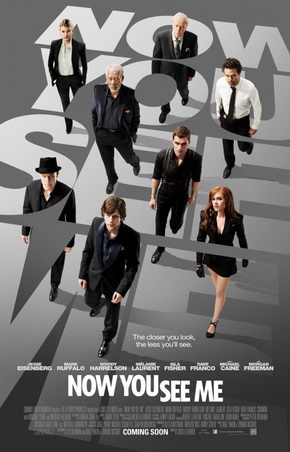
Now You See Me (2013)

The movies are a magical experience, and movies about magic can double up the fun by drawing attention to the innocuous deception of a theatrical illusion.  Unfortunately, Now You See Me spends so much time swaggering that it never really enchants. Now You See Me is ostensibly the story of four semi-professional magicians (Jesse Eisenberg, Woody Harrelson, Isla Fisher, and Dave Franco) who pull off a series of elaborate magic tricks as The Four Horsemen.  But when their illusions begin to look like theft by way of social justice, FBI agent Dylan Rhodes (Mark Ruffalo) and professional debunker Thaddeus Bradley (Morgan Freeman) begin to realize the magicians are, of course, not what they seem.

The key to any successful slight of hand is that the audience has to be so distracted by the flair that they miss the real trick.  Take Christopher Nolan’s The Prestige, a clever (perhaps brilliant) case study of competitive magicians; you’ll be so fascinated by the rivalry between Christian Bale and Hugh Jackman that you’ll miss the clues dropped by the filmmakers.  It’s possibly unfair but entirely unexpected that I’d make this comparison, but Now You See Me doesn’t let the audience play along.  Instead, we’re practically kidnapped, tied down by a film that continually insists on its own brilliance, reminding us at every turn that they’re smarter than we are.

Sure, I can be smarter than you if I don’t tell you what’s going on.  Then, the film gloats by showing you what really happened, though these scenarios are couched in so many maybes and perhapses that it’s never wholly clear what’s going on.  And when your focal character is an investigator, it’s a bit empty to have him never really understand anything.  Ruffalo’s solid as the not-smartest man in the room, and his charisma is enough to hold your attention, but it seems like a less successful riff on his character from The Brothers Bloom, which is saying something.

As for the rest of the cast, you’re looking at the disappointment of the summer.  The four leads have all done good work in the past, but the screenplay is incredibly thin, failing to distinguish any of the four characters beyond physical appearance.  You could rotate the actors in the cast, and it really wouldn’t matter; the characters are so boilerplate and so frustratingly identical that you’ll struggle to connect with them.  Perhaps the film’s worst offense?  Morgan Freeman and Michael Caine never share the frame; their scenes together crackle like a master class in acting, but we never get to see them side-by-side, which gives it a phoned-in feel.

Having said that, there’s a bit of fun to be had in some of the film’s stagier moments.  When The Four Horseman are performing, it’s an opportunity to chew some scenery, and the four leads do well there.  You might even want to see a full show by them at some point, since they convey a sense of infectious enthusiasm for their work.  And, naturally, once you’re told you’re about to be tricked, it’s engaging to watch and try to figure out where the trick is.

As Michael Caine said in The Prestige, “You want to be fooled.”  It’s a good thing, too, since Now You See Me never gives you an opportunity to figure out how the trick is done.  Nor is the ultimate explanation a fulfilling payoff; a last-minute twist is so clichéd that you’ll have already dismissed it as “too obvious.”  Now You See Me is superficial and a bit irksome, continually reminding you of its own cleverness without ever earning the moniker of “smart.”  Sad news for a strong cast, but the real trick is on the audience.

Or, in other words, now I saw it, now you don’t.

Now You See Me is rated PG-13 for “language, some action, and sexual content.”  There’s an F-bomb, playful banter, and some shouting; action consists of a car chase, a few explosions, and some shouting.  And there’s an aborted make-out scene thrown in to earn the “13.”

Monday, June 10, 2013

Monday at the Movies - June 10, 2013

With Man of Steel soaring into theaters this Friday, let’s take a look at the last time Superman headlined a feature film!

Superman: Unbound (2013) – These DC Universe Animated Original Movies have been hit or miss (even though, I concede, I’m a bit biased, albeit with high expectations), and such has especially been the case with the Superman entries; most recently, All-Star Superman was a win, while Superman vs. the Elite left something to be desired.  Adapting a stellar Geoff Johns story (but without attempting to replicate Gary Frank’s detailed artwork as All-Star Superman did with Frank Quitely’s technique), Superman: Unbound finds control freak Superman (Matt Bomer) facing off against Brainiac, collector of worlds (John Noble), with a little help from plucky cousin Supergirl (Molly Quinn).  The film takes a lot of liberties with the source material, and to mostly good effect; unfortunately, Pa Kent’s moving role in the book is reduced to an unfortunate punchline here, but as a result Supergirl gets a bigger part in the movie.  I wouldn’t mind seeing more of Quinn’s Supergirl on the big screen, since it’s an engaging portrayal of the Maid of Might, heroic but frustrated, invincible yet incorrigible; indeed, her character arc from frightened princess to empowered heroine is in some ways more compelling than Superman’s epiphany that he doesn’t need to protect everyone.  But it gets Superman to a fantastic conclusion which takes his relationship with Lois Lane (Stana Katic) to a wonderful place that the New 52 can only dream of.  The voice cast is entirely unoffensive, though no one really distinguishes themselves beyond effective; sorry, folks – Tim Daly and Dana Delaney really spoiled me.

That does it for this week’s edition of “Monday at the Movies.” We’ll see you here next week!

Friday, June 7, 2013

On Her Majesty's Secret Service (1969)

When we last left James Bond, he’d met (and defeated) his great nemesis, Ernst Stavro Blofeld.  Like any good sequel, On Her Majesty’s Secret Service gives us the rematch we wanted, though the faces are a little different – and not entirely, I might add, for the better.

George Lazenby takes the reins as superspy 007 opposite Telly Savalas’s Blofeld, whose dastardly plan aims to poison global food stores.  As if that weren’t trouble enough, Bond is in-and-out of employment at MI6 while wooing the feisty Tracy di Vicenzo (Diana Rigg), the only woman ever to win movie-Bond’s hand in marriage.  It sounds like it has the potential for horribly maudlin montages (to be fair, we do get one, set to Louis Armstrong’s “We Have All the Time in the World”), but director Peter R. Hunt wisely amps up the action for the whole 2:20 runtime, never letting you feel the 140 minutes.

If I haven’t said it already, the best Bond films are ones where James Bond and the audience are piecing together clues; Goldfinger and Skyfall did this quite well, but Thunderball tipped its hand too soon.  Here, we’re right with Bond in following the central mystery; we know, of course, that Blofeld is up to no good, but we don’t quite know how his “allergy clinic” and harem of female patients fit together.  Smartly, then, the film doubles the suspense; will Bond solve the case, and will he be discovered while doing so?

On top of it all, OHMSS includes several rousing chase scenes, most set near Blofeld’s ski lodge hideout.  One such scene runs for a very long time, going from the slopes to a carnival, but it’s to Hunt’s credit that it never feels bloated.  I suspect, though, that the captivating nature of these scenes has a great deal to do with John Barry’s score, which is among the best in the series so far (see also Goldfinger and Skyfall, which had exemplary scores by Barry and Thomas Newman, respectively).  Barry crafts a new theme tune for the film while deploying the Bond notes we’ve come to expect; lead actor aside, the soundtrack can for my money make or break a Bond film, and in this regard OHMSS thrives.  (Sidebar: The Propellerheads have recorded a brilliant version of the title track, which is well worth the listen.)

Now to the elephant in the room:  the recastings.  The unequivocally good news is that Telly Savalas is a fine Blofeld, adding a layer of physical menace to the squirrelly version Donald Pleasance animated in You Only Live Twice.  Gone are the facial scar and the cat (earlobes, too); instead, we get a burly heavy whose thuggish nature is concealed beneath a thin masquerade as a prospective count.  In fact, so good is his Blofeld that the 1990s Lex Luthor cartoon was modeled after him.

Your mileage may vary, though, when it comes to George Lazenby as James Bond.  Now, arguably the bulk of this review should be dedicated to a dissection of his one-and-only performance as 007, but honestly the film does so much else right that Lazenby would need to do a rubbish job for it to impact the success of the film.  Truth be told, Lazenby isn’t a remarkable Bond – he’s no Sean Connery, to be sure – but his work is, in a word, serviceable.  He never steps too far out of character, and his polish and charm make plausible his scenes with Diana Rigg (about whom I haven’t said enough, though she’s credible enough as a potential wife for Bond).

It’s been said that OHMSS would be the perfect Bond film had Sean Connery starred in it.  I don’t know about all that – Goldfinger is still a perfect movie, let alone a James Bond one – but OHMSS is successful enough at accomplishing a lot of things I thought impossible in a Bond film.  A different actor leads the womanizing James Bond to the altar in a 140-minute flick:  theoretically, that shouldn’t work, but the filmmakers have done a whiz-bang job.  I’m a bit saddened that Lazenby never got a second shot as Bond, but I can’t wait for Connery to return.

On Her Majesty’s Secret Service is rated PG.  Bond hops into bed with two separate partially-clothed women, while Tracy wears a few revealing outfits.  The violence is quite tame, with much bloodless gunfire and a few fistfights, though the final scene is a bit bloody.

And speaking of returns, James Bond and The Cinema King will return in a review of Diamonds Are Forever (1971) on July 7, 2013!

Monday, June 3, 2013

Monday at the Movies - June 3, 2013

In honor of last month's stellar first season finale of Bates Motel, the A&E show I ended up loving more than I ever thought I would, we take a look at the myth behind the filming of Psycho before turning to the film itself.

Hitchcock (2012) – One of our finest actors portrays one of the greatest directors of all time, yet somehow the results leave something to be desired.  Sacha Gervasi’s directorial debut follows the corpulent Alfred Hitchcock (Anthony Hopkins) during the making of his ostensible masterpiece, Psycho.  It sounds like a recipe for success, but something’s missing; my vote is that, engaging though they all are, there are far too many subplots going on in the film.  We’ve got Helen Mirren doing fab work as Alma Reville, but it’s a performance dulled by a lifeless tease of adulteries (Danny Huston, usually equally compelling, is uninteresting here).  The bits where Hitch hallucinates encounters with Ed Gein are wacky in a Tim Burton kind of way, but these scenes are mere sidebars to other narratives.  And the making of Psycho itself, which was the major draw for me, gets short shrift – a shame, since it’s Hitch/Hopkins at his liveliest, and we have solid turns from Scarlett Johansson and James D’Arcy (as Janet Leigh and an uncanny doppelganger of Anthony Perkins, respectively).  On top of all that, though Hopkins is divine as always, his own star power sometimes overshadows the role, so it’s difficult to see him just at surface level; his Hitch voice is killer and his mannerisms accurate, but Hopkins still bleeds through.  All told, there’s nothing wrong with the movie, but it teases so many fascinating movies within itself that nothing feels fully fleshed out.  If nothing else, you’ll be itching to rewatch Psycho when all’s said and done.

Psycho (1960) – What do you say about a movie which the universe has already agreed is a landmark classic?  Alfred Hitchcock, the undisputed master of suspense, directs the hell out of Robert Bloch’s pulpy novel about the shady Bates Motel and its troubled proprietor Norman Bates (Anthony Perkins), burdened with his own unique brand of mother issues when Marion Crane (Janet Leigh) arrives with a bundle of stolen cash.  Though it’s part of the air we breathe, the rest is criminal to spoil just in case, and I can only say that what Hitch does with the material is nothing short of golden.  He’s helped by a more than able score by the legendary Bernard Herrmann, who crafts no less than three unforgettable themes for the film (including those unmistakable violin screeches); indeed, Herrmann’s compositions are almost characters in themselves, governing the mood almost as much as Hitch’s own deliberate direction.  But oh, those directorial decisions:  the black and white, the montage (Eisenstein’s idea of montage as violence never felt so appropriate), the angles, the shadows, even the color of Janet Leigh’s underwear – all are the marks of an obsessive genius lending all his skill to a real project of passion.  Each visual is a treat unto itself, the shots of Norman’s taxidermy lending a beautiful horror to his calm conversation.  And from an industry standpoint, much about the film is delightfully innovative, making twist endings and arriving on time part of the moviegoing lexicon.  In short, it’s not crazy to love Psycho.

That does it for this week’s edition of “Monday at the Movies.” We’ll see you here on Friday for the Double-Oh-Seventh of the month!