Monday, February 24, 2014

Monday at the Movies - February 24, 2014

Welcome to another edition of “Monday at the Movies.” This week, we’re back to what we do best – reviewing comic book movies.

Justice League: War (2014) – Based on the revisionist New 52 incarnation of the Justice League, War gets the band back together again for the first time to repel the invading Darkseid, the literal god of evil.  Where the New 52 comics rebooted the DC Universe back to a publishing line of first issues, War is a reboot for the animated movie universe and – more notably – its prominent and quite popular stable of voice actors.  Gone are Tim Daly and Kevin Conroy; in are Alan Tudyk and Jason O’Mara as Superman and Batman, respectively.  Tudyk is mostly unremarkable as Superman, capturing this incarnation’s cockiness. O’Mara, meanwhile, is the more controversial choice, as Conroy’s an incredibly tough act to follow; O’Mara does lack Conroy’s bass-heavy gravitas, but he brings the Bat into a gruffer territory a la Harrison Ford.  So count me among the pro-O’Mara camp for now.  The big success in the casting, though, comes from Justin Kirk’s turn as Green Lantern.  Kirk gives the role all the braggadocio that forms the core of Hal Jordan, a swaggering portrait of masculinity that gets destabilized in a great “death wish” moment.  (It’s almost a shame he’s not playing Guy Gardner.)  We also get a comparable triumph with Wonder Woman, who's played by Michelle Monaghan as a hack-and-slash newcomer to man's world; this portrayal should appeal to audiences who want a strong female character without that being her defining attribute.  (Keep your eyes out for the foreshadowing of a romantic relationship with Superman.)  While the apocalyptic threat of Darkseid never quite carries the full weight of the comic’s incarnation (or Michael Ironside’s earlier voicework), it fulfills the plot function of “big enough threat” to get the Justice League to unite.  Indeed, the film’s great success is in introducing each Leaguer individually and positing a threat large enough for these disparate elements to join together.  If the rumors about the Man of Steel sequel are true, perhaps this is a good model for how to bring many big figures together without prior solo films.  In this respect, Justice League: War is the other side of the Avengers coin, but it works as well as DC’s other animated successes.  Except, of course, Mask of the Phantasm, which remains the gold standard.

That does it for this week’s edition of “Monday at the Movies.” We’ll see you here next week (and again when Jason O’Mara stars in Son of Batman, which adapts Grant Morrison’s popular “Batman and Son” plotline)!

Monday, February 17, 2014

The Lego Movie (2014)

It’d be a very short putt to brush off The Lego Movie as an extended toy commercial, but it would have been even easier to make that version of the film.  Instead, and fortunately for moviegoers, The Lego Movie more than lives up to its theme tune, “Everything Is Awesome,” by being exuberantly fun, deliciously creative, and containing a whopper of an important message.

Emmet Brickowski (Chris Pratt) is your average-joe Lego minifigure, indistinct in every way until he finds the Piece of Resistance, an object which freedom fighter Wyldstyle (Elizabeth Banks) and wizard Vitruvius (Morgan Freeman) tell him is the key to saving the Lego universe from the dastardly plans of President Business (Will Ferrell).  Emmet joins the other Master Builders – including spaceman Benny (Charlie Day), Unikitty (Alison Brie) and Batman (Will Arnett) – to discover his awesome destiny.

Critical approval of The Lego Movie is currently holding at 96% over on that tomato-based review site, and it’s no wonder.  Rather than pander to what we’d expect from a film based on a toy (looking at you, Transformers), The Lego Movie does some very creative things while building that creativity into the very fabric of the narrative, literalizing what amounts to a cogent critique of the current state of cinema.  The dystopia of The Lego Movie is the consequence of a cultural apathy for innovation, a contentment to follow instructions, ingest empty pop music, and consume expensive coffee.  The Lego builders rely on old formulas, stable sets of instructions to shape their world.

As a remedy for the plight of creativity, Emmet learns to build outside the box, without the crutch of directions.  Like the rest of the Master Builders, Emmet has to think in new ways, assembling extant pieces into original and fantastic shapes, utilizing the old forms only when absolutely necessary.  It’s a wonderful commentary on Hollywood’s remake-happy philosophy; rather than give moviegoers something they’ve never seen before (Emmet’s double-decker couch), filmmakers are all too reliant on proven formulas (cars with a wheel... and three other wheels).

It’s perhaps ironic that Batman is included in the Master Builders in the film, as he’s one of the most frequently deployed “pieces” in Hollywood’s toybox.  But even in the case of Batman, The Lego Movie proves its point.  We’ve seen possibly every incarnation of Batman on the silver screen – a deliberately campy one in 1966, Tim Burton’s comic-booky version, Schumacher’s homoerotic-inflected hero, and back to Nolan’s ultra-gritty realism – but The Lego Movie avoids falling into the stereotype of any of the previous incarnations by taking Batman in a new direction, guided by Arnett’s perfect voiceover work.  Taking a satirical bent on the “Dark Knight” and all his grim trappings, Arnett’s Batman is performative and growly, but it’s moments like Batman’s hatred of rainbows that add something new to the character.  Taking the pieces that filmmakers have already used, The Lego Movie shows us how to be creative by reinterpreting and revising (emphasis on “vision”).  Take note, Zack Snyder!

The Lego Movie is so delightfully self-aware, casting Morgan Freeman as an omniscient sorcerer but continually undercutting the character with delightful one-liners.  The film is full of surprises, best experienced and not spoiled, so I’ll refrain from my usual litany of review bullet points and conclude by saying that The Lego Movie is, simply put, awesome.

The Lego Movie is rated PG “for mild action and rude humor.”  Really, the movie is quite tame, and were it not for a scene or two where Lego figures are threatened with being melted, it’s entirely appropriate for all audiences.  I mean, my goodness – the characters won’t even say “gosh” as a swear word (Emmet spells it out to avoid speaking it).

Monday, February 10, 2014

Monday at the Movies - February 10, 2014

Welcome to another edition of “Monday at the Movies.” We’ve got another musical on the docket, but how does it compare to High School Musical 2?

Moulin Rouge (2001) – I’m really not the target audience for this. I’m quite certain of that. Having said that, my reaction to Moulin Rouge is really quite lukewarm. In Moulin Rouge Baz Luhrmann invents the velvet-vomit aesthetic with a rock opera take on fin-de-siècle Paris starring Ewan McGregor as an aspiring playwright and Nicole Kidman as the cabaret courtesan who loves him. The film might have made a bigger impact had I seen it earlier; thirteen years after its release, it feels like a lot of what I’ve already seen, especially in the wake of Luhrmann’s The Great Gatsby (about which I felt similarly ambivalent). Both films opened with their protagonist/narrator on a typewriter, the words zooming across the screen. As for the central conceit, the gimmicky pastiche of pop tunes and prewar visuals, it’s clever initially, and the use of Elton John’s “Your Song” is actually quite perfect for a romantic film. After a while, though, it gets tedious and at one point – the moment at which Jim Broadbent, otherwise engaging in the movie, is forced to sing Madonna’s “Like a Virgin” – quite demoralizing. Throw in John Leguizamo’s brutal caricature of Toulouse-Lautrec and a runtime that feels much longer than its two hours, and Moulin Rouge will have you seeing red. Unless of course you’re into this sort of thing. If you surrender to the chemistry Kidman and McGregor clearly have between themselves and overlook the fact that the film tries to compensate for its lack of substance with an overabundance of style, you’ll have yourself a blast. As for me, I’ll be over here with the more convincing flicks.

That does it for this week’s edition of “Monday at the Movies.” We’ll see you here next week!

Friday, February 7, 2014

Never Say Never Again (1983)

We’ve been doing this review series for fourteen months now, and I always tease the next installment by saying that “James Bond will return,” but it’s been a bit of a downward spiral these past few months as we hit the doldrums of the Roger Moore era (or should we say reign of error?).  Finally, with 1983’s Never Say Never Again, we can officially say:  James Bond is back, baby.  And with Sean Connery back at the helm, it’s almost enough to overlook the film’s faults.

Essentially a remake of Thunderball, Never Say Never Again finds Connery as an aging 007 pulled out of therapeutic retirement to counter SPECTRE’s latest plot for world domination.  While investigating Domino Petachi (Kim Basinger), the sister of a dead Air Force pilot, Bond realizes that two missing warheads are in the possession of Domino’s domineering lover Maximillian Largo (Klaus Maria Brandauer).

It seems odd to remake an entry in the canon less than twenty years after Thunderball, but the success of Never Say Never Again is largely due to the work of two men – Sean Connery and director Irvin Kershner (who, of course, helmed The Empire Strikes Back).  Kershner keeps the film moving, avoiding the dull bits with a good action sequence or attractive cinematography, and Connery slips back into the role with all the charisma we’d expect from a veteran thespian.  The decision to foreground Connery’s return as a crucial plot element is an inspired one, and it’s woven quite seamlessly into the tapestry of Thunderball for a film that seems familiar yet cleverly updated. 

The graying Bond plotline fits perfectly with the spa retreat portions of Thunderball, also giving Connery a solid action sequence after a frankly lackluster opening (the jungle infiltration here fails to live up to Thunderball’s jetpack funeral crash).  And Connery’s roguish sense of humor plays well opposite a frustrated M; though the “upper management loathes Bond” plot doesn’t quite mesh with what we’ve seen from previous films, a more welcome change is the newer camaraderie with Q – whose previous frustration with 007 gives way to a warmer embrace when he realizes how much fun it is to have Bond/Connery back.

Indeed, Never Say Never Again is an extremely fun outing for Bond.  It mercifully avoids the slapstick comedy of, say, Octopussy (released the same year), but Connery plays the role with a wry wink and a powerful penchant for opportune one-liners.  Brandauer too, as a contemporary Peter Lorre type, plays his madman baddie with gleeful insanity (which he proudly admits when one character labels him as such).  The big surprise here is Basinger’s Bond girl; while I’m not the world’s biggest fan of hers, she plays second fiddle to Connery without succumbing to the empty-headed bimbo stereotype, instead offering a Domino whose anger at her brother’s death is palpable.  More importantly, Bond’s seduction of Domino is entirely plausible, even in spite of the wiry gray tint in Connery’s sideburns (okay, maybe even because of the gray).

It’s not a perfect Bond film – Goldfinger can rest easy in that regard.  Because it’s a one-off in a sideways universe version of James Bond, we never get closure on Blofeld, who remains at large; it’s a shame, since Max von Sydow’s master criminal role is a treat and mixes menace with that classic British smug satisfaction.  Perhaps the biggest crime, aside from a motorcycle in place of an Aston Martin, is that the score is wholly devoid of the classic Bond theme.  For legal reasons, of course, it couldn’t have appeared, but in this regard Thunderball has the advantage; nothing beats a John Barry score.

If someone somewhere layers a Barry soundtrack over this film, though, we might be looking at a solid silver to stand beside Goldfinger.  As it stands, though, Never Say Never Again is a pleasant detour away from the catastrophe of the mainstream franchise, and I’ll never say never ever to more Sean Connery.

Never Say Never Again is rated PG.  Bond beds three different women, one of whom wears a translucent leotard.  The typical amount of fistfights and gunfights transpire, though with a little more blood than in the mainstream series thus far; one person explodes.

James Bond and The Cinema King will return in a review of A View to a Kill (1985) on March 7, 2014!

Monday, February 3, 2014

Monday at the Movies - February 3, 2014

Welcome to another edition of “Monday at the Movies.” This week, we are (as The Beatles would put it) fixing a hole in our coverage of a very special trilogy.

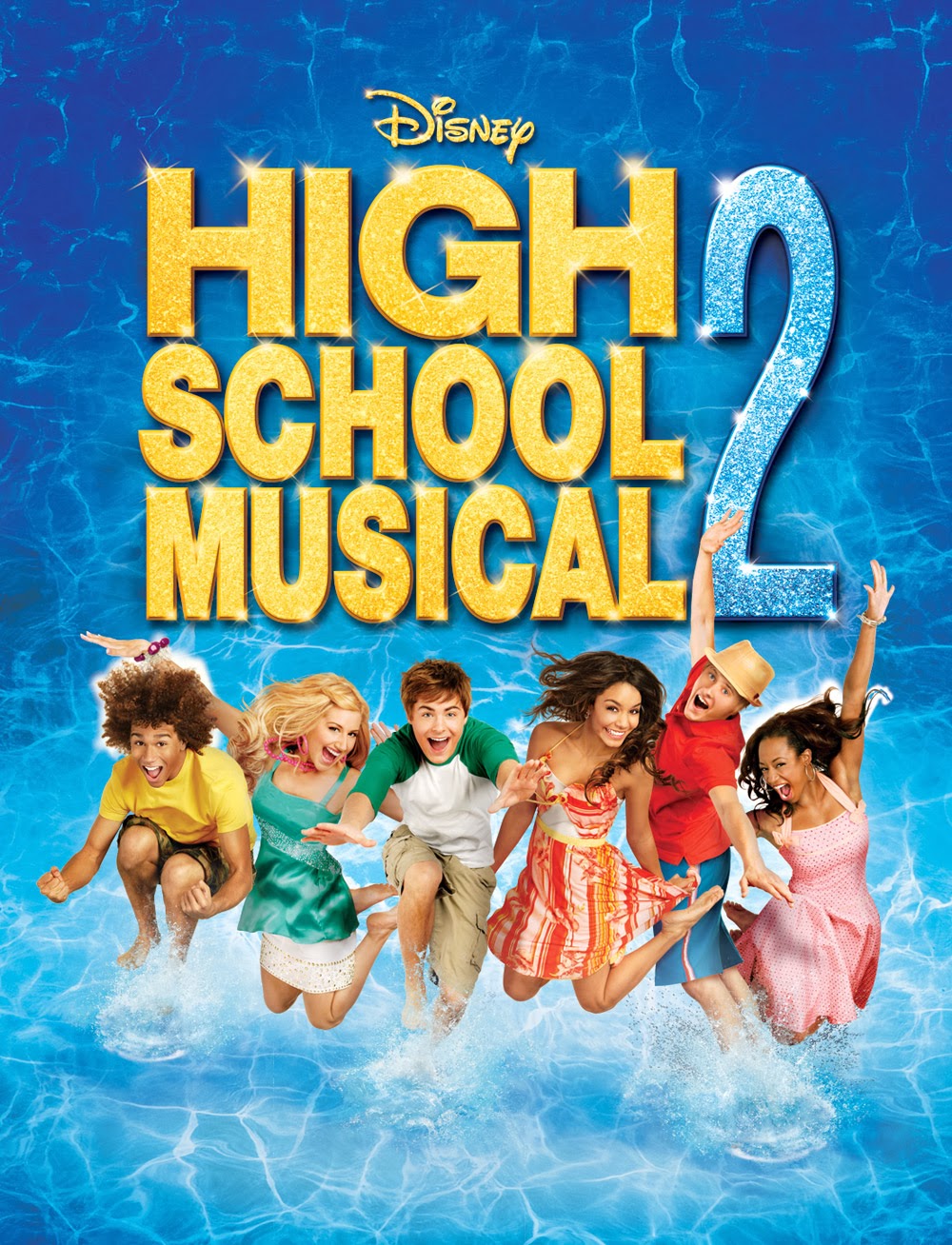
High School Musical 2 (2007) – It’s quite surprising that I never formally reviewed this film, as it’s my personal favorite in the trilogy.  The summer after High School Musical finds the Wildcats working at Lava Springs Country Club; Troy (Zac Efron) and Chad (Corbin Bleu) are on kitchen duty, while Gabriella (Vanessa Hudgens) lifeguards for pampered twins Sharpay (Ashley Tisdale) and Ryan (Lucas Grabeel).  What I like best about this film is the way it deepens the character relationships significant.  Troy and Chad get a trial-by-fire when the former’s future calls, and Ryan gains some self-confidence by stepping out of his sister’s shadow (indeed, Grabeel steals the show with a layered performance).  It’s not that you’re looking at Oscar-caliber performances, but after the first film the crew clearly know the strengths of their cast and play to those strengths, as when Troy and Sharpay get the duet you didn’t know you wanted from the first film.  The songs, too, are catchier, capturing the exuberance of summer vacation balanced by a fear of an uncertain future.  Wisely, Disney keeps the angst at bay, never surrendering the zeitgeisty just-have-fun of the plot and maintaining a high-energy infectious enthusiasm.  If you’re not smiling during Troy’s “Bet on It” number (or, more likely, guffawing at the goofiness), then you’re likely too cool for the room, a resident of Hipster Central, Population: You.  The hallucinatory “Humuhumunukunukuapua’a” alone is worth the price of admission for that weird moment when Disney meets David Lynch.  More of the same, really, from the first film, just bigger and better, setting the stage for the third installment in the trilogy with, finally, a big kiss on the Lava Springs golf course.

That does it for this week’s edition of “Monday at the Movies.”  We’ll see you here next week, but don’t forget to tune in this Friday for the Double-Oh-Seventh of the month with a very special returning star!

Monday, January 27, 2014

Monday at the Movies - January 27, 2014

Welcome to another edition of “Monday at the Movies.” Everyone else is talking about Target’s “stealth release” of a new Justice League movie, so why not us too?

JLA Adventures: Trapped in Time (2014) – This film is a bit of a strange beast, but it’s ultimately not an unsuccessful outing for DC’s premiere superhero team-up.  The plot finds Lex Luthor awakened in the 30th century after a world-conquest scheme goes awry; with the power over time itself, Luthor sends his Legion of Doom to prevent Superman from being raised on Earth.  While Trapped in Time mostly features a New 52-era Justice League – including Aquaman and Cyborg in positions of prominence – it also includes two Legion of Super-Heroes applicants, Dawnstar and Karate Kid.  Surprisingly, though the Justice League mostly takes a backseat to these two, the film still works as an engaging team story, enjoyable for those of us who love these characters almost as much as people we actually know.  Newcomers, though, probably won’t find much to appreciate here, and indeed Trapped in Time isn’t the best animated feature with these characters (offhand, I’d give that honor to Justice League: The New Frontier).  But what’s refreshing is that Trapped in Time doesn’t take itself too seriously.  In fact, the best scene in the film finds the Justice League and the Legion of Doom playing football with baby Superman, a hilarious bit of physical comedy that actually gets funnier.  It’s the kind of absurdly lighthearted play with the material that you won’t find in the uber-reverent DCAU series, which usually takes the cake in terms of quality adaptation.  Kudos to Diedrich Bader for returning to the role of Batman after his Brave and the Bold cartoon ended; he’s the most prominent in the voice cast that does its work well without exceptionally distinguishing itself.  The cliffhanger suggests there might be more to come from this production house, and I say bring it on.  Trapped in Time is reliable and entertaining without the burden of past success; looks like a fun future from here.

That does it for this week’s edition of “Monday at the Movies.”  We’ll see you here next week!

Monday, January 20, 2014

Jack Ryan: Shadow Recruit (2014)

Is Chris Pine the king of the rebooters?  After helming a very profitable new take on Star Trek, Pine’s been tapped to lead a post-9/11 reboot of Tom Clancy’s “Jack Ryan” espionage/thriller franchise.  Jack Ryan: Shadow Recruit, the first in what I can only assume is a series, is quite successful and engaging, even if it doesn’t forge new ground in the genre.

The film follows fresh-faced Jack Ryan (Pine), just off a tour of duty in Afghanistan as a Marine.  After undergoing extensive physical therapy and wooing his therapist Cathy (Keira Knightley), Ryan is recruited by Thomas Harper (Kevin Costner) to join the CIA.  Ten years later, Ryan’s undercover work on Wall Street exposes a plot to undermine the US economy, a conspiracy directed by Russian capitalist Viktor Cherevin (Kenneth Branagh).

Branagh pulls double-duty as villain and director here, and I would like to pause for a moment and ask the second question in this review:  when did Kenneth Branagh become a sterling action film director?  Short answer:  Thor.  But Jack Ryan proves that wasn’t a one-time fluke, a suitable hybrid of superhero throwdown with Branagh’s more comfortable Shakespearean swagger.  Jack Ryan proves Branagh a solid director of action sequences, culminating in an immensely suspenseful final hour or so of the film.

As the villain, Branagh refrains from noshing on the scenery and instead opts for cold and unpredictable; it’s a refreshing alternative to the bloviating Bond villain caricature we could have gotten.  Pine is credible as a first-time operative, particularly gifted in a key scene after his first kill, and Costner is a reliable choice for the stern senior agent.  Knightley’s beautiful as ever, though her American accent is a little too on-the-nose valley girl to be entirely believable.

I’ve praised the action scenes in the film, and boy do they deliver.  From a car chase with the threat of gruesome torture ahead to an intense close-quarters bathroom fight, Branagh turns in a film so capable that I’m eager to see him return for a Jack Ryan sequel to see what else he can do at play in the genre.  What I’d like to see more, though, is a little bit of innovation.  As successful as it is, Jack Ryan: Shadow Recruit is very much a paint-by-numbers spy thriller.  The classic beats are all there.  Post 9/11 film?  9/11 motivates character to serve his country.  Female character?  Hostage.  And even though the economic plot is a bit creative for a spy action film, it all amounts in the end to blowing something up.

One glaring weakness in the film is Ryan’s downright lack of a personality.  It’s easy enough to vicariously enjoy the film through him, but we never really get a reason to care about him beyond the unsuccessful pathos of a quick bout of physical therapy.  Pine plays a less cocky Captain Kirk here, devoid of the personality that made Star Trek a worthwhile hero’s-quest narrative.  There’s nothing really unique about his methods, nothing that sets him apart other than us knowing that Alec Baldwin and Harrison Ford played him before.  Hopefully the sequel rectifies that and clears up Ryan’s place in the espionage pantheon.

It remains to be seen, then, what kind of a spy Jack Ryan will become.  The economic angle is promisingly creative, but even if the writers fall back on a spy sans personality, Branagh’s capable hand at the directorial till delivers an engaging (if not cerebral) suspense film full of the good old eyeball kicks.

Jack Ryan: Shadow Recruit is rated PG-13 “for sequences of violence and intense action, and brief strong language.”  The violence is certainly more intense than bloody, and much of it deals more with the threat of menace than with actual spurts of the red stuff.  An F-bomb or two gets dropped, but it’s pretty tame in terms of language.

Monday, January 13, 2014

Lone Survivor (2014)

The box office receipts from this weekend indicate that Lone Survivor is a highly lucrative film, and it’s been compared to Saving Private Ryan.  While I’m not sure it’s as important a film as Spielberg’s take on World War II, it’s a compelling film that renders a true story in riveting detail, even if some of the storytelling itself is a little thin.

Mark Wahlberg stars as Marcus Luttrell, part of a four-man team (comprised also of Taylor Kitsch, Emile Hirsch, and Ben Foster) in pursuit of a terrorist in Afghanistan.  On the outskirts of an Afghani village, the mission goes horribly awry, putting the lives of the Navy SEALs in danger.

I’ll begin by saying that writer/director Peter Berg obviously has an immense respect for the work of servicemen like the ones portrayed in the film, and it’s refreshing to see a film this reverential; his last terrorism-themed movie, 2007’s The Kingdom, had a note of moral equivalency that still doesn’t taste right, but Lone Survivor just exudes a sense of unflinching admiration that might even turn off some cynical viewers.  But, as Phil Coulson says, “People might just need a little old-fashioned.”

Berg’s evident respect for the subject material and for Luttrell, who cameos as a SEAL in a few scenes, means that the combat sequences of the film are realistic and harrowing, highly effective at allowing the audience to feel some of the palpable terror that must come of being in such a situation – ambushed and outnumbered, staring down death.  Consequently, Lone Survivor is one of the more gripping films, and had the ending not been “spoiled” (see the title of the film and Luttrell’s presence on the PR circuits) it might have as suspenseful as Gravity because of how expertly directed both films were.

But Berg’s deft hand at the shootout scenes isn’t limited to just the one note.  Berg also knows when to punctuate the film with moments of levity, opportune placement of lines to elicit a smile or relieve the tension.  (Standout moments include a well-timed duck and a villager’s two-word summary of his opinion of the Taliban.)

What the film doesn’t manage to do very well is characterization.  On one level, portraying the SEALs as everymen allows the audience to put themselves in the soldiers’ shoes, heightening the anxiety of the situation as the danger escalates.  But on the other hand, the film feels a bit distanced when we don’t know much about the men or their personalities (it doesn’t help that some of them look very similar).  It’s not that the performances are bad – Wahlberg manages to suppress his Boston tough-guy persona enough to play up the real-life heroics of war – but the screenplay’s greater strengths lie in the violent action sequences and not in breathing much life into the characters themselves.

I wonder, though, if that’s not intentional.  Berg’s project here is clearly to valorize the real-life men who died during Operation Red Wings, so much so that he ends the film with an extended “in memoriam” montage that plays on the most basic heartstrings in the audience.  (Mine applauded at the end.)  There’s ultimately something missing from the film as a whole, but what we’re presented with is compelling enough and smartly put-together that it almost deserves better than a ghettoized mid-January release.

Lone Survivor is rated R “for strong bloody war violence and pervasive language.”  The violence is really quite brutal and often unpleasant to watch, frequently unrelenting after the first twenty minutes.  F-bombs pervade, as one would expect in a combat zone.

Tuesday, January 7, 2014

Octopussy (1983)

As we enter a new year, Roger Moore’s tenure on Bond is winding down (only one more entry left after this one), and it sure shows.  I’ve had my complaints about Moore’s outings as Bond – Moonraker was mystifyingly bad, while For Your Eyes Only was a forgettable step in the right direction – but Octopussy really takes the cake as, no contest, the dullest Bond yet.

James Bond (Roger Moore) is back in action after 009 dies uncovering a fake jewelry trafficking ring in East Berlin.  Bond smokes out smuggler Kamal Khan (Louis Jourdan) at an auction house and follows Khan to India, where he meets Octopussy (Maud Adams) and her gang of female assassins.  While dodging Kamal Khan’s attempts to kill him, Bond works to uncover a plot between Khan and the villainous Russian General Orlov (Steven Berkoff, practically choking on the scenery as a villain without a mustache to twirl).

The best thing I can say about Octopussy is that John Barry’s soundtrack is first-rate as ever, the kind of definitive Bond score that deserves a much better film.  I’m a huge believer in the idea that a soundtrack can do much of the lifting in a film if the other elements don’t quite hit it, and John Barry’s iconic work scoring Bond films automatically sets any entry apart from the ones where Barry is absent.  If you were to listen to the score and imagine a Bond movie in your head, it’d be a hit.

The execution on Octopussy, though, is execrable.  I’m really not sure whether this or Moonraker is worse; Moonraker has the “advantage” of veering so far off the rails that it’s an unmitigated catastrophe, but at least it had about an hour of somewhat engaging material.  In Octopussy, there’s honestly only one scene that didn’t bore me; like Moonraker, I’d actually tried to watch Octopussy once before but gave up.  And I can’t remember where I gave up because nothing in Octopussy is memorable.  Honestly, I took notes during the film because I knew it’d drop from my memory quickly and I had a hard enough time paying attention because of how tragically boring the film is.

A big part of the problem is that Roger Moore has overstayed his welcome.  Throughout his five previous films, I’ve noted that there is a glimmer of Bond inside of him that often seems smothered by the distinctly not-Bond films in which he’s starring, but in Octopussy we can’t help but notice that (at 55) Moore looks and moves like an old man.  Indeed, much of the film’s glacial pace is exacerbated by the fact that Bond never really moves quickly, even in moments of peril.  His action scenes are dimmed by his immobility, and his love scenes are unconvincing in their placidity.  (Compare to Diamonds Are Forever, in which Sean Connery looked quite old but still managed to capture that wry 007 glint in his eye.)

The plot doesn’t pick up any of the slack from Moore, either.  Some of the initial set pieces are based on Ian Fleming’s short stories, and the problem with adapting these stories to film is that nothing really happens in them.  It’s incredibly boring to watch Bond observe an auction on film because we don’t have his internal narration to follow (and besides, Moore looks old enough that he might fall asleep in his seat).  Furthermore, stringing these stories together results in an incredibly disjointed film experience that sees the plot veer sharply between storylines that never quite hang together; consequently, the viewer really needs to be paying attention to the tenuous links holding the plots together (I’m still a little murky on when exactly the film switched from jewel heist to mutually assured destruction).

As for that one scene that’s mildly compelling?  It’s right at the end of the film, when Louis Jourdan finally becomes the villain the film deserves, converting his disdain for Bond into actual hatred rather than just mere annoyance; simultaneously, Bond struggles to maintain his grip on a small aircraft midflight.  It’s the kind of stunt that the film needed more of – not the embarrassing clown costume, the cringeworthy Tarzan yell, the grotesque stereotypes of India that are actually offensive (you’d think the whole nation was one poverty-stricken slum through which white men literally throw money around as a diversion).

The worst thing of all is that Octopussy is not so exuberantly bad that it’s watchable.  Octopussy never musters up the energy to be anything other than uninteresting.  In fact, the most exciting moment is when the film actually ends and you can finally go to sleep.

Octopussy is rated PG.  A woman is seen fully nude emerging from a swimming pool, albeit at a great distance.  There are a few fistfights, shootouts, and seductions, but all with the naughty bits kept out of frame.  The only blood in the film is seen when Bond removes a leech from his chest.

James Bond and The Cinema King – and Sean Connery! – will return in a review of Never Say Never Again (1983) on February 7, 2014!

Monday, January 6, 2014

Monday at the Movies - January 6, 2014

Welcome to the first edition of “Monday at the Movies” in 2014.  We’re going into our third year with this feature; can you believe it?

Seven Psychopaths (2012) – In Bruges was a delightful surprise, marketed as a gangster comedy but actually a contemplative take on guilt with a stellar script.  With Seven Psychopaths, Martin McDonagh is at it again with another thoughtful film, though its slow burn might not appeal to everyone.  Colin Farrell stars as a screenwriter suffering from a creative block, while Sam Rockwell and Christopher Walken play dognappers who cross gangster Woody Harrelson by abducting his Shih Tzu.  The marketing bills this movie as a wacky slapstick action comedy, but the result is something much more sincere, a metafictional take on stories and endings.  But along the way, McDonagh doesn’t forget to let his cast have fun; Walken proves himself the king of the stammered non sequitur with many hilarious lines and outbursts, while no one does increasingly unhinged like Sam Rockwell.  I’m inclined to label the movie “smart” because of the way it’s structured, calling back to previous scenes and letting the audience figure certain plot details out without spoonfeeding them, but then there’s a legitimate problem with the film’s female characters.  There aren’t many of them, and all of them either take their clothes off or get killed (or both); the film seems aware of this when Farrell’s character is chastised for the poor quality of the female characters in his screenplay – another moment of clever metafictional play – but I’m not sure that self-awareness lets one off the hook, and indeed it might even exacerbate a problem by calling attention to it without attempting to rectify it.  But compelling if problematic, Seven Psychopaths manages to entertain, which in the final analysis is really all I ask of a film.

Happy New Year!  That does it for this week’s edition of “Monday at the Movies.”  Don’t forget to come back tomorrow for the Double-Oh-Seventh of the month (and boy is it a doozy)!