Wednesday, September 26, 2018

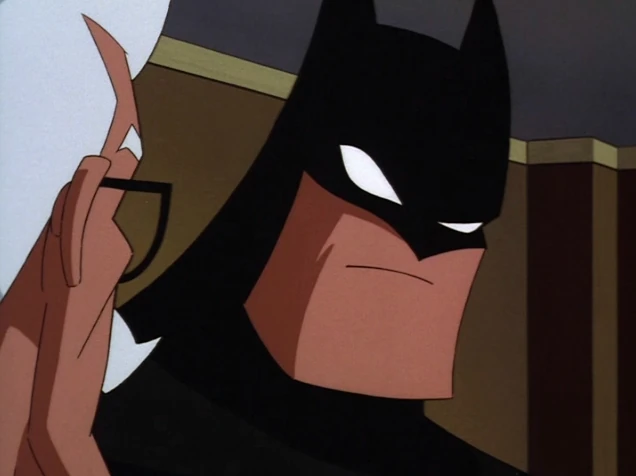
The New Batman Adventures - "Love is a Croc"

“What do you suppose they do on a date?”

Her reform efforts hindered by an unforgiving public, Mary Louise Dahl (Laraine Newman) watches the televised trial of Killer Croc (Brooks Gardner) and feels a pang of empathy for a man persecuted for his appearance. Donning her Baby-Doll regalia, she stages a breakout and retreats to the sewers with her new paramour. As they become Gotham’s Bonnie & Clyde, their crimes draw out Batman and Batgirl, while Croc’s uglier impulses start to overcome Baby-Doll’s more amorous ones.

As much as I didn’t enjoy “Baby-Doll” (clouding, recall, my memory of the quite decent third act), I’m not sure I’ve ever rewatched this episode. On the surface, it seems like this would put Baby-Doll at two for two in terms of dud episodes, but I found myself really digging “Love is a Croc” much more than I thought it was. It’s still somewhat off-putting and doesn’t quite sell me on Baby-Doll as a character, but writer Steve Gerber (who created Howard the Duck, among others) does well to take the focus away from Baby-Doll’s condition and emphasize instead that she’s a psychopath who just happens to be short. Her obsession with her appearance does, however, give her the unlikely yet narratively successful obsession with Croc, assuming he feels as she does – and missing, tragically, the fact that his “poor me” routine was a ploy for sympathy from the court. 

Here’s an episode that works really well in isolation, but it crumbles a bit if we think about it in the larger context of the show. You’ve got Baby-Doll, who acquits herself rather well in this episode, but it’s tough to buy that she’s reformed to the point where she can manage a motel – particularly in Gotham, where rehabilitation seems to be a dirty word within the walls of Arkham. (Sidebar: how did Paul Dini never write an episode where Harley Quinn tries to adopt Baby-Doll, much to Poison Ivy’s incredulity?) Furthermore, Killer Croc’s brutish disinterest in his monstrous appearance is at direct odds with his role in “Sideshow,” where his embrace of monstrosity was tempered by his own sense of tragedy at the same. Here, Croc loses that depth and becomes uninterestingly thuggish, a dispiriting decline for a character who had one of the more surprising emotional arcs on the show.

In terms of the redesign, it’s a wash for this episode. Baby-Doll’s redesign is more angular and helpfully strips her of the Looney Tunes cuteness that saddled her character in her debut; Laraine Newman replaces Alison LaPlaca, but her voice is so close that I didn’t notice until the credits rolled. For Killer Croc, though, the redesign scraps his gray scales for a dark green and more reptilian appearance, but the shading on his green skin is so dark that he fades into the background in many scenes. Worse yet, Aron Kincaid has been replaced by Brooks Gardner, who doesn’t do anything interesting with Croc’s snarls or grunts. I’m sure that my attachment to Kincaid stems from his unmistakable delivery of the line, “I threw a rock at him!” (which I should hope is not unreasonable for anyone following this series), but for a Croc-centric episode, Gardner isn’t really bringing much to the table to replace the character-laden Kincaid. Gardner’s Croc does, however, seem to prefigure the “Pimp Croc” of the comic Broken City (which, in turn, inspired the Academy Award-winning Suicide Squad).

Robin and Nightwing are nowhere to be seen in this episode, giving time instead to the Batman/Batgirl team-up that has been a consistent selling point for The New Batman Adventures. In an episode as littered with sexual tension as this one, there’s an uncomfortable note in knowing that Bruce Timm has been guiding Batman and Batgirl together in a romantic way (which will always, until the end of time, be a gross misreading of the relationship, in every sense of the word “gross”). Granted, the Timmverse romance only gets as explicit as transparent flirtation in Mystery of the Batwoman – setting aside, as we all should, the first forty minutes of The Killing Joke  – and thankfully here Batgirl plays the role of maturing teenager, joking about a villainous date night and maternally recommending a good spanking for Baby-Doll. It’s that spirit that has made Batgirl such an endearing member of the cast, and Tara Strong is doing definitive work in the role.

“Love is a Croc” is simultaneously the better Baby-Doll episode and the worst Killer Croc episode. It’s an odd story with a curious emotional center, defying resolution and sidelining its ostensible heroes in favor of an oddball romance between two misfit felons. But what else might we have expected from a writer who created a cigar-chomping pantsless duck? It’s rare for anyone to show up Paul Dini, but I almost think Gerber has gotten closer than anyone by halfway redeeming Baby-Doll.

Original Air Date: July 11, 1998

Writer: Steve Gerber

Director: Butch Lukic

Villains: Baby-Doll (Laraine Newman) and Killer Croc (Brooks Gardner)

Next episode: “Torch Song,” in which the star that burns brightest burns fastest.

🦇For the full list of The New Batman Adventures reviews, click here.🦇

Monday, September 24, 2018

Monday at the Movies - September 24, 2018

Welcome to another installment of “Monday at the Movies.” This week, a film which gives lie to the old expression about how the sausage is made.

All the Money in the World (2017)– A year or so from its release, it is a shame that the most interesting – and distracting – thing about All the Money in the World remains the ballyhoo surrounding the replacement of Kevin Spacey with Christopher Plummer in the role of billionaire J. Paul Getty. It’s unfortunate because the film is otherwise quite fine, neither a triumphant masterpiece nor a mordant trainwreck, but in every scene with Plummer there’s a macabre curiosity about what Spacey, beneath mountains of Gumby makeup, had done with the part, whether we’ll ever see any of the footage that necessitated the speedy and expensive reshoots. Plummer is doing masterful work, as he always does, and I have no doubt that he gave a more engaging performance than Spacey, who was exceedingly distracting in the prosthetics-laden trailers. Michelle Williams, as the mother of the abducted Getty grandson, is equally compelling, heartbreaking in the frustration we share with her at the immovable object of Plummer’s Getty. Mark Wahlberg, however, is disruptively miscast as the CIA operative turned Getty advisor Fletcher Chace; Wahlberg plays Chace like a scrappy everyman, albeit without the sobered gravitas needed to believe that this man is dangerous and capable of anything. (One almost expects him to tell an OPEC sheik, apropos of Andy Samberg, “Say hi to your mother for me.”) But the suspense of the film, a true story, falls somewhat tepid with knowledge of how the facts turned out, and the continual reminder of the film’s tumultuous gestation gets in the way of two very solid performances. Then again, I would much rather director Ridley Scott make films like this instead of persist in reinscribing the Alien mythos to the point of murky exposition (after Prometheus, I’ve still not hauled myself in front of Alien: Covenant, and I consider the prospect leavened with dread.)

That does it for this week’s edition of “Monday at the Movies.” We’ll see you next week!

Wednesday, September 19, 2018

The New Batman Adventures - "Growing Pains"

“It’s not you. I have to keep moving. There’s a man after me.”

After Robin saves a young girl (Francesca Marie Smith) from a street gang, he learns that her identity is something of a mystery. She doesn’t know her name – Robin dubs her “Annie” until they can learn more – and all she remembers is that she’s being pursued by a frightening man. Meanwhile, Batman’s investigation into a violent robbery intersects with Robin’s case when the heroes realize that this new robber is the man shadowing Annie.

Paul Dini gets a story credit on this episode, but I don’t feel he must have done very much on this one beyond pitching the basic outline to Robert Goodman, who pulls solo duty as script writer. It seems there are a few really interesting ideas in this episode, but I don’t sense that they’re given full attention in a plot that meanders and fumfers around until Batman figures out what’s going on.

There’s a nugget of a really good idea in this episode – that Robin sees Annie as something of a kindred spirit because they have similar backgrounds. “My dad wasn’t much of a prize either,” he tells her in a surprisingly sober emotional moment. It’s the kind of key character detail that was lost in “Sins of the Father” when it could have formed the backbone of a “Robin’s Reckoning”-style episode. We certainly start to get a better handle on Tim Drake as an emotional Boy Wonder, perhaps governed more by his passions than Dick Grayson ever was. If he came off as bratty in his debut and more or less neutral in the episodes since, “Growing Pains” gives us a strong sense of Tim’s personality, his dedication to his moral center, and his willingness to butt heads with Batman (something we glimpsed, to great success, in “Never Fear”).

But the largely chaste budding romance between Robin and Annie is a bit, pardon the pun, muddied by the fact that she’s revealed to be – spoilers ahead – an amnesiac piece of Clayface, sent off into the world after the events of “Mudslide” to scope out whether the coast was clear. All along, this series has blurred the line when it comes to its villains being pure evil; most if not all of them have very sympathetic reasons for doing what they do, and most villains have recognizable goals coming from deep cores in their psyches. Clayface already had the subtlety from “Feat of Clay,” in which we saw his addiction to the Renuyu cream drive him into madness. I don’t think he’s any more sympathetic when we see him as a preadolescent girl of the streets, much less when Robin appears to fall in love with Annie. The whole thing becomes a little uncomfortable, and Robin’s reaction to Annie becomes somewhat comical when we know she’s made of mud.

To top it off, “Growing Pains” continues the uncomfortable evolution of Batman into a cranky and abortive father figure. He’s curt and abrasive with Tim, perhaps giving us a hint as to why Dick left (again, spoilers – that’s exactly why he left), and worse yet he’s largely uninterested in Annie until he learns that she’s part of Clayface. Poor Kevin Conroy is saddled with the line “I know who Daddy is,” which he delivers with his nonpareil gravitas, but the absurdity of the dialogue deflates the tension of a second-act commercial break. Alfred catches some plot shrapnel too, first reminding Batman that Tim is a child before reacting with horror to learn that Batman is doing the responsible thing by tracking his protégé’s movements. Either Bruce and Alfred have become the world’s worst father figures – which, in a real sense, Bruce usually is – or they’ve been bludgeoned by a plot so peculiar that they can’t help but be warped.

Indeed, in an episode littered with faltering fathers, there’s a joke, surprisingly unsuccessful in its execution, in which Commissioner Gordon calmly observes that he’s “Glad my Barbara’s past her wild years.” It’s a decent enough gag (even though I’ve always maintained that Gordon winks at his daughter’s cape-and-cowl discords), but Batman pulls the most surprised face you’ll ever see him make, the visual equivalent of a record scratch straight out of a trailer for a mid-1990s teen comedy. It’s one of many moments in the episode where I genuinely don’t know what tone Goodman and Dini were trying to set.

The episode’s coda, in which Batman grimly intones, “Sometimes there are no happy endings,” is a fitting end for a strange episode, capped off by Robin’s oddly stubborn insistence that Clayface murdered Annie. Maybe once puberty settles in, Robin will look at “Growing Pains” differently; he doesn’t seem to be thinking clearly, and Batman doesn’t seem to understand at all what his young ward is going through. Seeing as how Batman himself had a strange adolescence, deprived of a normal childhood with normal childhood interactions, you’d think he might have a little more compassion. It’s ultimately a misfire for the otherwise usually impeccable Paul Dini, but at least it’s an uncompromising swing for the fences. It also seems to be one of the more divisive episodes of the series – fans either love this one (Dustin Nguyen, a top Bat-artist, frequently tosses Annie into his crowd scenes) or they’re unsettled by it. Count me among the latter – the fantasy of Batman is that he’s the best surrogate father a young boy could want, not an emotionally stunted absentee patriarch. 

Original Air Date: February 28, 1998

Writers: Paul Dini and Robert Goodman

Director: Atsuko Tanaka

Villain: Clayface (Ron Perlman)

Next episode: “Love is a Croc,” in which Baby-Doll has her first big girl crush.

🦇For the full list of The New Batman Adventures reviews, click here.🦇

Wednesday, September 12, 2018

The New Batman Adventures - "Joker's Millions"

“If I don’t pay up, I’ll go to jail for tax evasion! I’m crazy enough to take on Batman, but the IRS? No, thank you!”

The Joker (Mark Hamill) is flat broke. Struggling to make ends meet by taking on impossible jobs, Joker loses his Harley Quinn when a heist goes wrong. But a letter arrives for him, revealing that Joker has inherited $250 million from an old mob rival, the late King Barlowe (Allan Rich). With his financial woes behind him, Joker launches into a life of extravagance – until the tax collectors show up.

I can only beat the drum for Paul Dini so often before I feel myself becoming stale, and I think the declaration that I’ve said it all has itself become a wearied refrain. “Joker’s Millions” is yet another amazing episode from Dini, who turns in yet another first-rate Joker story, which barely involves Batman but nevertheless gives an immersive portrait of the sort of city that needs him. (It’s worth noting that Batman doesn’t even speak for nearly sixteen minutes of a twenty-one minute episode.) The finest writer is once more paired with his finest star, as Mark Hamill gives an uproariously funny performance with every line (“Haha! Let the good times roll!”). His ostensible muse, Arleen Sorkin, is in rare form as Harley, fuming at her boss and lover for abandoning her before hatching a harebrained scheme to escape Arkham and give him what-for.

What follows over the course of the episode is a series of well-crafted jokes that never miss their mark. From the myriad visual gags indicating Joker’s abject poverty (a wilting acid flower, a getaway car that stalls when the tank runs dry) to a montage of all the ways Joker (mis)spends his newfound inheritance, Dini has found the funny bone with surgical precision. Even the minute detail that Joker has found lodging in a flophouse under the alias “Mr. Kerr” is hysterical, since the landlady either doesn’t notice or doesn’t care that her tenant is an easily recognizable fugitive. 

“Joker’s Millions” is one of those episodes that doesn’t misfire (even Joker’s redesign is barely noticeable, considering what a treat the rest of the episode is), so rather than run down every delight one at a time, let’s turn our attention to another redesign. The Penguin makes his debut as owner of the Iceberg Lounge, an invention of the comics in 1995, and it’s really the best version of The Penguin, who’s always maintained a pretension of sophistication and legitimacy. Gone is the DeVito-inspired birdman, replaced with what Bruce Timm has described as a “nineteenth-century gentleman” by way of the Jack Burnley comics (Burnley made Penguin stouter than his initial appearances). Setting Joker’s ersatz reform amid Penguin’s larcenous nightclub is a giddy continuation of Dini’s topsy-turvy eye on Gotham – two criminals pretending to be otherwise, in plain view of those who know better.

Like a surprising number of great episodes, Batman and his crew don’t really feature in the episode, popping in to do a bit of action but otherwise leaving the focus on Joker and his own self-made fall from (temporary) grace. Dini’s best episodes remind us that crime doesn’t pay (and in this episode, boy doesn’t it) and that villainy always defeats itself with the most punishing irony, but it’s equally viable to see in these episodes the infectious fun that tempts so many to the dark side. Joker’s clearly having a ball, even as his fortunes – literal and figurative – roil beneath him. And Dini is too, which is a sure way to bring the audience along for one of his best episodes.

Original Air Date: February 21, 1998

Writer: Paul Dini

Director: Dan Riba

Villains: The Joker (Mark Hamill), Harley Quinn (Arleen Sorkin), and The Penguin (Paul Williams)

Next episode: “Growing Pains,” in which Robin gets a little muddy.

🦇For the full list of The New Batman Adventures reviews, click here.🦇

Wednesday, September 5, 2018

The New Batman Adventures - "Never Fear"

“Fear is the glue that holds society together. It’s what makes people suppress their worst impulses. Fear is power.”

All across Gotham, people have stopped listening to the better angels of their nature, throwing caution to the wind and behaving with reckless abandon. After saving a man swinging between rooftops, Batman follows a trail that leads from a brazen employee directly into the lair of The Scarecrow (Jeffrey Combs). The master of fear has developed a singularly unique way to bend his research into phobia, but when Batman is blasted with the gas, Robin wonders if he’s still in control.

The net effect of the redesign for The New Batman Adventures is largely neutral, with the bulk of the updates being mere streamlining. If the worst of these is the Joker redesign, we’re in pretty good shape; it’s by and large difficult to mess up the look of an iconic character like those in the Batman universe. In the case of The Scarcrow, however, it’s a marked improvement, both from the original baghead Scarecrow of “Nothing to Fear” and his toothier refresh in “Fear of Victory” and beyond. The long black duster, the wide-brimmed farmer’s hat, and the skeletal leathery frame finally make Scarecrow a figure of proper terror. Icing in the cake is the broken noose around his neck – which, I believe, is an invention of this show that’s since carried over into most visual interpretations of Scarecrow. Points also to Jeffrey Combs, who drops Henry Polic II’s slightly theatrical bravado for a lethally restrained monotone that’s positively chilling. (Combs, a schlock horror veteran, would later go on to redefine The Question as a raspy conspiracist with a crush on The Huntress over on Justice League Unlimited.)

In terms of visuals, Scarecrow is a winner here, but as far as narrative goes, Scarecrow had already begun to approach greatness with “Dreams in Darkness,” which figured out how to play up his scientific genius and his contempt for the city. “Never Fear,” however, is leaps and bounds Scarecrow’s best episode to date (though perhaps not his best overall, if we’ll count “Over the Edge” in a few weeks). Between the spooky redesign of the character, the moody red skies, and somber men’s chorus on the score, Scarecrow moves the show closer into a zone of horror, which is the right move for this character. The best villain stories are the ones that use the villain in a non-interchangeable way, finding a plot that’s uniquely suited to that particular foe. Here, Scarecrow reverse-engineers his own gimmick, depriving Gotham’s citizenry of fear in order to coax them into reckless and ultimately fatally dangerous behavior. 

It’s writer Stan Berkowitz’s animated Batman debut (he’d done some strong episodes of Superman: The Animated Series), and he’s firing on all cylinders. Not only does he find a great Scarecrow plot, but he makes excellent use of the Batman/Robin dynamic, something TNBA has largely struggled to do. First, though it isn’t explicitly stated in this episode, we see the return of Bruce’s “Matches Malone” disguise as he infiltrates Scarecrow’s operation. That’s the kind of deep dive into the mythology I really appreciate, since Matches isn’t used nearly often enough. Moreover, though, Berkowitz puts Jason Todd Tim Drake to great use when he realizes he may have to challenge his mentor after Batman might have fallen under the spell of Scarecrow’s anti-fear gas.

The episode concludes with the stunning visual of Scarecrow piloting a subway train barreling toward the heart of the city, all the while looking for all his withered self like a literal grim reaper, an avatar of the city’s doom. While the dénouement of the episode isn’t quite as thrilling as one might hope, its narrative payoff and the introduction of a scarier Scarecrow might even go so far as to make “Never Fear” the second-best episode of The New Batman Adventures thus far. (Hey, “Holiday Knights” is a tough opener to beat.) It’s a solid reminder that, as rocky as the first few episodes of TNBA have been, the same was true of Batman: The Animated Series. The really good stuff lies ahead of us.

Original Air Date: November 1, 1997

Writer: Stan Berkowitz

Director: Kenji Hachizaki

Villain: The Scarecrow (Jeffrey Combs)

Next episode: “Joker’s Millions,” in which The Joker faces his greatest fear.

🦇For the full list of The New Batman Adventures reviews, click here.🦇

Wednesday, August 29, 2018

The New Batman Adventures - "You Scratch My Back"

“He’s a big Boy Wonder now. A Man Wonder, in fact.”

On a patrol of the Gotham docks, Nightwing (Loren Lester) tracks a shipment of smuggled South American guns to Enrique El Gancho. While fighting off the goons, Nightwing finds an unexpected ally in Catwoman (Adrienne Barbeau), who offers her help in an effort to prove she’s gone straight. Batman and Batgirl are suspicious, but Nightwing opts to trust Catwoman, further straining the former Robin’s relationship with the Bat-family.

I don’t think I have terribly much to say about this episode because it’s particularly dull. The episode writes a lot of checks – Nightwing’s tension with Batman, his will-they-won’t-they with Catwoman, an ostensibly reformed villainess, plus a few third-act surprises – but it doesn’t manage to cash those checks as fully as it could have. Instead, it plays incredibly safe and ends up rather boring.

Worse yet, this episode leans on my least favorite kind of Batman story, which was all too common in the late 1990s and early 2000s. In these dreadful Bat-stories, the writers played up Batman’s gruff loner status far too heavily, turning him into an unlikable jerk with no social skills and no desire to play on anything remotely resembling a team. He drives away everyone close to him, who in turn all behave like petulant children. These stories are terrible because they overemphasize the fallen state of Batman’s soul without acknowledging that he uses the Batman identity to overcome that same fallenness; that is, Batman makes Bruce Wayne a better person, not a worse one. For this episode to fall into that trope, then, makes it an unbearable extreme version of something The New Batman Adventures often does – dramatize Batman’s clashes with his ostensible protégés. This friction trickles into Nightwing’s relationship with Batgirl, heavy with its romantic tension; instead of continuing the playful pairing we saw in Batgirl’s early adventures and in SubZero, this episode sees the two junior crimefighters bickering over what should be a non-issue – namely, the implausible reformation of Catwoman, standing in as a metaphor for their inexplicable inability to be with each other.

“You Scratch My Back” is especially infuriating because of its third-act reveals, which I can’t help but spoil here. The one-two revelations are that Catwoman didn’t actually reform (because of course she didn’t) and that Nightwing knew this the whole time, stringing her along until he and Batman could apprehend her. On the first count, this episode is a good indication that the writers have finally figured out Catwoman. She doesn’t need to be immersed in moralistic stories about animal cruelty; she just needs something shiny to chase onto the gray corners of the moral spectrum. What doesn’t work, however, is the twist that the Bat-family was spoofing her, and it doesn’t work because Nightwing’s reveal is entirely emotionless, completely unbelievable after all the acrimony we’ve seen. Recall that we still don’t know why Nightwing quit being Robin, and it’s much more plausible that he’s still mad at Batman than to believe that they fought, reconciled, and are now pretending to fight. Never mind the fact that Loren Lester’s monotone line reading of “She led us right to the emerald, like you said” is perhaps the most misjudged beat since Batman’s apparently insincere “Harvey, no...” from “Two-Face.” Worse yet, if Nightwing and Batman had planned the whole thing, they don’t seem to have included Batgirl in the scheme, seeing as how she and Dick Grayson carried on a private conversation with no incentive to perform being angry at each other. 

“You Scratch My Back” is an episode with a lot of unmined potential which chooses to focus instead on petty squabbling and immature silent treatments until an unearned conclusion that pretends everything’s all right. It’s an episode that feeds us sour milk and tries to pretend it’s ice cream. Catwoman is in rare successful form here, but the rest of the episode might end up bumping its way onto the “Bottom Ten” when all’s said and done.

Original Air Date: November 15, 1997

Writer: Hilary J. Bader

Director: Butch Lukic

Villains: Catwoman (Adrienne Barbeau) and Enrique El Gancho (Sal Lopez)

Next episode: “Never Fear,” in which phobia fails.

🦇For the full list of The New Batman Adventures reviews, click here.🦇

Wednesday, August 22, 2018

The New Batman Adventures - "Double Talk"

“When the muscle starts thinkin’ it’s the brains, then it’s time ta amputate!”

Arnold Wesker (George Dzundza) has been cured of his Scarface persona, and after six months without an episode he’s released from Arkham Asylum. His rehabilitation is going well until he starts to hear that familiar voice again, even as his old gang pressures him to lead them once more. Desperate never to become the Ventriloquist again, Wesker tells himself it’s all in his head – until the dummy calls him up on the phone and eludes a pursuing Batman.

Batman: The Animated Series frequently, though not exclusively, lived or died on the strength of its villain, and the same is widely true for The New Batman Adventures. Last week, I lamented that the series was leaning on the trope of “bad guy wants to destroy the city.” There’s only so much emotional investment to be wrung from seeing the same third act over and over again, and so with “Double Talk” it’s almost as though the show was listening to me, bringing back one of my favorite underrated villains in the process. “Double Talk” takes a deep dive into the psyche of The Ventriloquist amid a very compelling rehabilitation arc.

In a way, “Double Talk” reminds one of “Harley’s Holiday,” in which Harley Quinn’s furlough from Arkham Asylum went awry after she lost her temper and fell into an escalating series of misunderstandings, spiraling toward madness. Here, Arnold Wesker faces a Gotham that doesn’t believe he can reform, even as he himself remains uncertain that he’s mentally sound enough to be on his own. There’s a wonderful aura in this episode, as if Hitchcock directed an episode of The Twilight Zone, where the audience is kept in suspense as the episode draws out its main question. Has Scarface come to life, or is it all in Arnold’s head? Or is it something else altogether? I won’t spoil it here, but I’ll say that “Double Talk” plays with this question in interesting ways, even leaving a little room for interpretation.

We also get to see an underappreciated side of Bruce Wayne in this episode as we learn that he’s practically bankrolling Wesker’s rehabilitation; Wesker is staying at a Wayne-sponsored halfway house, and he’s in a work program at the mailroom of Wayne Enterprises. Bruce even greets him by name and shakes his hand, proof positive that Batman is invested in saving his city through more methods than just vigilantism. I don’t get the feeling, however, that he’s keeping Wesker nearby in case of recidivism; I think he’s genuinely invested in seeing a mentally ill criminal find inner peace. But he’s equally deft with the over-the-shoulder punch perfected by Michael Keaton in Batman ’89, which he whips out in a real crowd-pleaser of a moment.

Even as the episode revolves around whether or not Wesker can truly be free of the Scarface aspect of his personality, “Double Talk” plays it coy about how independent Scarface truly is. The episode is empirically clear about how the Scarface dummy manages to walk independently (and it involves, surprisingly enough, a guest role by none other than Billy Barty), but like their debut in “Read My Lips,” The Ventriloquist and Scarface seem to have a give-and-take relationship as to who is the more powerful, the more real personality. This is, alas, the final Ventriloquist episode, giving him a pretty good trilogy and concluding his story in a refreshingly optimistic way. It’s the kind of optimism that needs to remain at the core of Batman – that one good man can make a difference, that evil (even the evil within us) doesn’t have to win.

Original Air Date: November 22, 1997

Writer: Robert Goodman

Director: Curt Geda

Villain: Scarface and The Ventriloquist (George Dzundza)

Next episode: “You Scratch My Back,” in which a cat seizes the night(wing).

🦇For the full list of The New Batman Adventures reviews, click here.🦇

Monday, August 20, 2018

Monday at the Movies - August 20, 2018

Welcome to another installment of “Monday at the Movies.” This week, a murder/suicide.

Murder on the Orient Express (2017) – Kenneth Branagh’s adaptation of Agatha Christie’s 1934 novel isn’t quite a remake of the 1974 Sidney Lumet version, starring Albert Finney, but it doesn’t do enough to distinguish itself from its predecessor; it doesn’t misstep, to be sure, but one comes away feeling very much underwhelmed by the sense of having seen all of this already. Branagh all but drowns in a veritable river of ham as Belgian detective Hercule Poirot, perfectly suited to the detective’s (well-earned) ego but overly distracting with an exaggerated accent (compare, for one, to Judi Dench’s subtle accent as the Princess Dragomiroff). It doesn’t help that I can’t get past the mustache, which suggests that Kurt Russell is owed a royalty check. Because the film makes only cosmetic changes to the plot, it all feels rather inevitable, losing a great deal of suspense in the build-up toward solving the murder, and comes off like two hours of “Kenneth Branagh and Friends” – which, don’t get me wrong, is a roundtable I’d certainly watch week after week. Johnny Depp is suitably smarmy as murder victim Edward Ratchett, while Daisy Ridley proves she’s got a long and fruitful career ahead of her once she’s done with Star Wars. The aforementioned Judi Dench is resplendent as an imperious royal, while Branagh’s affection for Derek Jacobi is more than apparent in a warm interview sequence. If you’re a fan of anyone in the cast of all-stars – which includes also Willem Dafoe, Josh Gad, Penélope Cruz, and Michelle Pfeiffer – it’s worth a look, but there is little about this Murder that is particularly imperative. 

Suicide Squad: Hell to Pay (2018) – Perhaps it is just the circumstances of how I watched it, but Suicide Squad: Hell to Pay really feels like a Saturday morning cartoon for grown-ups (I watched on a Sunday, though). I say grown-ups, because Hell to Pay is unflinchingly adult in its objectionable content, almost to the point of being unnecessarily graphic. Don’t get me wrong, a Suicide Squad movie ought to be violent – maybe I’m just getting too old for this sort of thing – but there’s more blood here than anticipated, even from its R-rating. What I did appreciate, however, was the film’s strong connection to one of Gail Simone’s better Secret Six storylines, here appropriated so that Amanda Waller (Vanessa Williams) sends Deadshot (Christian Slater), Harley Quinn (Tara Strong), and the rest of the Suicide Squad in search of a magical, literal “Get Out of Hell Free” card. Part of the fun of a movie like this is that you never know quite who’s going to show up, as the filmmakers dig deep into DC’s stable of characters; Professor Zoom and Doctor Fate show up, though not in the ways you’re expecting, while Professor Pyg and Scandal Savage appear exactly as you’d imagine. All of this is inside baseball for those of us who live in the superhero dugout, particularly the film’s late-second-act surprise tie to another animated film (spoilers?), and I don’t imagine Hell to Pay will hold much appeal for anyone not already invested in the premise or its characters, but the curiosity of a big star like Christian Slater doing a voice might be incentive enough to check out this strange and gruesome flick.

That does it for this week’s edition of “Monday at the Movies.” We’ll see you next week!

Wednesday, August 15, 2018

The New Batman Adventures - "Cold Comfort"

“Search your hearts for the thing you value most, then despair, for I have come to take it from you.”

Mr. Freeze (Michael Ansara) has returned to Gotham, paving a path of pain as he destroys an archaeological find and a recently-debuted work of art. With his wife no longer cryogenically frozen (after the events of the film Batman and Mr. Freeze: Sub-Zero), Freeze’s plan baffles Batman until Bruce Wayne becomes a target, as Mr. Freeze aims to share his despair by taking from Gotham the things its citizens love best.

If you remember one thing from this episode, it’s almost certainly the moment when Mr. Freeze is revealed to be (spoilers) naught but a head in a jar mounted on robotic spider legs. You may even have had the action figure (as, surprise surprise, did I). And you’re probably wondering, as I have done all these years, why this episode takes one of the show’s best villains and runs him through a Cronenbergian body horror plot. In the “Arkham Files” features on the DVD set, Bruce Timm and Dan Riba talk about making Mr. Freeze more monstrous, more divorced from his humanity, after Sub-Zero “essentially took away his motivation.” There’s a cynical part of me that wonders how much the toy market factored into this move, but it’s worth noting that Timm and company don’t really phone in narratives like this one; put another way, the show hasn’t been very toyetic over the course of nearly ninety episodes, so why start now?

A relevant sidebar: I first learned the word “toyetic” from Joel Schumacher, who has famously deflected criticism of his Batman and Robin by saying that the powers that be at Warner Brothers had asked his movie to be more “toyetic.” (As someone who misspent his allowance on these figures, I’d say it worked.) It’s worth noting that Batman and Robin, widely regarded as the worst Batman film ever made, was released in 1997, the same year that “Cold Comfort” first aired on Kids WB, because it does seem that this episode tries to be very different from Arnold Schwarzenegger’s pun-laden portrayal of Mr. Freeze, even as it can’t help but retread some territory. Both are surrounded by henchpeople in parkas, owing as much to Batman ’66 as to each other. And yes, Schwarzenegger’s Freeze plundered the masterful “Heart of Ice” origin, as did the comics, but recall that the filmic Freeze planned to immerse Gotham in eternal winter, just as this Mr. Freeze aspires to drop a “Reverse Fusion Bomb” on the city.

What’s interesting, though, is the philosophical depth in this episode, which I don’t recall Batman and Robin approaching. In the film, Mr. Freeze planned to hold the city for ransom to fund a cure for his wife, dropping the financial pretense when he presumed her dead. Here, though, we get something much closer to Bane’s plot in The Dark Knight Rises, with both rogues more invested in how much despair they can wring from Batman’s soul after his city falls (there, fire; here, ice – cf. Robert Frost?).

Ultimately, however, “Cold Comfort” really feels like a case of “if it ain’t broke, don’t fix it.” You know by now that I’m a proud evangelist for “Heart of Ice,” labeling it the all-time greatest episode of this show in last month’s rundown. It might seem like a loaded assessment, but compare this episode’s “A touching scene. I would be moved, if I were still capable of it” to Mr. Freeze’s original line, “Yes, it would move me to tears if I still had tears to shed.” One I’ve committed to memory; the other strikes me as a pale reflection. There’s also something strange going on with Michael Ansara’s voice; where BtAS cast him as emotionless with a deliberate pace to his words, here he seems like he’s rushing the lines, and the hollow echo on his voice doesn’t have the same tinny effect as in his earlier episodes.

The suit is sleeker and his face more skeletally gaunt, but overall this newer Mr. Freeze just doesn’t live up to the original. It’s in service to a very effective third act, however, in which Batman and Batgirl lurk through Freeze’s horror-inflected lair, and the revulsion at seeing Freeze’s disembodied head is a major success. Moreover, the show is really working when it’s focused on Batman’s partnership with Batgirl, whose black and gold costume looks great bounding around. They work exceptionally well together, and their professional dynamic marks a major evolution from Batman’s incontestable condescension upon her debut. (I’m plugging my ears at the faint suggestion of romance, though - #NotMyBatman, even if it’s framed as a schoolgirl crush.) All told, though, “Cold Comfort” takes a Shakespearean tragic antihero and reduces him to a sadistic bully. Mr. Freeze would return to the DC Animated Universe once more, in an episode of Batman Beyond, but here he’s effective as a visual, an idea, and a toy – but little more.

Final sidebar: three episodes in, and I’ve already lost track of how many supervillain plots orbit around destroying the city for the sake of destroying it. Joker gets a pass in “Holiday Knights” because of his quirky motive by way of a New Year’s Resolution he could never keep, but Two-Face and Mr. Freeze ought to be better than this. I’d say it almost makes one long for the petty days of “The Terrible Trio,” but let’s not say things we can’t take back.

Original Air Date: October 11, 1997

Writer: Hilary J. Bader

Director: Dan Riba

Villain: Mr. Freeze (Michael Ansara)

Next episode: “Double Talk,” in which Arnold Wesker is no dummy.

🦇For the full list of The New Batman Adventures reviews, click here.🦇

Monday, August 13, 2018

Monday at the Movies - August 13, 2018

Welcome to another installment of “Monday at the Movies.” This week, a pair of movies that are – shall we say – exceedingly British.

Paddington (2014) – Despite my reservations that the titular bear was neither as cute as the Peggy Fortnum illustrations nor voiced by Colin Firth, I found myself captivated by the shameless whimsy and defiant British-ness of Paddington. In the case of the former, the bear looks much better in motion than he does in still photos, charmingly expressive; on the matter of the latter, Ben Whishaw is a fine Paddington, imbuing this unique bear with a roguish innocence that never misses a giggle when he pulls a marmalade sandwich from under his hat. There is something striking about the way writer/director Paul King (no relation; himself helming his first movie, a remarkable moment) manages to capture the madcap logic of a children’s story, in which a renegade shower massage can flood a bathroom while a sinister taxidermist (Nicole Kidman, between proud mouthfuls of scenery) plots to stuff and mount a living creature for a surprisingly well-developed and narratively integrated reason. I was also impressed at how artfully developed many of the film’s gags proved to be; for instance, a mishap with a handheld vacuum cleaner establishes the strength of the device for a pivotal and deft setpiece late in the film. For a character as prominent and marketable as Paddington Bear, it would have been exceptionally easy to make a lazy film that cashes in on the character’s adorable reputation, but it was quite apparent that everyone involved on Paddington cared deeply about the character and his legacy, and it strikes me that they have done right by him.

Victoria and Abdul (2017) – Here’s a film that offers Judi Dench the chance to be alternatingly heartwarming and cantankerous for two hours while breathing life into one of Britain’s most prominent figures (returning to a role, incidentally, for which she was nominated for an Oscar in Mrs. Brown). If that’s not a recipe for a good time at a film, I haven’t found one, because Judi Dench is riveting in this “mostly” true story about Queen Victoria’s friendship with an Indian subject, Abdul Karim (Ali Fazal), who becomes a teacher (“munshi”) and a confidante in the regent’s final years. Victoria and Abdul is funnier but no less delightful than I anticipated, taking a wry postcolonial approach to the British Empire, acknowledging its dehumanizing aspects in a sobering scene with Abdul’s friend Mohammed (Adeel Akhtar) but also highlighting Victoria’s efforts to learn more about her subjects, even if her naiveté is somewhat charming (“This mango is off,” she repeats in one notable scene). The cast is rounded out by Tim Pigott-Smith, Michael Gambon, Paul Higgins, and Eddie Izzard, all of whom play their xenophobia rather broadly in a quintessentially British tongue-in-cheek interrogation of prejudice; it’s all Izzard can do not to twirl his mustache as Victoria’s eldest son, horrified that a lowborn subject has his mother’s ear in a way he never has. The film is irrevocably and undeniably Dench’s, though, equally enthralling while asleep at tea or while insisting that her faculties have never been sharper, in a single-take monologue that lays bare in equal measure her insecurities and accomplishments. It’s a powerhouse moment in a potent performance, a real shame that she was snubbed at last year’s Oscars.

That does it for this week’s edition of “Monday at the Movies.” We’ll see you next week!