Wednesday, June 7, 2017

Batman: The Animated Series - "Appointment in Crime Alley"

“I told her to be careful. Bad things happen to people in Crime Alley.”

Industrialist Roland Daggett (Ed Asner) won’t take no for an answer, so after Gotham City declines his bid to rezone Crime Alley, he hires a pair of goons to level the block at precisely 9 p.m. Little does Daggett know, though, that this evening holds a special significance for Batman, and he has an annual appointment to keep with the neighborhood physician Dr. Leslie Thompkins (Diana Muldaur).

There’s a trio of episodes from Batman: The Animated Series that always ran together for me – “It’s Never Too Late,” this one, and “Paging the Crime Doctor.” They’re all underworld episodes, and the latter two star Leslie Thompkins, but more importantly none of them left an impression on me. I’d always gloss over these on rewatches, but I’m really glad to go through the series again because “Appointment in Crime Alley” is actually a great episode. You might not think it to look at it, since it’s not written by Paul Dini, nor does it feature a big-name villain, but that’d be an underestimation. And if I didn’t know we have so many perfect episodes down the pike, I’d wager this might be a new “Top 10” episode.

“Appointment” is written by comics veteran Gerry Conway, who’s best known for creating Killer Croc and The Punisher as well as killing Gwen Stacy, and what’s not immediately apparent is that he’s working from a story written by Dennis O’Neil, a man who probably belongs on the Mount Rushmore of Batman stories (if only for creating Ra’s al Ghul with Neal Adams). That’s a colossal assembly of authorial talent, but director Boyd Kirkland is no slouch, either, he of “Joker’s Favor” and “Beware the Gray Ghost.”

Kirkland’s direction here is really quite amazing, creating a great atmosphere of suspense as he continually reminds us of the ticking clock governing the action of this episode. Add to that a notably remarkable score by Stuart Balcomb, which makes long scenes without dialogue all the more punchy (and often literally, given Batman’s nocturnal activities). This is a very fluid episode, one that works exceptionally well, and it does so without much pomp or flair. Indeed, there’s a “just another night” feeling to this episode, showing what Batman’s nights are like when he isn’t involved in saving the city on a macro scale. It’s small acts of heroism, only some of which add up to the larger plot, showing that Gotham City is a massively dysfunctional place in need of a protector even if all the colorful rogues are incarcerated.

Yet as much as the episode goes for the quotidian, there’s something pointedly noteworthy about this particular evening, and I believe this is the first time that BtAS has gone into the concrete specifics of what happened to Thomas and Martha Wayne. We’ve known that they died and that Batman feels intensely guilty about this, but seeing the details – even in newspaper clippings – carries a power that those earlier dreams and flashes could only glimpse. Moreover, tethering those feelings to Leslie Thompkins, who struggles to do good in a part of town on which Gotham has entirely given up, anchors Batman’s drive for justice in his core optimism that there are still good people in Gotham, even in the darkest part of town. It’s a lesson that Ben Affleck’s Batman needed to relearn – “Men are still good...” – and indirectly this episode shows why it’s so important for Batman to remember that. As much as the city would seem to fall apart without its caped crusader, Batman is continually reminded that there are others who, in their own small way, are holding the city together. It’s damned poetic that one such hero held Bruce Wayne together after his parents died.

The episode closes with the revelation of Batman’s appointment in Crime Alley, and if you haven’t figured it out yet, there’s a spoiler here, but it’s one you’ve probably seen in other adaptations of Batman – The Dark Knight returns to Crime Alley once a year to lay flowers at the spot where his parents were gunned down. It’s a theme that originated in the O’Neil story back in 1976, but it’s chill-inducing here; no matter how many times I’ve seen a variation of this image, be it in Tim Burton’s Batman or in the Arkham City game, it’s sobering to see the humanity and the tragedy of Batman laid bare in a moment of remembrance. “Appointment in Crime Alley” does it in a moving way that reinforces the optimism of Batman, particularly important for a young audience seeing this animated show.

Original Air Date: September 17, 1992

Writer: Gerry Conway

Director: Boyd Kirkland

Villains: Roland Daggett (Ed Asner), Nitro (David L. Lander), and Crocker (Jeffrey Tambor)

Next episode: “Mad as a Hatter,” in which the vorpal blade goes snicker-snack.

🦇For the full list of Batman: The Animated Series reviews, click here.🦇

Monday, June 5, 2017

Wonder Woman (2017)

In a word, wow.

Diana, princess of Themyscira (Gal Gadot), has trained her whole life – against the wishes of her mother, Hippolyta, Queen of the Amazons (Connie Nielsen) – to defeat the god of war should Ares return centuries after his defeat at the hands of his father Zeus. When man’s world, in the form of downed fighter pilot Steve Trevor (Chris Pine), comes to her island home, Diana has the chance to fight the war to end all wars, joining the First World War as Wonder Woman. As she crosses the trenches of no man’s land, she faces Erich Ludendorff (Danny Huston), the German general intent on avoiding an armistice, and his chemist, Dr. Isabel Maru, alias Doctor Poison (Elena Anaya).

Let’s get the preliminary out of the way up front: I’m perpetually aghast at the fact that it took more than 75 years for Wonder Woman to headline her own live-action feature film, but if that’s time we spent “Waiting for Gadot” I’m almost inclined to say it was worth the wait. Gal Gadot is frankly definitive as Wonder Woman, and I’m relieved that audiences are embracing her as much as she has embraced the role; I look forward to many more films with her as Wonder Woman because it’s almost as if she’s stepped out of a comic book and onto the silver screen. The moments when she’s unleashing her warrior’s fury, backed by Tina Guo’s electric cello theme (thankfully maintained from Batman v Superman), are at once fist-pumpingly thrilling and simultaneously genuinely awe-inspiring.

There’s certainly a meta-level reading here, with Steve Trevor telling Wonder Woman that no one can cross a no man’s land before watching her accomplish just that. In many ways, that’s an echo of all the bigwigs and even audience members who sniffed at the notion that a female-led superhero film could do big business, and here we are, $100 million later. But even on its own merits, the moments when Wonder Woman charges into battle are legitimately inspirational, as is her continual emphasis on personal acts of heroism; for all that Wonder Woman is looking to defeat Ares, she never neglects the personal cost of war, as in the deeply touching moment when she heals a traumatized soldier by asking him to sing. Gadot embodies the character’s unique blend of compassion and ferocity, as well as her welcome sense of humor amid the absurdities of man’s world.

Wonder Woman is unquestionably Gal Gadot’s show, but she’s surrounded by strong supporting characters. Chris Pine is a well-nuanced Steve Trevor, funny and somewhat dunderheaded but never incompetent; previous incarnations have struggled with whether Steve is a patronizing patriarch or an empty-headed buffoon, but Pine finds a way to make Steve capable yet human. The Amazons who dominate the first act are wonderful enough that I’d have gladly taken a ticket for a movie just about them, particularly Robin Wright’s fierce Antiope, and I do hope we’ll see more of Themyscira, perhaps as soon as Justice League in November. And our villains are clearly having a good time playing evil to the hilt; there’s a fascinating backstory to be told about Dr. Maru, while Danny Huston’s Ludendorff takes the occasional chomp out of the scenery in a snarling, vamping performance that manages also to be scary.

What I loved the most about Wonder Woman – aside from the mere fact of its existence and the notion that, finally, others love a DC movie as much as I do – is that it takes subtext from Batman v Superman and literalizes it. We have had to imagine and defer the promise of Jor-El’s prophecy to his son – “They will stumble, they will fall, but in time they will join you in the sun” – but Wonder Woman shows us what that looks like in the real world. The audience who joined me for Wonder Woman was probably the most diverse audience (in terms of age, gender, and race) I’ve seen at a superhero movie, at least in recent memory, and that alone is something to celebrate, that finally everyone understands the power of the superhero, that we see what they can do, and that we’re standing behind them.

Put another way, you go, Gal.

Wonder Woman is rated PG-13 for “sequences of violence and action, and some suggestive content.” Directed by Patty Jenkins. Written by Allan Heinberg, Zack Snyder, and Jason Fuchs. Starring Gal Gadot, Chris Pine, Connie Nielsen, Robin Wright, Danny Huston, Elena Anaya, and David Thewlis.

Wednesday, May 31, 2017

Batman: The Animated Series - "The Clock King"

“It’s about time.”

Harboring a seven-year grudge, Temple Fugate (Alan Rachins) assumes the moniker of The Clock King, hellbent on disrupting Gotham City as an elaborate revenge scheme against Mayor Hamilton Hill (Lloyd Bochner) amid his reelection campaign. Batman finds himself short on time as the clock runs out for Mayor Hill, and it’s high time to stop these time-related puns from running one second longer.

I’ve always thought that The Clock King is largely underrated – both as an episode, a Batman antagonist, and a villain for the DC Universe at large. He appears in only three episodes of the DC Animated Universe – including a particularly inspired turn as the master strategist for Task Force X (alias the Suicide Squad) – and he’s been a sporadic presence in the Arrow-verse of television shows; you might even remember him from back when I reviewed “Mayhem of the Music Meister!” in his appearance as a man with an actual clock for a face.

The thing I love about The Clock King is tied to one of the core tenets of my conception of Batman. In The Dark Knight, The Joker is portrayed as an agent of chaos, whose villainy metaphorically and literally represents the introduction of anarchy into Batman’s ordered world. Batman represents the struggle against madness, forcing the world to make sense by taking a stand against the irrational. He’s a detective; every crime can be solved, every mad act restrained. Yet The Clock King’s villainy stems from his ability to create a system of pure order while at the same time finding that one domino which can completely disrupt the rational order of Gotham; he can, at once, derail a subway train by altering its schedule by seconds, but he can also calculate the precise amount of time needed to entomb Batman in a bank vault.

The Clock King is presented, then, as a particularly clever Bat-villain, on an intellectual par with The Riddler (whom we haven’t yet met, though both debut episodes are written by David Wise) but with a more personal motivation than Riddler’s more compulsive behavior. As is generally the case with Batman: The Animated Series, the visual design of The Clock King is elegant and expressive – though, unfortunately, I can’t say the same for the animation in this episode, which comes off uneven and jerky. Matched with an arrogant nasal clip of a voice, a perfectly irritated how-dare-you quality that can’t believe Batman would interfere with his perfect plans, The Clock King’s costume is a restrained brown suit with only the clock hands on his glasses indicating his particular modus operandi. That little flair is one more reminder at how objectively successful the BtAS crew was at distilling a character’s entire essence into a singular image.

The plotting is really bang-on, too. David Wise turns in a script that manages to be impressively clever, groaningly pun-laden, and genuinely scary, as in the surprisingly alarming subway crash sequence. Like The Clock King, Wise only contributed three episodes to Batman: The Animated Series – this one, Riddler’s debut, and Hugo Strange’s only appearance – and if you don’t see him on my Top 10 list, he’s a solid contender for the “Next 10” (also known as “Top 10 Episodes NOT Written by Paul Dini”). Not a one of Wise’s three episodes is anything less than strong, solid Batman fare.

Aside from the curious decision to have Batman appear exclusively in daylight for this episode, “The Clock King” is a well-oiled machine, a tasteful timepiece of a thing that holds up for this reviewer, who always remembered it fondly, even if the rest of the Bat-fan community seems to have moved on. It earns extra brownie points by including a pointed number of streets named after famous Batman comic book creators (Breyfogle, Toth, Broome, and a nod to Jack Kirby among them).

Original Air Date: September 21, 1992

Writer: David Wise

Director: Kevin Altieri

Villain: The Clock King (Alan Rachins)

Next episode: “Appointment in Crime Alley,” in which Batman anticipates the lesson of Batman v Superman.

🦇For the full list of Batman: The Animated Series reviews, click here.🦇

Monday, May 29, 2017

Pirates of the Caribbean: Dead Men Tell No Tales (2017)

Here’s the thing about Pirates of the Caribbean: Dead Men Tell No Tales: for all that critics have contorted themselves to work the film’s subtitle into some kind of indictment of whether this particular tale should have been told, it is for all intents and purposes Pirates of the Caribbean 5, resurrecting plotlines from past films and trotting them out again for more high-seas adventure. So if you’re already weary of Captain Jack Sparrow and his ilk, this one won’t win you over. For those of us dyed-in-the-wool landlubbers, though, it’s more of the same good fun.

Captain Jack Sparrow (Johnny Depp) is down on his luck when he learns that the ghostly pirate Captain Salazar (Javier Bardem) is coming for him and the rest of the pirates on the seas, including the lucre-laden Hector Barbossa (Geoffrey Rush). Meanwhile, Henry Turner (Brenton Thwaites) needs Jack’s help to seek out the Trident of Poseidon to free his father Will Turner (Orlando Bloom) from the curse of the Flying Dutchman, while horologist Carina Smyth (Kaya Scodelario) knows how to read the map to find it.

I was struck by how many parts of Dead Men felt familiar, almost like clues along a treasure map that loyal fans know how to read. I first caught it when I noticed that the romantic theme from At World’s End was repurposed for an action cue involving Henry Turner; I chalked it up to new composer Geoff Zanelli slyly remastering Hans Zimmer’s superlative earlier score, but then the similarities really started manifesting. There’s a curse, and Jack’s responsible; there’s a mystical artifact buried on an island to which the compass points; there’s a witch and a crew of inhuman pirates with a decaying ship; we’ve got a chase through cobblestone streets and an execution sequence that doesn’t quite go as planned; and there’s a well-intentioned pretty boy paired off with an unconventional woman. I would go so far as to hazard a guess that every scene in Dead Men involves a callback to another moment in the franchise.

What I can’t determine, doubtless because I am too uncritical a critic in my appreciation for a film series that’s been a favorite for nearly half my life, is whether this is for better or worse. Put another way, I’m not sure if the franchise has run out of ideas or if the crew of Dead Men, like Roald Dahl on You Only Live Twice (itself a fifth film in a franchise), have taken stock of the preceding films and attempted to canonize the rules and tropes that govern such a movie, for there does seem to be a sense that Dead Men is going back to square one for a kind of velvety-soft reboot and revivification. I did not, however, feel that On Stranger Tides strayed too far from the Pirates brand and indeed appreciated the new corner it carved out in the universe. Dead Men does, then, feel a bit like playing it safe, not unlike the ship at the film’s climax which risks falling into an immense cavern (though I never perceived that metaphorical cavern).

What Dead Men does contribute is a deeper sense of the mythology of the universe, just ahead of what might be an extension of the franchise (and yes, the post-credits scene is, as ever in these movies, pivotal). We’ve got flashbacks and “secret origins” and retroactive continuity vis-à-vis the curse of the Dutchman, as well as an expanded family tree that Geoffrey Rush has compared (spoilers in the link) to a Dickens novel, an assessment with which I’d have to agree; Dead Men feels very much like “the next chapter,” perhaps more than On Stranger Tides did.

But for all the critical hemming and hawing over whether this is a fresh or stale “next chapter,” I have to say that it’s a fun one, and I think one’s overall take on this Pirates film has very much to do with the degree to which one has ever enjoyed a Pirates film. As before, you’ve got spooky villains with quirky gimmicks, which are animated with grisly compelling detail, and you’ve got the trademark Pirates brand of humor on display, from an uproarious bank heist that goes awry in the strangest way to hilarious confusion over the precise meaning of the word “horologist.” But there are no false notes, no moments where one might tweet out #NotMyPirates. There’s continuity here, not unlike the devoted patience one affords the Marvel Cinematic Universe, which is thrice as long.

In short, dead men tell no tales, but franchise newcomers Joachim Rønning and Espen Sandberg have directed a safe yet entertaining one that makes me equally, not less, enthusiastic about the prospect of a sixth Pirates film. (Remember, Penelope Cruz’s Angelica is still out there somewhere...) Dead Men is a useful primer on what the Pirates franchise has done, and here’s hoping that a sixth will demonstrate what it can do.

Pirates of the Caribbean: Dead Men Tell No Tales is rated PG-13 for “sequences of adventure violence, and some suggestive content.” Directed by Joachim Rønning and Espen Sandberg. Written by Jeff Nathanson and Terry Rossio. Starring Johnny Depp, Javier Bardem, Geoffrey Rush, Brenton Thwaites, and Kaya Scodelario.

Wednesday, May 24, 2017

Batman: The Animated Series - "Fear of Victory"

“It’s no joke, I assure you. It’s the fear of victory and the agony of... The Scarecrow!”

At Gotham University, Dick Grayson (remember him?) discovers that not only has his star quarterback roommate been infected with a strain of fear toxin, but the Boy Wonder himself has also come down with a case of terror, courtesy of The Scarecrow (Henry Polic II). If Batman can find the so-called professor of fear in time to stop his next attack, Robin will have to face his phobias.

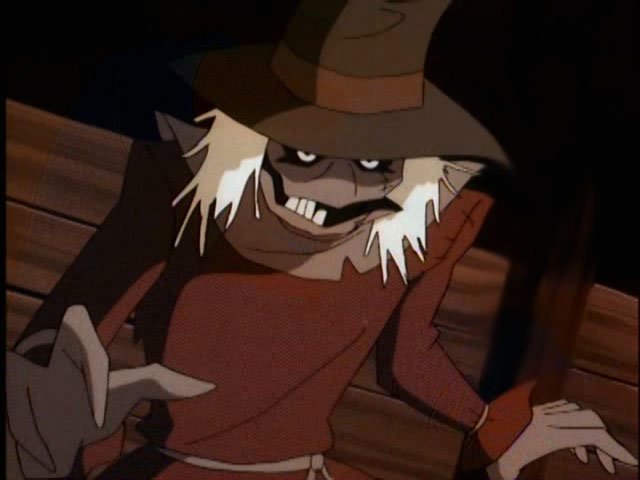
We should talk a little bit about Scarecrow and Robin, since for both of them this is his second episode (Scarecrow in “Nothing to Fear” and Robin in “Christmas with the Joker”). First, Scarecrow gets a facelift of sorts with a redesign that makes him less angular and more globular. I’ve always had a soft spot for this look, in large part because I had/have an action figure of this incarnation in my childhood toy box; it’s not as abjectly scary as his later appearances in The New Batman Adventures or the Arkham games, which play up the rotting appearance of his burlap mask, but it’s definitely more polished than his “Nothing to Fear” look, which always felt unfinished.

As for The Scarecrow’s scheme in this episode, I’m of two minds. In short, Scarecrow douses Gotham athletes with fear toxin, then bets against them to make a windfall of cash. On the one hand, it’s another underwhelming objective for Scarecrow – for the second time in a row, we’re seeing him put that brilliant academic mind to work for petty cash. Then again, I really appreciated the moment when Batman suggests that Scarecrow might be amassing money to pull off a more terrifying plot against Gotham City. We’ve seen more contemporary treatments of Scarecrow take advantage of the metaphorical depths you can plumb with a subject as rich as fear, and maybe in 1992 Scarecrow wasn’t “there” yet as a character, but it does make this episode feel a little undercooked, as though there’s more beneath the surface.

That said, “Fear of Victory” isn’t a bad episode by any stretch of the imagination, and a big part of that is that it differentiates itself from “Nothing to Fear” by subjecting Robin, not Batman, to the fear-inducing toxins concocted by The Scarecrow. It is a little odd to have Robin just drop into the plot as though he’s been there all along – his “origin story” is still eight episodes away – and this episode certainly feels tonally different by virtue of his presence. The captivating idea of Robin is that he’s at once someone Batman wants to protect because he sees that same orphan boy in himself, while at the same time he’s also a beacon of light and hope in Batman’s (self-) darkened world. The latter is certainly true, as Batman cracks a few jokes in this episode, albeit uncomfortably; I’ll chalk it up to the writing that makes these jokes seem mean-spirited, as Kevin Conroy has proven elsewhere he can give Batman a less sardonic sense of humor.

I’ll close by highlighting a surprise standout sequence in the episode, which has very little to do with the main plot of “Fear of Victory” and everything to do with the overall narrative and aesthetic successes of Batman: The Animated Series. I’m talking about the scene set inside Arkham Asylum, where Batman discovers that The Scarecrow has indeed escaped. For one, the interior of a madhouse at midnight gives the animators a chance to do the kind of shadow-play they do best, reminding us that BtAS was drawn on black, not white, paper to give that dark mood. But as Batman strolls past the cells at Arkham, each pane of glass revealing another of his colorful rogues, I realized this is the first good look we’ve gotten inside Arkham (aside, that is, from the cells seen in “Heart of Ice” and “Pretty Poison”), and boy is it nuts in there. More importantly, though, twenty-four (of eighty-five) episodes in, Batman: The Animated Series has done a masterful job of populating Batman’s world with thickly developed, instantly recognizable villains whose backstories are somehow gracefully expressed through their visual appearance. It might be difficult to believe, but Scarecrow is only the second villain (barring the mobsters) to appear in more than one single episode – The Joker, of course, is the other – and this walk down the hallway gives one the sense that BtAS has really been warming up at the plate and building its world.

Postscript: how awesome are those retro sports designs? Football hasn’t looked like that since the Great Depression, but it’s a delightful addition to the timeless atmosphere of Batman: The Animated Series.

Original Air Date: September 29, 1992

Writer: Samuel Warren Joseph

Director: Dick Sebast

Villain: The Scarecrow (Henry Polic II)

Next episode: “The Clock King,” in which the tolling of the iron bell calls the faithful to their knees.

🦇For the full list of Batman: The Animated Series reviews, click here.🦇

Monday, May 22, 2017

Monday at the Movies - May 22, 2017

Welcome to another installment of “Monday at the Movies.” We continue to review movies adjacent to Guy Ritchie’s King Arthur: Legend of the Sword without actually approaching the critically panned Camelot flick.

The Man from U.N.C.L.E. (2015) – My immediate reaction after seeing this film, one confirmed by consulting with my resident expert (hat-tip to you, pops), was that this was a film that didn’t need to be called The Man from U.N.C.L.E. to succeed, both in its construction and in the general lack of major audience appeal for the 1960s television show. Put another way, this could have been “The Adventures of Jack and Vlad” without affecting the plot at all. As it stands, though, we have an entertaining action flick which would have been just as good on its own strengths; slick CIA man Napoleon Solo (Henry Cavill) begrudgingly teams up with his opposite number from the KGB, Ilya Kuryakin (Armie Hammer), to guide an East German mechanic (Alicia Vikander) into the lion’s den to stop a nuclear weapon from falling into the wrong hands. I very much enjoyed the period piece aspect of the film, set in 1963, and the trademark Ritchie sense of humor, reminiscent of Ritchie’s Sherlock Holmes films. While this is clearly intended as an opening salvo in a franchise which the mainstream audience didn’t seem to demand any too highly, Armie Hammer acquits himself finer than he did in The Lone Ranger; though it’s difficult to see Cavill and not think “Superman,” he’s well-cast as a smooth operator, a kind of American James Bond. Vikander is her usual engaging self, though the film waits until the third act to give her more to do than wear mod fashion; surprisingly, it’s Elizabeth Debicki, late of Guardians of the Galaxy, Vol. 2, who gets the meatier role as the scheming villainess. In short, I dug it, and I’d happily watch more installments.

That does it for this week’s edition of “Monday at the Movies.” We’ll see you next week!

Wednesday, May 17, 2017

Batman: The Animated Series - "Vendetta"

“Look, Harvey Bullock is hard to work with. Even harder than I’d like, but he's a good cop, Batman. He’s clean!”

Things don’t look good for Harvey Bullock (Robert Costanzo). Several low-level convicts, set to testify against Bullock in a graft corruption case, have vanished. But Batman smells a rat – a giant man-sized crocodile of a rat, the sewer dweller known as Killer Croc (Aron Kincaid).

I think Bullock sums up this episode best when he says, “Not a bad piece of work.” I’ve never been especially enamored of Killer Croc, nor does he leave me cold. But I can honestly say I’ve never been ecstatic when I discover that I’m reading a Batman story that has Killer Croc in it. Maybe it’s just that Killer Croc has never had a “Heart of Ice” story that defines the character in an incredibly moving and effective way, and as ostensible origins go “Vendetta” is no “Heart of Ice.” Then again, that’s an incredibly unfair bar to set, and “Vendetta” certainly doesn’t do anything wrong. Put another way, it’s not a bad piece of work.

Maybe more than Killer Croc, this episode got me pretty invested in Harvey Bullock and his place in the Gotham City police department. As far back as “On Leather Wings” and “POV,” we’ve seen that Bullock is none too keen on Batman, but that’s been lost in the shuffle of late as the writers have instead opted to treat him like a donut-munching buffoon, a punching bag of a punch line to counter the more competent efforts of Renee Montoya. But with “Vendetta,” writer Michael Reaves – he who will co-write Mask of the Phantasm, for interest’s sake – returns to the gruff exterior, Bat-disdain, and do-it-myself attitude that define Bullock. In a way, it’s his “Heart of Ice.” And Robert Costanzo is a fine presence as Bullock, one of the more underrated but nevertheless definitive performances Batman: The Animated Series frequently gave us.

Speaking of buffoonish, though, it’s interesting to see just how capable Killer Croc is portrayed to be in this episode. I say that because devotees of the show likely remember Killer Croc for six words (which, if we’re being nitpicky, he never actually spoke) from an episode down the road, “Almost Got ’Im” – “I threw a rock at him!” But aside from that moment, I do recall that the show portrays Killer Croc as increasingly tragic and doltish (the former often the consequence of the latter), and so it’s refreshing to see him as clever enough to hatch a scheme like this one, with a method and motive that are actually quite sophisticated and very nearly work.

I often feel I don’t talk about the visuals enough in this review series, but there are a number of arresting frames in this episode, a good number of them having to do with eyes. There’s one scene with Bullock in the shadows where it’s not initially clear whether it’s Bullock, Batman impersonating Bullock, or Killer Croc impersonating Bullock. The voice starts to clue us in that it’s not Bullock, but the eyes aren’t the dead giveaway you’d expect. And speaking of eyes, Batman deploys a gadget which requires his eyes to use a red filter that gives him a distinctly cyborgian appearance, while the breathing mask he dons recalls the visual design of The Phantasm. Finally, there are a few shots of lightning illuminating a silhouetted figure that really just take my breath away. They don’t amount to major elements of the episode, but these are standout visuals that remind the viewer how impressive Batman: The Animated Series can be on a technical level.

Sidebar: “Vendetta” does make me wonder if the abysmal early episode “The Underdwellers” might have been better served as a Killer Croc episode. The Sewer King was underwhelming at best and mystifying at worst, and I can’t help but feel that the episode would have gone into much more interesting territory with Killer Croc, who could have lent ambiguity to whether the underdwellers were abducted or actually ran away from a surface world that scorned them. We would have lost the righteous wrath of Batman, but we would have gained a better Killer Croc story and a better episode overall with a little more depth than the Sewer King could offer.

Original Air Date: October 5, 1992

Writer: Michael Reaves

Director: Frank Paur

Villains: Killer Croc (Aron Kincaid) and Rupert Thorne (John Vernon)

Next episode: “Fear of Victory,” in which the Boy Wonder is shown fear in a handful of football games.

🦇For the full list of Batman: The Animated Series reviews, click here.🦇

Monday, May 15, 2017

Monday at the Movies - May 15, 2017

Welcome to another installment of “Monday at the Movies.” There’s a new King Arthur film at the box office this week... this is not a review of that movie.

Excalibur (1981) – Amid the dismal reviews for Guy Ritchie’s King Arthur: Legend of the Sword, I went back to the well for an ostensibly definitive film of the Arthur legend which I’d managed to miss, even amid an Arthurian phase in my adolescence. Although there are moments that, oddly enough, recall a straight-faced Monty Python and the Holy Grail, John Boorman’s Excalibur is otherwise iconic and epic, sweeping in a way that sometimes makes the film seem episodic because of its steadfast refusal to identify a singular protagonist. Is it Merlin (Nicol Williamson, delightfully quirky as the aging wizard), the magician who shepherds England to prominence even as his time is passing? Is it Arthur (Nigel Terry), the squire who has greatness thrust upon him? Or is it the sword, whose absences and presences account for the failures and triumphs of Camelot? Boorman isn’t choosy, which allows the legend to spread out and take on a proper epic fantasy form. In just over two hours, Excalibur squeezes in the sword in the stone, the assembly of the Round Table, the grail quest, Lancelot’s affair with Guinevere, and the final battle with Mordred – a far-reaching and ambitious effort that aims to do more in one movie than most trilogies accomplish. Keep your eyes open, since Excalibur stars a number of soon-to-be major stars in supporting roles: Helen Mirren turns up as the sultry Morgana, the mother of Arthur’s adversary Mordred, while Patrick Stewart, Liam Neeson, and Ciarán Hinds pop in as knights of the round table. Excalibur has a visual style that sets a standard for mystical medieval fare and an admirable amount of ambition befitting its subject matter.

That does it for this week’s edition of “Monday at the Movies.” We’ll see you next week!

Wednesday, May 10, 2017

Batman: The Animated Series - "Joker's Favor"

“Now, look, my rude friend – we can’t have people cursing at each other on the freeway. It’s simply not polite! I’m just going to have to teach you some manners...”

Sad sack Charlie Collins (Ed Begley, Jr., at his shlubbiest) has had a rough life and a rougher day, but it’s about to get a whole lot worse after a traffic altercation with none other than The Joker (Mark Hamill). The Joker spares Charlie’s life in exchange for a favor to be called in at Joker’s pleasure... two years later, despite relocating in witness protection, Charlie gets the phone call he’s been dreading, and you can bet it’s no coincidence that Commissioner Gordon is being honored on the same night.

Look, the headline for this episode is that it’s the debut of Harley Quinn, arguably the most important and successful character introduced to the Batman canon in the last twenty-five years (and that includes Bane, who debuted in 1993, and Batman’s own son, Damian Wayne, introduced in 2006). And we’ll get to her in a minute, but lost in the shuffle of this episode’s historic nature is the fact that it’s a damned good episode, almost certainly the best of the four Joker episodes we’ve reviewed thus far. That’s entirely due to this being Paul Dini’s first episode writing The Joker, a character that I daresay no living writer “gets” as well as Dini. Dini understands that Joker ought to be equal parts deadly terrifying and genuinely, if uncomfortably, funny. And despite featuring Batman very little at all in this episode, something I’ve chastised other episodes for doing, “Joker’s Favor” goes one better by fashioning a story that could only happen in Batman’s world, exposing a little slice of the common man’s experience of this madcap metropolis.

One of the episode’s punchlines involves – spoiler warning for the rest of this paragraph – the revelation that The Joker’s “favor” is simply to have Charlie open a door... that’s a stroke of dark comedic genius. Dini deflates Charlie’s two years of suffering with a shaggy-dog gag, quickly followed up by the revelation that Joker plans to go back on his word and kill Charlie anyway by coating the doorknob with adhesive. “Of course it’s nonsense!” we realize, before it dawns on us, “No, of course he’ll kill him!” And the episode’s last laugh, naturally, will surprise you.

Paul Dini is, I daresay, the most underrated Batman writer of the last few years, and that’s even before we get to Harley Quinn, almost inarguably his greatest creation. The concept of a harlequin moll at Joker’s side is so perfect that it’s almost unfathomable it hadn’t happened in the 53 years Batman had been around thus far, and it’s almost impossible to imagine The Joker without Harley Quinn. I’ll have more to say about Ms. Quinn when we get to some of the Harley-centric episodes down the line, but suffice it to say that Arleen Sorkin’s Jersey squeak is the perfect counterpart to Mark Hamill’s pseudo-theatrical growl, though her joke about cosmetology school rings somewhat false in a world where we’ve seen (or read) “Mad Love.”

In short, “Joker’s Favor” is just about a perfect Joker episode, and it succeeds at being a great Batman episode too, with the Dark Knight getting a tender moment to laud his colleague Commissioner Gordon before running the gauntlet through a museum exhibit turned death trap. In these moments, Dini understands that Batman’s great appeal is that he is thoroughly human, but the most exaggerated and frankly awesome version of humanity. Above all, Dini knows how to tell a dynamite self-contained story in little more than twenty minutes, proving himself – and I think the numbers on my Top 10 list will bear witness – the undisputed master of this form.

Original Air Date: September 11, 1992

Writer: Paul Dini

Director: Boyd Kirkland

Villains: The Joker (Mark Hamill) and Harley Quinn (Arleen Sorkin)

Next episode: “Vendetta,” in which Bullock takes it personally.

🦇For the full list of Batman: The Animated Series reviews, click here.🦇

Tuesday, May 9, 2017

Guardians of the Galaxy, Vol. 2 (2017)

It’s a bit weird to reflect on the idea that, three years ago, there had been speculation that Guardians of the Galaxy, starring a talking raccoon and a walking tree, might be Marvel’s first box office bomb. In 2017, though, we are Groot; put another way, it’s Star-Lord’s galaxy, and we all just go to the movies in it. As for Vol. 2, it’s a real delight, often more of the same but in a way that feels like qualitatively more.

Having saved the galaxy once before, the Guardians have inflated their prices and their egos to match. In disparate plotlines that coalesce in surprising ways, Star-Lord (Chris Pratt) meets the omnipotent Ego (Kurt Russell), his long-lost father; Gamora (Zoe Saldana) takes up anew her feud with wicked sister Nebula (Karen Gillan); and Rocket and Baby Groot (voices of Bradley Cooper and Vin Diesel, respectively) find themselves caught up in a war between Yondu (Michael Rooker) and his mutinous band of Ravagers. And then there’s Drax (Dave Bautista), the metaphor-less marauder, who’s happy just to slice and dice as needed.

I’ve got a soft critique of the film, though it’s more a bit of a backhanded compliment, and it’s that the film is wearingly funny. And I don’t mean that Vol. 2 ever becomes unfunny, but around the second act I had this surprising and acute desire for the jokes to take a breather and get back to the character work that made the first film such a rousing success. Indeed, a more cynical moviegoer might lament that the film is undercut by the overabundance of jokes, gags, and giggles, and I certainly feel the balance tipped in favor of humor this go-around.

That is not to say, however, that there isn’t really compelling character work being done, although surprisingly it’s the supporting characters that really get developed over the core five. Ego has a pretty engaging story arc, and writer/director James Gunn was right to make the film less about the mystery of Star-Lord’s paternity and more about what he does with that knowledge. If you’d told me that Yondu was going to be the most interesting member of the cast this go-around, I’d have thought it had something to do with the size of his red fin, but Gunn and Rooker did the pleasantly unexpected and gave Yondu a plot arc that goes over the course of the film and also clarifies a few bits about his role as Star-Lord’s erstwhile stepfather.

It’s the main cast that doesn’t quite make the leap from A to B as they did in the first, discovering their capacity for working together and finding a kind of family. Star-Lord grows, sure, but how could he not, where Gamora’s arc mainly consists in convincing other characters of things; Rocket and Groot are the same lovable violent pair, a kind of Rocketcrantz and Grootenstern for the cosmos. It is – and this should come as no surprise – Groot who steals the film wholesale, from his opening performance of ELO’s “Mister Blue Sky” to the perpetual challenges he faces in expressing himself. These characters are, however, fun enough that it’s still a treat to spend two hours with this particular “bunch of a-holes.”

Gunn continues not to play ball with the Marvel Cinematic Universe, eschewing the usual batch of cameo appearances (though Stan Lee appears, naturally, in what might be a kind of game-changer). There’s nary an Infinity Stone in sight, yet as we dash apace toward Infinity War, there’s something refreshing about that; as much as I love the shared universe, there would have been something inorganic about seeing Iron Man or even Thor wander in. Lest we forget, though, Gunn maintains and exacerbates the central rule of Marvel Studios with not one but five post-credits sequences, which suggest that the shared universe will bend toward the cosmic, if only because there’s more nodded toward than can possibly be encompassed in a Vol. 3. And while I can’t say I’ve ever been a big fan of “Cosmic Marvel” – The Silver Surfer is about as far as I go, and Marvel Studios doesn’t own him (yet) – if Gunn is guiding the Guardians, I’m on board.

Guardians of the Galaxy, Vol. 2 is rated PG-13 for “sequences of sci-fi action and violence, language, and brief suggestive content.” Written and directed by James Gunn. Based on the Marvel Comics by Dan Abnett and Andy Lanning. Starring Chris Pratt, Zoe Saldana, Dave Bautista, Vin Diesel, Bradley Cooper, Michael Rooker, Karen Gillan, Pom Klementieff, and Kurt Russell.