Wednesday, October 31, 2018

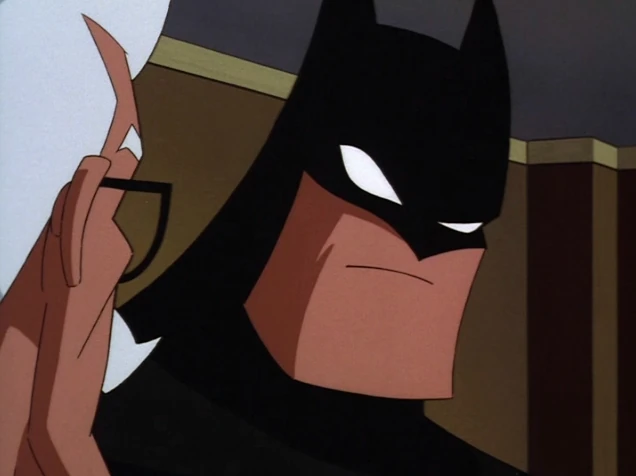
The New Batman Adventures - "Critters"

“That’s a lot of bull.”

A year after a court order banned him from using experimental steroids on his livestock, Farmer Brown (Peter Breck) returns to Gotham with his daughter Emmylou (Dina Sherman) to unleash their latest breed of monsters. Waves of critters stomp their way through the city, with the Bat-family stumped as to their motives or how to defeat them.

“Critters” has a broad reputation as one of the worst episodes of the Batman animated project, and so I won’t bury the headline here – it’s in my bottom five. I don’t like it; it’s off-putting and uninspiring, weird for the sake of being weird, and its creators have proven themselves capable of better (Steve Gerber has a delightful range of absurdist comics to his name, while Joe R. Lansdale gave us “Perchance to Dream”). While I’ve said in the past that Batman’s greatest strength is that he is genre-bulletproof, this isn’t a story that serves him well, struggling to find a place for his skill set in a tale that feels in part like an unproduced episode of Batman ’66

Perhaps more appropriately, “Critters” feels more like an episode of Superman: The Animated Series, with oversized monsters inspired by Jack Kirby and an emphasis on fisticuffs over conventional detective work. At the risk of drawing a line in the sand, Superman always seemed to prioritize action over story, a natural extension when your main character’s big thing is punching stuff. I felt acutely that the show never quite captured the key fact that Superman’s greatest superpower is that he always knows what the right thing is, resorting instead to finding behemoths and baddies for him to devastate with his fists. (It got some things right, of course, Lex Luthor among them, but that’s perhaps a story for another review series.) Batman, on the other hand, always seemed to be about something other than the fighting – there was a purpose, a quest to be fulfilled, a metaphor to be made. “Critters,” on the other hand, is comparatively wordless, pausing instead for visual gags like an oversized bull crashing into a china shop (yes, yes, rimshot). We saw him fight a dinosaur last week, but this is precisely what I meant when I said, “It’s not the sort of wild flight of fancy that the show should have indulged too frequently.”

And as if to emphasize that Batman’s fallen headlong into the wrong episode, he spends a good deal of time flying – yes, flying – in what feels like a vaguely toyetic Bat-hang-glider. (Yes, I’ve checked, and yes Virginia, there was a “Knight Glider” action figure.) To make matters more disorienting, the episode’s third act sees Batman duke it out in Farmer Brown’s underground bunker, which isn’t of itself a locale ill-suited to our Dark Knight, but it’s a bunker that’s dolled up to look like a sunny Midwestern prairie, which is particularly unforgiving toward the two-dimensional redesign of Batman and his Bat-family. They pass for perfect amid a red night sky, but in the stark (artificial) daylight they’re not especially robust.

If there’s one saving grace in the episode, it’s that the writers know exactly how preposterous the premise can be, and they run headlong toward that territory. If you had any doubts about the episode’s sincerity, the moment when a talking goat delivers a ransom message (with the stipulation, “No Baaaaaaa-tman”) to Commissioner Gordon ought to assuage those jangled nerves. But for the moment when we see our storytellers have their fingers crossed behind their backs, it comes entirely too late, long after the episode lost me. And the conclusion of “Critters” makes the fatal error of reminding me of “Tyger, Tyger,” another mad science-gone-wrong episode with a lackluster villain, except this one is empirically dull and never even gives Kevin Conroy a slice of poetry to recite.

Original Air Date: September 18, 1998

Writers: Steve Gerber and Joe R. Lansdale

Director: Dan Riba

Villains: Farmer Brown (Peter Breck) and Emmylou Brown (Dina Sherman)

Next episode: “Cult of the Cat,” in which the show hits 100 and closes the catflap.

🦇For the full list of The New Batman Adventures reviews, click here.🦇

Wednesday, October 24, 2018

The New Batman Adventures - "Mean Seasons"

“Another season, another reason... for making trouble.”

Meet the Calendar Girl (Sela Ward), who debuts a new festive outfit every time she abducts a top Gotham citizen, leaving behind a torn page from a calendar. It’s Batgirl who pieces together the pattern – that Calendar Girl is Page Monroe, a model whose contracts ran out once she turned thirty. With Calendar Girl collecting the hostages she blames for her downfall, Batman and Batgirl have to guess her next move before the abductions become murders.

“Mean Seasons” is a quick one-and-done, a gender flip of a comics villain (Calendar Man) that ends up being lightly topical in the same vein as “Torch Song” a few weeks ago. Calendar Man began life as a sort of joke character, wearing an oversized calendar and theming his crimes around various holidays; over time, the character has gotten much more sinister, dropping the theatricality and becoming a contemplative Hannibal Lecter type (cf. The Long Halloween and the Arkham videogames). Calendar Girl, on the other hand, is less menacing and more mentally ill, believing herself to be disfigured by her age.

Calendar Girl is particularly relevant today of all days, considering that Jamie Lee Curtis just this weekend posted the biggest movie opening with a female lead over 55 with her Halloween reboot/sequel, an important (and belated) defiance of this episode’s position that the entertainment industries unfairly discriminate on the basis of age. It puts “Mean Seasons” in an odd dialogue, too, with “Baby-Doll” as an episode that covers a pretty obvious point about show business on a cartoon that has no real business exploring that particular topic, and it makes me wonder how Calendar Girl and Baby-Doll might have fared in a team-up (a Harley and Ivy for the red carpet crowd?). Sidebar: why might so many of the also-ran animated Bat-villains have fared better with Baby-Doll than on their own?

I say it’s odd terrain for this episode to tread because of the curious way it bends Batman himself to accommodate the plot. First, the episode establishes Batman as a casual misogynist – he observes passingly, “Pretty girl,” before Batgirl gives him a note-perfect clapback. In doing so, however, she opens the question of just how old Batman is supposed to be: “Don’t you mean woman? She was your age when she made that commercial, Bat Boy.” But if Monroe was forced out of the industry at thirty, she had to be younger in the commercial, which means Batman himself can’t be older than thirty. It’s a silly argument to begin to have – Grant Morrison has handwaved the question by saying Batman is (currently) 79 – but it’s a sign of the episode’s slipping engagement and needless focus that I had time to be distracted by this issue. Recall, however, that Batman is far from misogyny – he is, as we learned in “The Cat and the Claw,” “an equal opportunity crimefighter.”

But “Mean Seasons” does two things really well, one of which is to give Batgirl a pivotal scene as a detective. Where “The Ultimate Thrill” presupposed Batman’s detective skill as a matter of course, we get to see Batgirl do the hard work of trolling through the Bat-computer (speaking of whom, remember the good old days when Batman would spend long hours clicking through evidence?). It’s a neat wink to Barbara Gordon’s legacy as Oracle, DC’s hacker guru for most of my life (itself a fun update on her background as a library scientist), and it gives her something better to do than flirt with Bruce Wayne.

Finally, the other thing “Mean Seasons” has going for it is that it finds a way for a dinosaur to attack Batman and Batgirl (is Robin still on this show?). It’s an action setpiece that would probably be more at home over on Superman: The Animated Series, with the main villain stepping away from the plot in order to let this sequence play out, but there is something undeniably cool about seeing the two Bats take on a (robot) dinosaur and use their wits to defeat it. It’s not the sort of wild flight of fancy that the show should have indulged too frequently, but it’s a great primal treat for those of us who had a wide assortment in our own toyboxes.

Original Air Date: May 4, 1998

Writers: Rich Fogel and Hilary J. Bader

Director: Hiroyuki Aoyama

Villain: Calendar Girl (Sela Ward)

Next episode: “Critters,” in which we see if this really is the worst episode of the DCAU.

🦇For the full list of The New Batman Adventures reviews, click here.🦇

Wednesday, October 17, 2018

The New Batman Adventures - "Over the Edge"

“Ten minutes on Barbara’s computer told me everything. Like a fool, I allowed you to run wild on your private crusade. A psychotic misfit playing masked hero. Now I’ve paid for it with Barbara’s life.”

Not since the likes of “Perchance to Dream” have I had to toss up a spoiler warning this big, but “Over the Edge” is one of the greatest episodes of The New Batman Adventures and indeed of the entire Batman animated project because of how fearlessly Paul Dini breaks all the rules and yet manages to put all the toys back without feeling like a cop-out. It’s an episode akin to a long chain of dominoes, toppling over in logical succession but with profoundly destructive influence.

This episode starts with a bang as Commissioner Gordon pursues Batman and Robin through the Batcave, firing a hail of bullets after them. He calls for their surrender, revealing that he knows their secret identities. All of Gotham has turned against the Dark Knight, and Batman recounts to Nightwing how it all went wrong, beginning on a night when the Scarecrow broke loose, haunted Gotham – and killed Batgirl.

And yet, it’s all a dream, the ultimate fake-out ending when it’s revealed that the entire episode has been one long nightmare inside Batgirl’s mind as she exorcises Scarecrow’s fear toxin from her body. This is an imaginary story, Alan Moore might say, but aren’t they all? In the hands of any writer less talented, it’d feel like an insult, a waste of an episode, but Dini takes the opportunity to say something new and otherwise impossible about the Bat-mythos and the family relationships that hold it together. Where The New Batman Adventures has struggled to give us a non-dysfunctional Bat-family, leave it to Paul Dini to give us a story of two fathers – Jim Gordon and Bruce Wayne – both blaming themselves (and both blaming Batman, too) for Barbara Gordon’s demise. If you’re anything like me, and you care more about Batman than most real people, this episode is a real tearjerker because of how tangible Dini makes the family dynamics feel.

It’s heart-wrenchingly believable to imagine that Barbara’s death would drive her father to investigate, finally, Batman’s secret identity, and that furthermore his rage would lead him to try to destroy his one-time friend. Bruce’s sad defense, that “the only way I could hold on to my sanity was to take matters into my own hands,” is a moment of pure pathos until Gordon replies bitterly, “That makes us even.” It’s a sobering reminder that the real power of the Batman myth is that it’s the story of one man’s efforts to heal himself by healing others, by expelling any internalized grief and manifesting it into something productive; without that impulse to save, we get something like this episode’s Gordon, a sad shell of a man who wants to eradicate his own loss by exploding it out onto others. (There’s a third father in play, of course – Alfred Pennyworth, who sacrifices his freedom to ensure that his charges can escape the police. The episode doesn’t dwell on him, for Dini is careful not to overplay this moment of quiet, selfless heroism, but his inclusion is not accidental.)

And because it’s a Paul Dini episode, the man jams as many villains as he can into the plot – six, by my count, including new redesigns for Riddler, Mad Hatter, and Bane. The talk show appearance of four villains protesting Batman’s unfair vigilantism is classic Dini, head-scratchingly funny and yet entirely plausible that this blend of nutcases would find this avenue of deluded self-justification. “We were helpless, lost souls crying out for understanding,” laments the Mad Hatter as Harley Quinn sobs about the nightmares she endures because of Batman. The idea of a television audience sympathetic to the villains isn’t quite new to Batman – Frank Miller did it in The Dark Knight Returns twelve years earlier – but its execution here is quintessential Dini humor. While the Scarecrow’s appearance in this episode is fairly brief, it’s Bane who emerges as a figure of pure terror, first a warped weapon of Gordon’s fractured psyche before revealing himself as the self-serving mastermind brute from the source material. He works better here than he did in his debut because he’s allowed to serve his own goals, even in spite of working as a gun for hire, a mercenary in the service of Gordon’s pain.

It’s an episode littered with heartbreak and grief, in big moments and small. The beat where a broken Gordon, dangling from the GCPD rooftop, bites back tears and accepts Batman’s hand is a quiet emotional scorcher, but the episode’s most powerful moment comes in the real world, when Barbara tries to admit her secret identity to her father (having already received the tacit permission of her Bat-father). I just want to quote the Commissioner’s response, because it’s damned beautiful, aided by the underrated Bob Hastings in the role that will always be the voice I hear in my head when I read a Gordon story:
Sweetheart, you’re capable of making your own decisions. You don’t need me to approve or even acknowledge them. And in this case, I can’t. All you need to know is I love you. All of you. (kiss) And that is all I have to say on the subject.
The whole episode, we learn, is borne out of Barbara’s deep-rooted fear that her secrets will destroy her families, so this quiet revelation – that Gordon both knows about her alter ego and is protecting them both by not admitting it – is a masterclass in concise writing, resolving the episode’s central conflict for maximum emotional effect. Again, Dini has found a way to take an imaginary story and give its revelations significant weight in the “real” world of the story. Moreover, he manages to craft an episode in which the bad guys, despite being largely imaginary, nevertheless do not win; the fears that crippled Barbara prove both unfounded and insufficient. Both her fathers are always already on her side, wanting what’s best for her despite any jeopardy it might create for them. It’s a love much stronger than whatever romantic relationship The New Batman Adventures has been trying to generate between Bruce and Barbara, and as a result it’s one of the best episodes of what has been an odd and uneven run.

Original Air Date: May 23, 1998

Writer: Paul Dini

Director: Yuichiro Yano

Villains: The Scarecrow (Jeff Bennett) and Bane (Henry Silva)

Next episode: “Mean Seasons,” in which Gotham doesn’t love its little calendar girl.

🦇For the full list of The New Batman Adventures reviews, click here.🦇

Monday, October 15, 2018

First Man (2018)

At the risk of opening myself up to relitigating 2016, it was the year Damien Chazelle demanded I take him seriously with La La Land, a beautiful film which I perhaps overhastily dubbed “best of 2016” (though then-runner-up Batman v Superman: Dawn of Justice has only risen in my estimations). He had physically rattled me with Whiplash, one of the only movies to leave me visibly shaking, but La La Land was something else entirely, revelatory and emotional, resonant and instant Personal Canon material. With First Man, a movie at once quite different and yet of a piece with his oeuvre, Damien Chazelle three-peats and earns himself a spot on my “worth a look” list.

Ryan Gosling stars as Neil Armstrong, the aforementioned “first man” on the moon in this biopic that begins with his application to NASA and culminates (spoilers?) with his walk on the moon. Claire Foy co-stars as his wife Janet, the emotional center of the film amid her husband’s obdurate refusal to acknowledge that his missions are increasingly dangerous.

As a true story, First Man is quite different from Whiplash and La La Land, and though it continues Chazelle’s exploration of the sacrifices necessary to achieve greatness, it puts the audience in the interesting position of knowing that Neil Armstrong does indeed succeed; we didn’t know if Andrew, Mia, or Sebastian would achieve their goals, which added a tension to those stories (and a heartbreak if the costs ever outweighed the results). With First Man, we know where this is going, which lets Chazelle and screenwriter Josh Singer flip the script and examine the emotional toll of this achievement and the grave uncertainty that leads up to it. Here Foy is particularly riveting, playing opposite a veritable cipher in the form of Gosling; where Gosling bottles up every emotion he has, Foy proves unable – or more likely, unwilling – to curb those feelings when they are killing her. Gosling, meanwhile, plays the portrait of restraint, single-minded focus with a twitchy flinch at the prospect of facing his fears. 

Also returning from La La Land is Justin Hurwitz on score duties, and I have to say it does show. There’s something about the way Hurwitz organizes a melody and a musical refrain that recalls the sweeping score of 2016’s top musical. New to Hurwitz’s repertoire is the theremin, underappreciated and right at home in a science-fiction movie (this being, of course, nonfiction); invoking the score from The Day the Earth Stood Still is never a bad idea, and hearing the theremin build up to the moon landing sequence proves highly effective. 

Equally (and perhaps more) successful is the way the film drops out most of the audio during the moon landing. There’s been much ballyhoo about “needing” to see the film in IMAX, and I’ll certainly agree that it’s a standout feature when the aspect ratio opens up and the film goes dead silent – I’ve never seen a theater audience that respectful of silence. Emphasizing that the only things on the moon with Neil are what he brings up with him, the score focuses on a swirling martial beat, John Barry by way of Hans Zimmer (or is it the other way around?), before ceding to the majesty of the lunar surface. It’s a breathtaking sequence, worth the price of admission even in spite of the fact that we know he’s going to stick the landing – Hurwitz and Chazelle give a real powerhouse of a moment.

The film ends on a much quieter note – I won’t spoil it, because the film does go beyond the moon landing just a bit. The silent closing sequence is tremendously powerful, even after the bombastic scope of the moon; it’s a potent scene between two performers who should earn Oscar nominations on those facial expressions alone. Whiplash left me shaken, and La La Land left me sobbing; First Man is somewhere closer to the latter end of the spectrum, but softer, less painful by far. It’s a poetic conclusion to a movie with a surprising emotional core, but then Chazelle has hit me with more than his fair share of sentimental sucker punches. Three in a row, at least, guarantees I’ll be in attendance for whatever he tries next.

First Man is rated PG-13 for “some thematic content involving peril, and brief strong language.” Directed by Damien Chazelle. Written by Josh Singer. Based on the book by James R. Hansen. Starring Ryan Gosling, Claire Foy, Corey Stoll, Jason Clarke, Kyle Chandler, and Ciaran Hinds.

Wednesday, October 10, 2018

The New Batman Adventures - "The Ultimate Thrill"

“I know he lives for the chase, and I was the best he ever had.”

A new thief in Gotham makes her mark after a daring zeppelin robbery and an airborne getaway. Batman recognizes Roxy Rocket (Charity James) as adrenaline junkie stuntwoman Roxanne Sutton. Recognizing that Roxy will need a fence for her ill-gotten gains – but not knowing she’s in cahoots with The Penguin (Paul Williams), Batman and Batgirl take to the streets, while Roxy hits the skies.

Roxy Rocket is a curious addition to the Bat-mythos because of her winding entry into the material. She began life in a Paul Dini/Bruce Timm issue of the tie-in comic The Batman Adventures (a series I can’t recommend enough) before wending her way onto The New Batman Adventures four years later. And though neither Dini nor Timm has a direct credited hand in this episode, “The Ultimate Thrill” has Timm written all over it. The image of Roxy enthusiastically straddling a transparently phallic rocket is a particularly Timm brand of cheesecake, leavened with a dose of Dave Stevens’s postwar pin-up style. Indeed, as Batman episodes go, this one is comparatively oversexed, right down to Roxy’s downright orgasmic reaction to the possibility of sudden death in a game of chicken with Batman.

With the above proviso, then, as the first “new” villain created “for” The New Batman Adventures, Roxy Rocket is a pretty fun addition to the catalog, and it’s a shame the comics haven’t drawn on her more. As something of a cinema buff myself, it’s no surprise that I found Roxy’s showbiz background highly engaging, and I immediately wondered what might happen if she had worked on one of Matt Hagen’s movies before the accident that made him Clayface. Moreover, the idea that she’s motivated by an addiction to adrenaline is something of a novel concept for a Bat-villain, who are generally driven by the fact that they’re plain-and-simple nuts. She’s Harley Quinn without the delusion, Poison Ivy with a sense of humor, and Baby-Doll without the burden of trauma. Best of all, she’s fun, which is sadly not a word I’ve used much in the frequently dour New Batman Adventures

This episode also finds a niche for Penguin to fill. Despite appearing in several episodes as an ostensibly aboveboard nightclub owner, he’s always had a whiff of incorrigibility about him. Here, we see in full his continued devotion to a life of crime as a discreet fence for Roxy’s stolen goods. Paul Williams shines as Penguin, maintaining his aristocratic air even as he ogles the jewels – and their thief, dubbing her a “felonious falcon” before asking if she’s “ever been pursued by a bird of prey.” And the interrogation sequence between Penguin and Batman is solid gold, treating the Bat as an unstoppable creature of the night while Penguin braces himself against the limitations of due process. It’s the kind of scene that illustrates why Penguin works better when he’s pretending to be legitimate – so Batman has someone to throw around a room until he gets the information he needs.

This episode feels a lot like a throwback to The Animated Series because of its direct and self-contained nature, but it’s also a key moment when Batman doesn’t rely on any other members of the Bat-family. Aside from a payphone call from Batgirl, Batman’s riding solo, up to and including the moment when he instantly recognizes Roxy as Roxanne Sutton and rattles off her backstory as a matter of course; it’s either lazy writing or quintessential Batman to have all this information right at his fingertips. (No, it’s definitely the latter.) For as much as the show fumbles the relationships within the Bat-family – Nightwing and Robin are needlessly angsty, while Batgirl is uncomfortably flirtatious with her ersatz father figure – it recognizes that Batman is a polished crime-fighting machine who, despite needing a family to keep him human, works most efficiently on his own. (It’s perhaps not a coincidence that, between my two Top Ten lists, only three episodes involved Robin.) Roxy, meanwhile, represents a temptation to stray on the dark side, to join her in a romantically charged game of cat-and-mouse; unfortunately for her, this Bat’s already chasing a Cat.

Original Air Date: September 14, 1998

Writer: Hilary J. Bader

Director: Dan Riba

Villains: Roxy Rocket (Charity James) and The Penguin (Paul Williams)

Next episode: “Over the Edge,” in which a bat falls, and life is but a dream.

🦇For the full list of The New Batman Adventures reviews, click here.🦇

Monday, October 8, 2018

Venom (2018)

I’ll not bury the lead here: guys, Venom is fine. It’s a movie about Tom Hardy and his relationship with his weird voice, personified by a giant blob monster that wants to make as much of a mess as he can. The movie is clunky and basic, but it knows that it’s not going to change the world. Even though it feels at times overlong, it doesn’t overstay its welcome. Put another way, it’s fun enough that I don’t begrudge it the $6 I paid to see it.

Hardy stars as Eddie Brock, an investigative reporter with a chip on his shoulder. Assigned to a puff piece on one-percenter Carlton Drake (Riz Ahmed), Eddie discovers that Drake’s Life Foundation is preying on vulnerable members of society for shady experimental tests. One such test involves Drake’s acquisition of several symbiotes, gooey space aliens that bond with other lifeforms – and soon one bonds with Eddie, transforming him into the hulking Venom.

The principal thing to get out of the way is that this isn’t a Spider-Man film, and that’s upset a lot of people. But here’s my hot take – I don’t think that Spider-Man would actually fix anything that’s wrong with the film, and anyone who thinks otherwise is actually still sore over the third act of Spider-Man 3 eleven (yes, eleven) years ago. The trouble with putting Spider-Man and Venom in a movie together is that it’s a lot of ground to cover; you’ve got to do Spider-Man’s black costume, Spidey ditching the suit, and Eddie Brock becoming Venom first as a villain before somewhat reforming. But wait, you say, this is why God (or Stan Lee) invented a shared universe, to make this story over the course of a few films! To which I reply, yes, but who has the patience to see that story again, only this time spread out across several years? No, better to try something new, and since superheroes are our modern mythology it’s perfectly fine to reinterpret them every once in a while and try something new.

The first act, as I mentioned above, is somewhat heavyhanded. It’s full of characters who speak their motivation rather than show us, with a villain who’s only evil because he’s evil and rich. Academy Award nominee Michelle Williams, who’s all but admitted she turned up for the paycheck, has very little to do as Brock’s fiancée, a kind of obligatory character who reminds one of the narratively inert love interests from late-90s Batman movies. Indeed, her most interesting scene is quickly brushed aside, in a way that feels very much like the film saying, “No, no, a final setpiece is no place for a lady.” In that vein, the film sweats at each turn in the story, baldly showing the effort needed to pivot from one plotline to the next. Once the film establishes what Drake is up to, for example, it quickly swerves by having one character explain that, actually, never mind, what’s he’s really doing is something more sinister, which requires a bigger setpiece to resolve.

The seams on the film are so readily apparent that it’s a marvel the film works at all. However, what it stitches together is actually quite interesting, governed by the most watchably peculiar performance from Tom Hardy whose dialogue, in a rare departure for Hardy, is rather easy to understand. Hardy makes the peculiar choice to play Eddie Brock like a folksy huckster of a reporter, distracted and fidgety; his Venom voice, on the other hand, is classic Hardy, all snarls and grunts with more digital filter than a Daft Punk greatest hits album. This dichotomy, with Hardy playing both to his strength and at once wildly against type, is riveting, and while most of the movie seems to be phoning it in, Hardy is singlehandedly making the best case for more movies in a Venom Cinematic Universe.

So too is a wildly optimistic mid-credits sequence – optimistic in its swing-for-the-bleachers bid for a sequel co-starring a real surprise. No spoilers, but it’s a moment that led at least one man in my audience to holler incredulously, “Wait, is that [name redacted]?!” But it’s emblematic of the movie writ large – nuts and silly and a little ill-advised, but wholly confident and earnest in a way that I think resonated with $80 million or so worth of moviegoers this weekend. It’s a throwback to a simpler era of comic book movies, which ended without the necessity of a sequel to build the narrative world. Even the Eminem track that plays over the credits, written especially for this movie, feels like a relic of a bygone era. But I won’t deny that the clunky first act reminded me a lot of the equally unwieldy first act of Ant-Man, which ended up being a sleeper hit. I won’t say that Venom is as objectively good as Ant-Man, and I can’t say that I’m in a terrific hurry to see it again, but it’s at least as fun as a pint-sized Ant-Man.

Venom is rated PG-13 for “intense sequences of sci-fi violence and action, and for language.” Directed by Ruben Fleischer. Written by Jeff Pinkner, Scott Rosenberg, and Kelly Marcel. Based on the Marvel Comics by Todd McFarlane and David Michelinie. Starring Tom Hardy, Michelle Williams, Riz Ahmed, Scott Haze, Reid Scott, and Jenny Slate.

Wednesday, October 3, 2018

The New Batman Adventures - "Torch Song"

“Hey, you’re the expert on burning people, you little tramp. And if you think I’m going to step aside like one of your pretty boys—”

Bruce Wayne is in the front row of a Cassidy concert when the singer (Karla DeVito) is attacked by her jilted pyrotechnician Garfield Lynns (Mark Rolston). Lynns’s obsession runs deep, driving him into pyromania as Gotham’s latest rogue, Firefly. Batman and Batgirl shadow Cassidy, fearing that her old flame will turn up the heat on his pursuit.

For those playing the home game, this is the tenth episode of twenty-four on The New Batman Adventures, but it’s only the first time that the show has introduced a new villain from the comics, instead revisiting familiar faces from Batman: The Animated Series. (Next week, we’ll meet a villain created, mostly, for the show. Stay tuned!) I’ve lost count, however, on the different iterations of Firefly that have existed since his debut in 1952; Wikipedia tells me three, but that seems low, even just considering his variable appearances in video games and television shows. Indeed, I’d hazard an unsubstantiated guess that Firefly has had more costume changes than most other Bat-rogues (aside, perhaps, from Two-Face, who can rock a mean half-tartan when he needs). 

Here, Firefly has a pretty slick look, encased in silver with giant red bug-eyes. With his sleek wings sweeping behind his back and a subtle antenna atop his head, he almost looks like a twisted inversion of Batman – which is always good territory for a villain to inhabit. In fact, can we take a moment to acknowledge how good this episode looks overall? As much as fans tend to dunk on TNBA for its stripped-down animation style, this is one of the better episodes, visually speaking; it’s set almost entirely at night, so the blacks and reds really pop. What’s more, the fire sequences are pretty intense, often stripping away the colors to give everything a sepia tone, giving Batman a real otherworldly appearance (another Bat-plus). Finally, we also get a new Batsuit, a flame-retardant black number that looks so crisply toyetic that I’d swear I had this in my box of action figures. (Merchandise spotlight: It seems, however, that one was made only recently.)

In terms of the narrative, I was more than a little surprised at how topical this episode is. I was struck, recall, at the vaguely Trumpean analogues in “Lock-Up” (the last time, incidentally, the show debuted a villain into its repertoire), but here Firefly presents as the poster villain for the #MeToo era, a hulking he-man who won’t take “no” for an answer, treats women as objects to be ogled and possessed, and will pursue Cassidy even if it means quite literally burning the entire city to the ground. He is weirdly fixated on the way she dresses and alternates manically between wanting to kill her and trying to abduct her. He’s not a foaming caricature, but this episode manages to take a costume that is slightly derpy and turn it into something rather terrifying when we consider the motives and mindset of the man inside the suit.

However, “Torch Song” shoots itself in the foot by – and I know I sound like a broken record here – weaving in what appears to be romantic jealousy leavened in the relationship between Bruce Wayne and Barbara Gordon. Perhaps this is just a natural outgrowth of living in a post-Killing Joke world, but there’s something less than innocent in the moments Bruce and Barbara share at the concert, where she’s almost put out that he’s with another woman – and where he seems to long to be with her instead. (Never mind his condescending “Good girl!” when Batgirl initially saves Cassidy.) And if you think I’m reading too much into this, consider the moment when Bruce asks Barbara, in an unnecessarily flirtatious line-reading from Kevin Conroy, “What are you doing tonight?” Barbara fobs it off with a rather clever reference to Pinky and the Brain – “Same thing we do every night, Pinky” – but I can’t be the only one in the room who reads their dynamic duet as something shellacked over with amorous intent. It makes me want to vomit.

I’m also unclear why the episode ends with a sadistic epilogue that seems to punish Cassidy, of all people. In a coda that feels largely plagiarized from Stephen King’s Misery (or, at least, the Rob Reiner film version from 1990), we see that Cassidy is unable to carry on with a normal life because her encounters with Firefly have virtually crippled her with pyrophobia. As compelling as the episode’s rejection of toxic masculinity began, it’s a bizarre (if sadly plausible) finale to see the woman bearing the sole emotional pain of the story. One could imagine instead the grim irony of learning that Firefly has been covered in burn scars, or that he’s fixated by a flickering candle just out of reach. Or maybe he teams up with Killer Moth and the two of them just fly into a giant light bulb. Put another way, of all the people on whom the episode could have the last laugh, why choose the victim?

I’m relitigating, however, two of about twenty minutes in an otherwise solid episode. Just when it seemed that the show was satisfied to retread its own content, revisiting ground it had already paved, “Torch Song” is a different kind of return to form – a classical story introducing a new villain with a believable (if broadly unsympathetic) motivation. It’s a good opportunity for the animators to strut their stuff, and – romance aside – it continues the good trend of Batman and Batgirl as mature crime-fighting partners. We could ask for little more from a solid middle-of-the-road episode.

Original Air Date: June 13, 1998

Writer: Rich Fogel

Director: Curt Geda

Villain: Firefly (Mark Rolston)

Next episode: “The Ultimate Thrill,” in which it’s neither a bird nor a plane, but she is a new Bat-villain.

🦇For the full list of The New Batman Adventures reviews, click here.🦇

Wednesday, September 26, 2018

The New Batman Adventures - "Love is a Croc"

“What do you suppose they do on a date?”

Her reform efforts hindered by an unforgiving public, Mary Louise Dahl (Laraine Newman) watches the televised trial of Killer Croc (Brooks Gardner) and feels a pang of empathy for a man persecuted for his appearance. Donning her Baby-Doll regalia, she stages a breakout and retreats to the sewers with her new paramour. As they become Gotham’s Bonnie & Clyde, their crimes draw out Batman and Batgirl, while Croc’s uglier impulses start to overcome Baby-Doll’s more amorous ones.

As much as I didn’t enjoy “Baby-Doll” (clouding, recall, my memory of the quite decent third act), I’m not sure I’ve ever rewatched this episode. On the surface, it seems like this would put Baby-Doll at two for two in terms of dud episodes, but I found myself really digging “Love is a Croc” much more than I thought it was. It’s still somewhat off-putting and doesn’t quite sell me on Baby-Doll as a character, but writer Steve Gerber (who created Howard the Duck, among others) does well to take the focus away from Baby-Doll’s condition and emphasize instead that she’s a psychopath who just happens to be short. Her obsession with her appearance does, however, give her the unlikely yet narratively successful obsession with Croc, assuming he feels as she does – and missing, tragically, the fact that his “poor me” routine was a ploy for sympathy from the court. 

Here’s an episode that works really well in isolation, but it crumbles a bit if we think about it in the larger context of the show. You’ve got Baby-Doll, who acquits herself rather well in this episode, but it’s tough to buy that she’s reformed to the point where she can manage a motel – particularly in Gotham, where rehabilitation seems to be a dirty word within the walls of Arkham. (Sidebar: how did Paul Dini never write an episode where Harley Quinn tries to adopt Baby-Doll, much to Poison Ivy’s incredulity?) Furthermore, Killer Croc’s brutish disinterest in his monstrous appearance is at direct odds with his role in “Sideshow,” where his embrace of monstrosity was tempered by his own sense of tragedy at the same. Here, Croc loses that depth and becomes uninterestingly thuggish, a dispiriting decline for a character who had one of the more surprising emotional arcs on the show.

In terms of the redesign, it’s a wash for this episode. Baby-Doll’s redesign is more angular and helpfully strips her of the Looney Tunes cuteness that saddled her character in her debut; Laraine Newman replaces Alison LaPlaca, but her voice is so close that I didn’t notice until the credits rolled. For Killer Croc, though, the redesign scraps his gray scales for a dark green and more reptilian appearance, but the shading on his green skin is so dark that he fades into the background in many scenes. Worse yet, Aron Kincaid has been replaced by Brooks Gardner, who doesn’t do anything interesting with Croc’s snarls or grunts. I’m sure that my attachment to Kincaid stems from his unmistakable delivery of the line, “I threw a rock at him!” (which I should hope is not unreasonable for anyone following this series), but for a Croc-centric episode, Gardner isn’t really bringing much to the table to replace the character-laden Kincaid. Gardner’s Croc does, however, seem to prefigure the “Pimp Croc” of the comic Broken City (which, in turn, inspired the Academy Award-winning Suicide Squad).

Robin and Nightwing are nowhere to be seen in this episode, giving time instead to the Batman/Batgirl team-up that has been a consistent selling point for The New Batman Adventures. In an episode as littered with sexual tension as this one, there’s an uncomfortable note in knowing that Bruce Timm has been guiding Batman and Batgirl together in a romantic way (which will always, until the end of time, be a gross misreading of the relationship, in every sense of the word “gross”). Granted, the Timmverse romance only gets as explicit as transparent flirtation in Mystery of the Batwoman – setting aside, as we all should, the first forty minutes of The Killing Joke  – and thankfully here Batgirl plays the role of maturing teenager, joking about a villainous date night and maternally recommending a good spanking for Baby-Doll. It’s that spirit that has made Batgirl such an endearing member of the cast, and Tara Strong is doing definitive work in the role.

“Love is a Croc” is simultaneously the better Baby-Doll episode and the worst Killer Croc episode. It’s an odd story with a curious emotional center, defying resolution and sidelining its ostensible heroes in favor of an oddball romance between two misfit felons. But what else might we have expected from a writer who created a cigar-chomping pantsless duck? It’s rare for anyone to show up Paul Dini, but I almost think Gerber has gotten closer than anyone by halfway redeeming Baby-Doll.

Original Air Date: July 11, 1998

Writer: Steve Gerber

Director: Butch Lukic

Villains: Baby-Doll (Laraine Newman) and Killer Croc (Brooks Gardner)

Next episode: “Torch Song,” in which the star that burns brightest burns fastest.

🦇For the full list of The New Batman Adventures reviews, click here.🦇

Monday, September 24, 2018

Monday at the Movies - September 24, 2018

Welcome to another installment of “Monday at the Movies.” This week, a film which gives lie to the old expression about how the sausage is made.

All the Money in the World (2017)– A year or so from its release, it is a shame that the most interesting – and distracting – thing about All the Money in the World remains the ballyhoo surrounding the replacement of Kevin Spacey with Christopher Plummer in the role of billionaire J. Paul Getty. It’s unfortunate because the film is otherwise quite fine, neither a triumphant masterpiece nor a mordant trainwreck, but in every scene with Plummer there’s a macabre curiosity about what Spacey, beneath mountains of Gumby makeup, had done with the part, whether we’ll ever see any of the footage that necessitated the speedy and expensive reshoots. Plummer is doing masterful work, as he always does, and I have no doubt that he gave a more engaging performance than Spacey, who was exceedingly distracting in the prosthetics-laden trailers. Michelle Williams, as the mother of the abducted Getty grandson, is equally compelling, heartbreaking in the frustration we share with her at the immovable object of Plummer’s Getty. Mark Wahlberg, however, is disruptively miscast as the CIA operative turned Getty advisor Fletcher Chace; Wahlberg plays Chace like a scrappy everyman, albeit without the sobered gravitas needed to believe that this man is dangerous and capable of anything. (One almost expects him to tell an OPEC sheik, apropos of Andy Samberg, “Say hi to your mother for me.”) But the suspense of the film, a true story, falls somewhat tepid with knowledge of how the facts turned out, and the continual reminder of the film’s tumultuous gestation gets in the way of two very solid performances. Then again, I would much rather director Ridley Scott make films like this instead of persist in reinscribing the Alien mythos to the point of murky exposition (after Prometheus, I’ve still not hauled myself in front of Alien: Covenant, and I consider the prospect leavened with dread.)

That does it for this week’s edition of “Monday at the Movies.” We’ll see you next week!

Wednesday, September 19, 2018

The New Batman Adventures - "Growing Pains"

“It’s not you. I have to keep moving. There’s a man after me.”

After Robin saves a young girl (Francesca Marie Smith) from a street gang, he learns that her identity is something of a mystery. She doesn’t know her name – Robin dubs her “Annie” until they can learn more – and all she remembers is that she’s being pursued by a frightening man. Meanwhile, Batman’s investigation into a violent robbery intersects with Robin’s case when the heroes realize that this new robber is the man shadowing Annie.

Paul Dini gets a story credit on this episode, but I don’t feel he must have done very much on this one beyond pitching the basic outline to Robert Goodman, who pulls solo duty as script writer. It seems there are a few really interesting ideas in this episode, but I don’t sense that they’re given full attention in a plot that meanders and fumfers around until Batman figures out what’s going on.

There’s a nugget of a really good idea in this episode – that Robin sees Annie as something of a kindred spirit because they have similar backgrounds. “My dad wasn’t much of a prize either,” he tells her in a surprisingly sober emotional moment. It’s the kind of key character detail that was lost in “Sins of the Father” when it could have formed the backbone of a “Robin’s Reckoning”-style episode. We certainly start to get a better handle on Tim Drake as an emotional Boy Wonder, perhaps governed more by his passions than Dick Grayson ever was. If he came off as bratty in his debut and more or less neutral in the episodes since, “Growing Pains” gives us a strong sense of Tim’s personality, his dedication to his moral center, and his willingness to butt heads with Batman (something we glimpsed, to great success, in “Never Fear”).

But the largely chaste budding romance between Robin and Annie is a bit, pardon the pun, muddied by the fact that she’s revealed to be – spoilers ahead – an amnesiac piece of Clayface, sent off into the world after the events of “Mudslide” to scope out whether the coast was clear. All along, this series has blurred the line when it comes to its villains being pure evil; most if not all of them have very sympathetic reasons for doing what they do, and most villains have recognizable goals coming from deep cores in their psyches. Clayface already had the subtlety from “Feat of Clay,” in which we saw his addiction to the Renuyu cream drive him into madness. I don’t think he’s any more sympathetic when we see him as a preadolescent girl of the streets, much less when Robin appears to fall in love with Annie. The whole thing becomes a little uncomfortable, and Robin’s reaction to Annie becomes somewhat comical when we know she’s made of mud.

To top it off, “Growing Pains” continues the uncomfortable evolution of Batman into a cranky and abortive father figure. He’s curt and abrasive with Tim, perhaps giving us a hint as to why Dick left (again, spoilers – that’s exactly why he left), and worse yet he’s largely uninterested in Annie until he learns that she’s part of Clayface. Poor Kevin Conroy is saddled with the line “I know who Daddy is,” which he delivers with his nonpareil gravitas, but the absurdity of the dialogue deflates the tension of a second-act commercial break. Alfred catches some plot shrapnel too, first reminding Batman that Tim is a child before reacting with horror to learn that Batman is doing the responsible thing by tracking his protégé’s movements. Either Bruce and Alfred have become the world’s worst father figures – which, in a real sense, Bruce usually is – or they’ve been bludgeoned by a plot so peculiar that they can’t help but be warped.

Indeed, in an episode littered with faltering fathers, there’s a joke, surprisingly unsuccessful in its execution, in which Commissioner Gordon calmly observes that he’s “Glad my Barbara’s past her wild years.” It’s a decent enough gag (even though I’ve always maintained that Gordon winks at his daughter’s cape-and-cowl discords), but Batman pulls the most surprised face you’ll ever see him make, the visual equivalent of a record scratch straight out of a trailer for a mid-1990s teen comedy. It’s one of many moments in the episode where I genuinely don’t know what tone Goodman and Dini were trying to set.

The episode’s coda, in which Batman grimly intones, “Sometimes there are no happy endings,” is a fitting end for a strange episode, capped off by Robin’s oddly stubborn insistence that Clayface murdered Annie. Maybe once puberty settles in, Robin will look at “Growing Pains” differently; he doesn’t seem to be thinking clearly, and Batman doesn’t seem to understand at all what his young ward is going through. Seeing as how Batman himself had a strange adolescence, deprived of a normal childhood with normal childhood interactions, you’d think he might have a little more compassion. It’s ultimately a misfire for the otherwise usually impeccable Paul Dini, but at least it’s an uncompromising swing for the fences. It also seems to be one of the more divisive episodes of the series – fans either love this one (Dustin Nguyen, a top Bat-artist, frequently tosses Annie into his crowd scenes) or they’re unsettled by it. Count me among the latter – the fantasy of Batman is that he’s the best surrogate father a young boy could want, not an emotionally stunted absentee patriarch. 

Original Air Date: February 28, 1998

Writers: Paul Dini and Robert Goodman

Director: Atsuko Tanaka

Villain: Clayface (Ron Perlman)

Next episode: “Love is a Croc,” in which Baby-Doll has her first big girl crush.

🦇For the full list of The New Batman Adventures reviews, click here.🦇