Monday, February 27, 2023

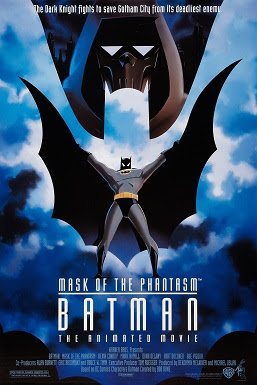
Batman: Mask of the Phantasm (1993)

“I need it to be different now. I know I made a promise, but I didn’t see this coming. I didn’t count on being happy.”
 
When I reviewed Batman: Mask of the Phantasm back in 2012, I said that it was “impossible” to compare it to The Dark Knight, finding Phantasm to be “quintessential.” Four years later, in my first expansion of my Personal Canon, Mask of the Phantasm made the cut – and yet I had said it was “imperfect... the resolution doesn’t quite hold up after repeat viewings.”
 
Reader, I was wrong. This review could have been so many things – an edition of “Take Two Tuesdays,” a continuation of my 2017-2019 reviews of Batman: The Animated Series, or part of my heretofore undeclared attempt to review every movie on the Personal Canon. Even before rereading my original review, I wanted to revisit Mask of the Phantasm because it deserved so much more than just 250 words in that “Monday at the Movies” format – especially on the occasion of its 30th anniversary this year. Whatever I was thinking in 2012, Phantasm has never truly let me down.
 
The Batman (Kevin Conroy) is a wanted man, wrongly accused of the murders of some of Gotham’s most notorious mobsters. Batman is hot on the trail of the real killer, The Phantasm (Stacy Keach), when an old flame returns to town – Andrea Beaumont (Dana Delany), whose past relationship with Bruce Wayne is explored in heartbreaking flashbacks, even as the plot marches inexorably toward a final confrontation with The Joker (Mark Hamill).
 
I always forget that Phantasm is as brief as it is. In the neighborhood of 75 minutes, it’s hard to find a film that hits all the bases like this one does: suspense, romance, comedy, heartbreak. Between dynamite action sequences and deeply human character work, Mask of the Phantasm includes no fewer than three origin stories across two timelines, telling an indelible and original story about Batman. It’s a tale that has cast its own shadow over Batman in the past thirty years, with fans constantly asking, “When will the Phantasm show up?” (The Phantasm appeared in Batman Beyond comics circa 2015 and in 2020’s Batman/Catwoman; over on film, we got a name-only tease in Batman v Superman, while the Phantasm is frequently name-checked in wishlists for the inevitable sequel to The Batman.)
 
Yet the reason I’ve never quite sounded the call for more Phantasm stories is because this one is perfect. The comics did a semi-sequel to the film in Batman & Robin Adventures, in an issue that could only be called “Shadow of the Phantasm.” While it’s a fun romp, it’s not indispensable, and it essentially leaves the characters in the same place where the film did: separated, exiled, and presumed dead. I’m being cagey about spoilers, even though the film is thirty years old and the action figure infamously unmasked the Phantasm just in time to disappoint kids on Christmas. My spoiler-phobia is largely due to my quasi-religious devotion to stories and the art of storytelling, but it’s also because the mystery isn’t entirely the point; if you know how tragedies work, you’ll plot this one out in short order.
 
Because the key to Phantasm isn’t that it’s a mystery; it’s a film noir about brooding avengers and the dark shadowy antiheroes who love them. It’s a tragedy about what happens when people let their pasts define them, but it’s also about the inescapability of the past, of chickens coming home to roost when it’s least convenient. Indeed, the past looms as large as the heavy tombstone on which the WAYNE family name is inscribed, and the real pain of the film is Bruce Wayne’s inability to escape that destiny he pledged for himself. “The way I see it,” Andrea snipes in one incisive moment, “the only one in this room controlled by his parents is you.”
 
Phantasm is somewhat unique for a Batman origin story in that we never see the murder of the Waynes, that random act of devastating violence that set Bruce Wayne on a course of dark vengeance. Instead, the film takes their loss as a given and sets the real origin story as a choice – Bruce Wayne chooses his vow over his own selfhood, and when he dons the cape and cowl for the first time, it’s not a moment of triumph. Alfred intones, “My God!” and recoils. The music swells, but even that refrain is sobered and pained. From that moment on, Bruce Wayne is the performance, a careless playboy charade who has to hide himself away from others lest they see through his façade.
 
The Phantasm, too, is a performance, reciting the ominous refrain, “Your angel of death awaits,” like some grim prophecy that explains everything. Outfitted with a theatrical costume and an insistence on dramatic violence, the Phantasm is wrestling with demons that have nothing to do with framing Batman for murder. Meanwhile, the mobsters – most notably Sal Valestra, voiced by Abe Vigoda – are stuck in their roles, playing out cheap imitations of The Godfather while their past catches up to them. The casting of Vigoda is inspired, mired in the genre’s past while playing on the arrested timelessness of Vigoda’s permanent old age.
 
Paradoxically, only The Joker is perfectly liberated. If you didn’t know he was in the movie, his first appearance reads like something out of a nightmare; the film takes a hard pivot and bends around his manic gravity. At first, the mobsters try to recruit Joker to protect them from Batman, but the incorrigible Joker can’t help but take over the plot for his own purposes, bumping off as many gangsters as The Phantasm does. He even seems to grasp the cruel irony of the film’s finale, laughing with gleeful abandon as he, Batman, and The Phantasm stare down certain death. Indeed, throughout Joker plays the Shakespearean fool, commenting on the coincidences of the plot, calling out red herrings about Phantasm’s identity, and cracking wise with a sense of humor best suited to the gallows of Gotham.
 
I haven’t said anything about the voice cast because the scripting is so impressive, but suffice it to say that Kevin Conroy remains the definitive Batman, giving us no fewer than three takes on the character (costumed vigilante, fresh-faced bachelor, and jaded philanthropist). He can plumb the depths of grief or crack a wry one-liner, and he’s the voice I’ll always hear in my head for any comic book. Ditto for Mark Hamill, whose Joker is so good that you forget he was ever a farmboy from Tatooine. Hamill has a knack for uncomfortable punchlines like “That’s what I want to see, a nice big smile.” Then there’s Dana Delany, who has to be the emotional heart of the story while keeping her own feelings clenched beneath a cool exterior. She can keep pace with both Bruce Wayne and Batman, and using nothing but her voice, she convinces us that she’s Bruce’s true star-crossed lover.
 
Ultimately, the reason people want more Phantasm isn’t because there’s more to say. It’s because this film is so good, so perfect, that 75 minutes feels criminally brief. We want to hear Conroy and Hamill riffing on each other until the end of time. We want to chase happiness just like Bruce Wayne does, and we want to revel in the bittersweet fatefulness that finds Bruce pursuing a darker calling. Or maybe we just want to live in that glorious art deco Gotham, painted on black with red skies, with a breathtaking Shirley Walker score to make sense of it all. (I know I do.) It’s an agonizingly human story, heightened by the presence of elaborate costumes and a certain Clown Prince, and as in the best films no one wants to see it end.
 
I don’t know what I meant in 2012 by “doesn’t quite hold up,” because Phantasm is a movie that has held up – and it has held me up when I’ve felt down about storytelling, disappointed by my favorite genre, or just grim about life itself. It’s almost like a calculated distillation of a superhero narrative, sweeping from start to finish, from origin story to never-ending battle. It’s not a movie that necessarily makes one feel good about humanity, but it does make one feel good about being alive. What life is worth living if you don’t have Conroy and Hamill narrating it?
 

Batman: Mask of the Phantasm
 is rated PG for “animated violence.” Directed by Eric Radomski and Bruce Timm. Written by Alan Burnett, Paul Dini, Martin Pasko, and Michael Reaves. Based on the DC Comics. Starring Kevin Conroy, Dana Delaney, Hart Bochner, Stacy Keach, Abe Vigoda, Efrem Zimbalist Jr., and Mark Hamill.

Monday, February 20, 2023

Ant-Man and the Wasp: Quantumania (2023)

Welcome to Phase Five of the Marvel Cinematic Universe, a phrase that might not mean much of anything to the mainstream critics, who are starting to sniff at Ant-Man and the Wasp: Quantumania. Truth be told, this is the 31st film in the MCU, and fatigue may be setting in, especially considering that three of the last seven Marvel flicks were duds. In actuality, Quantumania is proof positive that we’ve been spoiled over the last fifteen years – Marvel spent so much time upping its own game that it can’t keep competing at that level. Quantumania is fine, but that used to be a much lower bar.
 
Scott Lang (Paul Rudd) is riding high after helping to save the universe in Avengers: Endgame. While Hope Van Dyne (Evangeline Lilly) is saving the world with her humanitarian foundation, Scott’s daughter Cassie (Kathryn Newton) has begun her own explorations of the Quantum Realm, which will drag Scott, Hope, and her parents (Michael Douglas and Michelle Pfeiffer) into a conflict with one of the Quantum Realm’s most feared inhabitants – Kang the Conqueror (Jonathan Majors).
 
As we’re entering Phase Five, firmly entrenched in what the marketing boys are calling “The Multiverse Saga,” Quantumania feels a bit like a cross between table setting and the first course. It’s got to introduce Kang, our new big bad, while following up on at least the appearance of He Who Remains in the first season of Loki. For those who didn’t see it, He Who Remains was also played by Jonathan Majors, who teed up the notion that we’d be seeing lots of versions of him, traversing the multiverse and causing all sorts of Avengers-level havoc. Meanwhile, No Way Home and Multiverse of Madness have been hinting at all the bad things that might happen when parallel universes collide (in short, multiversal incursions, the deaths of whole universes, and plots glued together by fan service).
 
It’s heady stuff, and if you’re not already bought into the MCU project, you’ll probably have checked out long ago. If you’re a tried-and-true Marvel Zombie, you might be bored by all this in light of recent middling fare. And if you’re only in it for Ant-Man (I have to believe there are some of you out there), this movie might not be as zany as its subtitle promises. All of which is to say that Quantumania is a weird movie, and it may not be transcendent or titanically significant, but it is good clean fun, a worthy diversion for two hours. And I liked it well enough to say that if you’ve come this far with Marvel, Quantumania isn’t worth bidding the franchise farewell.
 
For starters, Quantumania is a very good time. Paul Rudd is effortlessly charming as Ant-Man, having lost none of his aw-shucks charm or good-natured wonderment. When something amazing happens, he breathlessly fires off one-liners like, “Boy, a lot’s happened today,” which is more my speed compared to the scatological or postmodern humor that’s pervaded much of the superhero genre lately (looking at you, Gunn and Waititi). The key is that the joke is never on the material or on the audience, but rather on the situation or on the characters – and it helps that Rudd is a genuinely funny individual (and just a genuine mensch all around).
 
Ant-Man’s usual gang (including Michael Peña, David Dastmalchian, and T.I.) are nowhere to be seen, but Douglas and Pfeiffer are stellar as Hank Pym and Janet Van Dyne; Douglas is bemusingly charming, while Pfeiffer never buckles under the weight of the expositional retcons her character is used to deploy. It’s only too bad that they don’t have much to do in the film’s climax, because we’ve never gotten to see the original Ant-Man and Wasp in full action. We’re also introduced to Kathryn Newton, plucky and precocious; she’s going to make a fine addition to the Young Avengers, once we get around to them, but for now she plays very well against Rudd as his “peanut.”
 
And then there’s Kang. In much of the critical reviews I’ve read for Quantumania, I’ve seen critics praising Jonathan Majors as the one piece of Quantumania that actually works. I’m not quite sure I’d fall over myself just yet – I thought his performance as He Who Remains did more to convince me of Kang’s fearsomeness than actually seeing The Conqueror himself, which is maybe a greater testament to Majors then it sounds. I do wish the film had shown us a little more of Kang rather than simply tell us how evil he is, but then we have a ways to go before The Kang Dynasty in May 2025. Suffice it to say, though, that Majors is right in the pocket with what the film needs him to be, and he’s in a unique and promising position as far as the future of the MCU is concerned. I’m looking forward to seeing a lot more of him.
 
The key to Quantumania is, I think, that it’s not a terrific Marvel movie. It’s a fairly middle-of-the-road outing in a franchise with some exceptional highs and some dismal lows. It might not even be the best Ant-Man movie, which is as an incredible sentence to type as it is to read, but that fact is still better than things like Morbius or 80 For Brady, God save us. Quantumania is, however, a pretty good Star Wars film that just happens to have Ant-Man in it; it’s chock full of bizarre creatures and garish special effects, and if you surrender yourself to the bonkers frivolity and go along for the ride, Quantumania is not going to disappoint. 
 

Ant-Man and the Wasp: Quantumania
 is rated PG-13 for “violence/action and language.” Directed by Peyton Reed. Written by Jeff Loveness. Based on the Marvel Comics. Starring Paul Rudd, Evangeline Lilly, Jonathan Majors, Kathryn Newton, Bill Murray, Michelle Pfeiffer, and Michael Douglas.

Monday, December 26, 2022

Babylon (2022)

I became a fan of Damien Chazelle almost overnight. I rented Whiplash, one of the only films ever to leave me physically shaking, shortly before seeing La La Land in theaters (twice) and breaking down in full sobs. First Man was an odd follow-up, a spaceman biopic after a big Hollywood musical, but Babylon feels a bit more a return to form. Again (and still), Chazelle is looking at what makes successful people tick, what pushes them to succeed beyond their comfort zones, and what price fame exacts on their souls. 

Babylon is bigger and it is more boisterous, a three-hour version of Hail, Caesar! by way of Quentin Tarantino, which begins with a pachyderm’s diarrhea and concludes with a long montage that serves as – unsurprisingly, given his past work – Chazelle’s big love letter to the movies. For my money, it’s a grand success until that finale, which overinflates the point made by La La Land in a movie that is already perilously extravagant.


Babylon is a sprawling film epic in the tradition of, say, Once Upon a Time in Hollywood, featuring a bevy of characters bumping into each other on the way up the showbiz ladder: aspirant and ingenue Nellie LaRoy (Margot Robbie), whose dreams of stardom occlude the perils along her way; silent star Jack Conrad (Brad Pitt), who speaks bad Italian while proposing marriage to a different woman every other scene; accidental stagehand Manny Torres (Diego Calva); jazz trumpeter Sidney Palmer (Jovan Adepo); and gossip columnist Elinor St. John (Jean Smart), who sees all and writes even more.


I knew just from the runtime that the decadence of Babylon was going to be the point, that its sheer exorbitance would likely be a comment in itself. La La Land was a tight two hours, but it seems that three-hour runtimes are becoming the way of the future; James Cameron needed the full three to give us the next Avatar film, while Wakanda Forever landed only twenty minutes shy. After the aforementioned elephant sequence, Chazelle stages an exorbitant party sequence that would make Baz Luhrmann blush with envy. It’s The Great Gatsby times a million, and how our protagonists react to and inhabit it will set the course for the next two hours and change.


Chazelle is a confident filmmaker, and the vast majority of the film is leisurely world-building, episodic sequences that explore the consequences of Hollywood’s meteoric rise. In some such episodes, our protagonists are asked to make moral sacrifices in exchange for fortune and glory; in others, they voluntarily sacrifice their dignity or their physical well-being for a shot at the big time. To sustain this episodic structure, a storyteller must be supremely confident and adept in ferrying the audience along, and Chazelle is certainly that, but he’s helped ably by a terrific cast.


As Nellie LaRoy, Robbie is electrifying. I’m not sure if her performance is sufficiently different from, say, her Harley Quinn to land her an Oscar, though the idea is being bandied about; she’s certainly manic and magnetic, like a dark Judy Holliday. Her chemistry with Diego Calva’s Manny is supposed to be star-crossed, but I sense that only Manny feels that way, and that’s precisely the point. This is a far cry from Mia and Sebastian of La La Land, perhaps because Babylon is largely more cynical. Meanwhile, Pitt’s terrific, as he always is, though one may be wondering why Jean Smart was given a role as toothless as Elinor until the third act, when Smart – in her role as scribe, prophet, and gatekeeper – gets an incisive monologue that could very well crop up in an awards season sizzle reel. Indeed, Elinor’s big speech makes a better summation of the film than Chazelle’s ending proper, which leads me to my conflicted feelings about the film’s ending.


I was deliberately not looking at my watch throughout the film but felt it must surely be on its way toward denouement when Chazelle began to stage his final episode before the film’s coda. Nothing I had seen so far prepared me for a terrifying performance from Tobey Maguire as mobster James McKay. In the film’s final act, Chazelle ratchets up the tension until the film descends into its own version of Dante’s Inferno – itself a perfect inversion of Babylon’s opener – with the ghastly Maguire as Virgil, our sunken-eyed guide into the underbelly of Los Angeles. From there, the film wraps up by telling us who will and won’t change, just in time for an epilogue that puts a button on the story. 


It’s almost as though Chazelle is in a rush to conclude the movie in time for his final sequence, which feels less like a satisfying and integrated climax and more like the final moments of Walt Disney World’s The Great Movie Ride. Without spoiling, Chazelle’s grand point had always been clear, and the extended conclusion feels like a less successful version of La La Land’s ending – which worked precisely because it was rooted in the characters. Here, though, Chazelle is making a broader point about the filmmaking industry, and when he acknowledges, for example, Singin’ in the Rain, he tips his hand, gilding the lily and unfortunately suggesting that Babylon has just been an R-rated remake of the 1952 classic.


Babylon isn’t Singin’ in the Rain, but nor is it La La Land, which I maintain is still Chazelle’s best. If there’s an issue with Babylon, it isn’t that it lacks restraint or focus – its madcap meandering is precisely the point – but if it’s a shaggy dog story, the punchline needs to be a little more substantive and personal than where Chazelle leaves it. I still don’t know if La La Land ends on a happy, sad, or wistful note, but Babylon closes with one foot firmly in treacle, which is a sentiment the movie never fully earns. If the film had ended ten minutes earlier, this might have been a different review, but Babylon trips over its own feet right at the finish line – but what a race up until that point.



Babylon
 is rated R for “strong and crude sexual content, graphic nudity, bloody violence, drug use, and pervasive language.” Written and directed by Damien Chazelle. Starring Brad Pitt, Margot Robbie, Diego Calva, Jean Smart, Jovan Adepo, Li Jun Li, Eric Roberts, Jeff Garlin, and Tobey Maguire.

Monday, December 19, 2022

Avatar: The Way of Water (2022)

Yes, it’s been thirteen years since Avatar, and I can say that not a day has gone by when I’ve wanted more from the franchise. I’ve strolled around the theme park in Orlando, and I’ve listened to the soundtrack off and on, and I even attended the IMAX rerelease three months ago once it seemed that James Cameron was finally going to deliver on his decade-plus of promises to revisit the world of Pandora. I did all these things out of no particular affection for the movie, its creators, or even its specific world; any attachment I have to Avatar is purely on the level of an appreciation for spectacle. Avatar: The Way of Water is no better than its predecessor, but it is certainly more, and your take on the movie will probably tell us more about you than it will about the film itself. It is, in a sense, a pure cinematic Rorschach test.

It’s been several years since Jake Sully (Sam Worthington) “went native” and abandoned his human body for a Na’vi avatar; he’s started a family with Neytiri (Zoe Saldaña) and made a home in the forests of Pandora. But when the “sky people” return to the alien world, in search of profit and revenge, they’re accompanied by the impossibly-resurrected Colonel Miles Quaritch (Stephen Lang), who wants Sully’s blood for himself. To protect their Omatikaya tribe, Sully and his family flee their home and take refuge with the water-dwelling Metkayina Clan.


Let’s begin right off the bat with an admission that The Way of Water is loaded with some Grade-A nonsense, bordering on sheer balderdash. Even setting aside the bonkers reinclusion of Stephen Lang’s snarly villain, this is a three-hour movie where Sigourney Weaver also returns, but in the body of a blue teenager; where holding your breath is a pivotal plot point; and where crucial exposition is delivered by an immense telepathic whale. If you made it through that sentence without rolling your eyes, this might be the movie for you, but if not, your patience for sci-fi claptrap may wear thin long before the film’s three hours elapse. 


And it is long, make no mistake about it. It’s three hours long, and it does feel it; though I’m not sure exactly what I would cut (because James Cameron seems never to have met a Chekhov’s gun he didn’t fire), the last twenty minutes feel like extended set-up for a third film. While things are always happening on screen, there’s a point about two hours in, just before the third act and all its 3D action begin, when one’s hindquarters may be falling asleep. I was never entirely bored, but I was growing restless. Put another way, The Way of Water never quite earns its runtime the way Avengers: Endgame did – which may say more about me than about either movie. 


Part of the challenge is that The Way of Water is paper-thin. Its plotting is entirely unsubtle, its characterization never transcends the immediate needs of the plot, and the dialogue is in places ear-scrapingly direct. (“Who’s got the harpoon now?” one character sarcastically asks another after a third quite literally takes possession of a harpoon.) As far as the story goes, Cameron has never really scored points for originality. Indeed, after Black Panther: Wakanda Forever, he’s not even the first movie this winter about a lost civilization of underwater blue people at war with a technologically-advanced military. Like the first one, this Avatar is equal parts Pocahontas and Dances With Wolves, Ferngully and Smurfs in space, though The Way of Water is generously leavened with Free Willy and even a helping of Moby-Dick. We’ve seen all of this before, and most of it in the last Avatar film.


Yet I will give Cameron points for the film paying out like a slot machine in its third act. Nearly everything that’s been set up in the first two acts comes to bear in the grand finale, and I’d be lying if I didn’t admit that I too got swept along with the rest of my theater when the aforementioned giant whale returned to the plot and did its Tulkun thing all over the bad guys. Other plot threads resurface in surprising ways, including one especially gratifying amputation, and you do end up with a very satisfying conclusion – if you have the patience and the tolerance to get there.


I can grumble about the fact that the acting is a little wooden (especially and egregiously, Edie Falco, who seems to be reading her lines cold off a cue card) or that the storytelling is nothing new, but I don’t think anyone comes to a James Cameron film because he’s some sort of poet laureate. Rather, he’s an expert ringmaster in the circus of spectacle; we come to his movies to be entertained, to be dazzled by special effects and ultra-widescreen action. Things blow up in three pristine dimensions, and water has never looked this crystalline. You have to wade through storytelling that is less than inspired to get there, but the Cameron vibe has always been, “Trust me, this will be worth it.” No one came to Titanic for the greatest love story ever; we came to watch a big ship sink. Likewise, no one comes to The Way of Water because we can’t get enough of those Na’vi; we come to see motion-capture evolve, to see a world unlike ours, and if it feels a little like a nature documentary, so be it – The Way of Water has a mellow hang-out aura that verges on overstaying its welcome before hitting a rousing third act. 


In terms of its narrative, The Way of Water is only as effective as it needs to be to serve that third act, and on an emotional level I’m not sure that we grow attached enough to the characters to feel the climax. But on the level of visual spectacle, there’s really nothing quite like an Avatar movie, and your ability to derive maximum enjoyment from the film really depends on how much you’re willing and able to silence your critic’s brain and just ride the waves. That’s, after all, the true way of water – go with the flow.


Avatar: The Way of Water
 is rated PG-13 for “sequences of strong violence and intense action, partial nudity, and some strong language.” Directed by James Cameron. Written by James Cameron, Rick Jaffa, Amanda Silver, Josh Friedman, and Shane Salerno. Starring Sam Worthington, Zoe Saldaña, Sigourney Weaver, Stephen Lang, and Kate Winslet. 

Monday, November 14, 2022

Black Panther: Wakanda Forever (2022)

There’s a line from the original Black Panther film that seems to hang over its sequel, Wakanda Forever: King T’Challa sees his late father on the ancestral plane and admits tearfully, “I am not ready to be without you.” No one reprises the line in Wakanda Forever, though someone might as well have; the subtext of every scene (and, in many places, the literal text) is that no one is quite sure how to proceed in the absence of the late Chadwick Boseman, or even whether anyone should. In the course of processing the loss of his friend, director Ryan Coogler turns in an almost poetic elegy that manages nonetheless to close out Phase Four of the Marvel Cinematic Universe with dynamite action and somber grace.

A year after the passing of King T’Challa, his mother Queen Ramonda (Angela Bassett) has been protecting the throne in his absence while her daughter Shuri (Letitia Wright) grieves in her laboratory. The world thinks Wakanda is weak, and several attempts to steal vibranium bring the underwater king Namor (Tenoch Huerta Mejía) into conflict with the surface world. While Namor hopes for an allegiance with Wakanda, the African nation is not so sure that there can be peace.


It might have been easier to recast the role of T’Challa, carry on as though Wakanda hadn’t lost its king – and one has to imagine there was a corporate suit or two pushing for exactly that. But Coogler and crew have chosen the more difficult path, to make a film that confronts Boseman’s passing head on and to make the film into a kind of celebration of life. Each character feels T’Challa’s absence acutely, reacting multifariously to a world without him. In this way, the film reminds of the more tender scenes in The Rise of Skywalker, in which both audience and performers grappled with the loss of Carrie Fisher and the mournful directionlessness of grief. There’s a metafictional bent to sequences where you’re not sure whether the film is commenting on T’Challa, Boseman, or both, but it’s highly effective all around.


Wakanda Forever is emotionally weighty, but it’s also narratively dense, teeing up at least two Disney+ series as well as wherever Namor, sometimes-foe to the Fantastic Four, might turn up next. At two hours and forty-one minutes, there’s probably a joke to be made about Wakanda “Forever,” though I think the film might just as easily have been called “World of Wakanda” – in the sense of both the various factions within Wakanda and the reaction of the geopolitical world to the loss of T’Challa. If there’s anything to be cut, it’s the ties to the other projects: Martin Freeman reprises as Everett Ross, ahead of his turn on Secret Invasion; meanwhile, Dominique Thorne debuts as Riri “Ironheart” Williams, a spunky and precocious inventor who drives but never quite fits into the plot at large. Both are charming and affable presences, but they do more world-building than “World” building.


All of the performances in the film are exceptionally strong, almost certainly because of the powerfully true aspects of the story. Wright and Bassett are stellar as the royal family of Wakanda, but it’s a blessing to see Danai Gurira take center stage. Gurira had quietly stolen the show in the first Black Panther as General Okoye, a spirited and deadly warrior, and seeing her as arguably a co-lead is a terrific development. Huerta Mejía, however, is the latest Marvel “find” as Namor; he captures perfectly the character’s unique blend of romantic charm and arrogant swagger. What’s more, the film’s update on Namor, from Atlantean royalty to Mayan ex-pat, is roundly successful, especially in a dazzling sequence when Coogler takes the time to introduce us to his underwater kingdom, Talokan. (One wonders, though, what James Cameron makes of Wakanda Forever featuring blue-skinned ocean dwellers a full month before Avatar: The Way of Water.)


Wakanda Forever doesn’t appear that it’ll have the same seismic cultural impact as its predecessor, but then how could it? And isn’t that exactly the point? The film refers several times to a Wakandan mourning ritual, suggesting that the film itself is an extended period of grieving. Its solo mid-credits sequence isn’t a prologue to a new story, but it is the epilogue to this one, a hopeful moment that reminds us, as the Wakandans would say, “Death is not the end. It’s more of a stepping-off point.” And rather than being the end, Wakanda Forever is itself a kind of “stepping-off point” for its characters and for the World of Wakanda, an elegiac coda to what came before – but no less emotionally potent, particularly when the immortal salute “Wakanda forever!” is uttered at a climactic moment. It’s hard not to feel a thrill of excitement after going through the grieving process with this cast. Long live the king.


Black Panther: Wakanda Forever
 is rated PG-13 for “sequences of strong violence, action and some language.” Directed by Ryan Coogler. Written by Ryan Coogler and Joe Robert Cole. Based on the Marvel Comics. Starring Letitia Wright, Lupita Nyong’o, Danai Gurira, Winston Duke, Tenoch Huerta Mejía, Martin Freeman, and Angela Bassett. 

Monday, October 24, 2022

Black Adam (2022)

While DC Comics has been the elder statesman of the publishing world, having virtually invented the superhero genre with Superman in 1938, Marvel Comics positioned itself in the Swingin’ 60s as the scrappy underdog, even as its sales began to outstrip its “Distinguished Competition.” Not so in the world of the box office, where Marvel’s stock continues to rise, raking in the big bucks despite (in this critic’s estimation) creatively lackluster fare of late; DC, meanwhile, has struggled to get its act together, firing then rehiring its flagship director while losing studio heads and repeatedly scrapping and reconfiguring plans for an extended cinematic universe. DC lacks, it would seem, a central creative captain, a Kevin Feige to guide their ships. (The two leading contenders, Zack Snyder and Geoff Johns, have seen their fortunes wax and wane at parent company Warner Brothers.)
 
Has DC Comics found its cinematic savior in Dwayne Johnson? The internet seems to have anointed him so, even if critics are less impressed with his DC debut as the titular Black Adam. What is clear is that Johnson is DC’s most vocal hype man, funneling all his powers from his pro wrestling days, and one wonders if the price of Black Adam’s existence is Johnson’s reliance on his own star power.
 
Johnson stars as Teth-Adam, an ancient champion who fell in battle during the twilight of Kahndaq’s golden age. Centuries later, Teth-Adam is awakened into a world he no longer recognizes, prompting Hawkman (Aldis Hodge) to assemble a new Justice Society to keep the champion in line; he and his old comrade Doctor Fate (Pierce Brosnan) are joined by newcomers Cyclone (Quintessa Swindell) and Atom Smasher (Noah Centineo), who find that Teth-Adam will be somewhat less than accommodating to the heroes of this world.
 
Fans and insiders have been waiting for this movie since its initial announcement in 2007 – and even before then, ever since the moment that some comics fan first noticed that the Black Adam comic book character looks a bit like Dwayne “The Rock” Johnson. It’s perhaps another indicator of how much trouble DC has had getting its properties on the big screen. (For context, 2007 was a year before The Dark Knight [and Iron Man] and a year after V for Vendetta, with not much else in the neighborhood.) And for months now, Johnson has been repeating the self-aware catchphrase, now memed into immortality, that “the hierarchy of power in the DC Universe is about to change,” while simultaneously teasing that a showdown between himself and Henry Cavill’s Superman isn’t far off.
 
And so it is impossible to watch Black Adam without being acutely aware of how forcefully insistent Johnson’s own personality has been in the creation and promotion of the film. Consequently, it is never quite Black Adam we see on the screen; it is always Dwayne Johnson picking fights and calling out antagonists, carving out his own franchise and demanding that the audience see him as the bringer of justice and the whetter of appetites. That the film features numerous sequences of bystanders chanting, “Long live the champion!” only furthers my belief that the movie is as much a love letter to Johnson as it is to the character he portrays. 
 
Director Jaume Collet-Serra, late of the uninspiring Jungle Cruise, returns to partner with Johnson, and while this film acquits itself a little more holistically than the theme park adaptation, there is still the sense of disparate parts never quite coalescing into a whole. The Justice Society, for example, boasts a roster of dozens in the source material, yet the film’s version feels cobbled together – quite literally, in an introductory sequence where Hawkman picks his team members with all the enthusiasm of dealing four playing cards from the top of a shuffled deck. Consequently, there’s never a sense that the Justice Society has any sort of an arc, save for Brosnan’s Doctor Fate (maybe); instead, their scenes come off as though Collet-Serra picked four action figures and threw them against his favorite toy. Put another way, you could sub in Wildcat or Stargirl, The Sandman or Liberty Belle, and the effect would be the same, giving the film the kind of careless team dynamic that marked early 2000s superhero films, which treated characters only as trademarked names recognizable to the initiated.
 
Then there’s the continuity detritus that Collet-Serra interposes, ostensibly to elicit a cheer from an audience who recognizes the references. Viola Davis video-chats into the film in a few scenes, suggesting that if the hierarchy of the DC Universe has indeed changed, it’s put her morally ambiguous (yet perfectly cast) Amanda Waller at the top of the heap. Elsewhere, Jennifer Holland reprises her role as Emilia Harcourt, wedding the film firmly to the dismal James Gunn iteration of The Suicide Squad. Meanwhile, Djimon Hounsou appears as the wizard Shazam, reminding audiences that this all started, more or less, with 2019’s Shazam! And while one character’s bedroom is adorned with the recognizable artwork of Jim Lee and Ivan Reis, one figure of note appears in a mid-credits sequence; I won’t spoil it, but it’d be a small miracle if you hadn’t already heard of this.
 
All of this is to say that the film is so distractingly composed to declare, “Don’t worry, we know what we’re doing,” so focused on projecting a corporate confidence, that it never quite finds its own feet as a narrative proper. Callbacks and references do not a shared universe make, nor does the peculiar brand of hero worship we see in Black Adam. Robert Downey Jr. waited until Iron Man 2 to appear alongside a standing ovation for himself; perhaps Johnson might have done better to wait for his sequel before anointing himself ruler, protector, and champion of the DC Universe.
 
Yet if anything sobered my take on Black Adam, it was hearing the little kids leaving the theater behind me, shouting onomatopoeias at each other and assuring one another, “That was awesome!” I know I’ve written a version of that sentence before, acknowledging that I’m getting older and maybe I’ve seen all of this before and grown jaded by it. So if the DC Universe belongs to the next generation, God bless them. And indeed, there were some very solid eyeball kicks to be had in Black Adam – Teth-Adam hurling his enemies into the sky, Atom Smasher enlarging himself and bumping into things, and the special effects bonanza of the film’s climax. It was all quite fine, and if others loved it more, a rising tide lifts all ships in this genre. Roll on, Adam v Whomever; I’m on board for whatever comes next.
 
Black Adam is rated PG-13 for “sequences of strong violence, intense action and some language.” Directed by Jaume Collet-Serra. Written by Adam Sztykiel, Rory Haines, and Sohrab Noshirvani. Based on the DC Comics by Otto Binder and C.C. Beck. Starring Dwayne Johnson, Aldis Hodge, Noah Centineo, Sarah Shahi, Quintessa Swindell, and Pierce Brosnan.

Monday, August 15, 2022

Morbius (2022)

Comic book fans are completists, gluttons for punishment. As terrible as a comic book storyline might be, better to stick it out and suffer; the alternative is a gaping hole in your collection, an otherwise complete run that showcases your religious dedication to the totality. Even when the entire world warns you, even when its veritable terribleness is memed into existence so earnestly that it’s the only thing on which the entire internet agrees, completists like me still find themselves watching Morbius. 

And it’s appallingly bad. Worse, though, it’s not as bad as I’d been led to believe. In its short existence, Morbius has already become shorthand for the very worst that the comic book movie has to offer. Yet I find myself wishing Morbius were as bad as all that; a true cinematic catastrophe might have been a little bit fun to watch, yet Morbius is almost aggressively mediocre and unspeakably dull. It’s too boring to be as bad as I’d hoped.


After inventing artificial blood, Dr. Michael Morbius (Jared Leto) uncovers a secret to the moribund malady that plagues him, concocted through experimentation on vampire bats. His human trials on himself, however, prove less than inspiring, transforming him into a living vampire of sorts, to the consternation of his lady friend Martine Bancroft (Adria Arjona), while piquing the interest of his childhood friend Lucien (Matt Smith), who suffers from the same illness as Morbius.


I watched Morbius as a completist, yes, dragging myself unwillingly through every piece of media tangentially related to the Marvel Cinematic Universe. Morbius is set in the same universe as the middling Venom duology, which has its own tenuous ties to Spider-Man, and the film closes with an infuriating post-credits scene tying Michael Keaton’s Vulture into the events of Spider-Man: No Way Home through the magic of corporate synergy. To see the whole, then, I had to agonize through the sum of its parts. But I also bit the bullet (no pun intended) and watched Morbius so that I’d have a bad review to write. I wanted to tear this thing apart, vivisect its exquisite corpse for a page and a half, and inveigle against a universe that conjured up a monstrosity as macabre as Morbius. 


And yet Morbius is the second Marvel movie in a year to make me want to fall asleep. Like Black Widow before it, Morbius is entirely basic, carrying no thrills or surprises as it proceeds from plot point to editorially-mandated plot point. It makes only as much sense as it needs, its characters are thin and stereotypical, and it is exactly the movie you expect to see based on the first frames of the film, let alone the trailer. Morbius lacks only Florence Pugh to lend it a semblance of watchability; without her delightful enthusiasm, Morbius ends up being an altogether joyless affair. 


At times the king of overacting, Leto is virtually sleepwalking through this franchise non-starter. His dialogue is drowsy, and the only interesting thing about his performance is the occasional CGI transition from his human face to a vampiric one. It’s got nothing to do with Leto, though, and everything to do with the fact that I would rather have been reading a comic book (or, as I reflected during some of the snoozier bits, rewatching the “Neogenic Nightmare” episodes of the mid-90s Spider-Man: The Animated Series). When he’s fighting as Morbius, Leto is passably more watchable, yet I’m certain that’s more to do with dangling a computer-generated shiny object in front of the primitive centers of my brain.


The rest of the cast are crowning achievements in forgettability. Adria Arjona is a snore as Morbius’s colleague-turned-love interest, an about-face that’s so uninspired that the abrupt kiss between them made me realize that I was supposed to mistake this lazy writing for character development. The only memorable moment in Arjona’s performance comes when she mispronounces the name of the “Nobel Prize,” calling it the “Noble Prize” twice in a row. Matt Smith’s antagonist is thinly written, not quite saved but placed on life support by Smith’s hammy fervor for the part; why he’s gone evil, or whether he’s been bad all along, is something about which the script doesn’t quite seem to care. Meanwhile, Tyrese Gibson is cast as a policeman tracking Morbius, who has no character development beyond being gruff and surly, and his periodic appearances serve to give the illusion of tension, as though any of us quite cares whether he’ll arrest Morbius or not.


Then there’s Jared Harris, who’s in the film for reasons I can’t quite fathom. He’s a doctor who runs an orphanage, who then pivots his career into becoming an overpaid home health aide, and he’s only around to deliver a bit of pointed exposition when the movie remembers that he’s on the payroll. I’d spoil where his character ends up if I had any sense that readers or screenwriters alike had a fraction of a care for his good doctor. He’s perhaps included to lend a bit of class to this dour proceeding, but he’s given nary an opportunity to do it. He is good talent squandered; imagine if he’d been given the room to work this role into something approximating an Alfred-level confidant.


Morbius is dismal, but it’s not unwatchable in any kind of a dynamic way. It’s unwatchable in the way that a static feed actively resists being viewed, tedious and monotonous for far too long, even at 100 minutes. I’m all the more offended by the fact that the film threatens us with a sequel – and pressgangs poor Michael Keaton into trying to trick us to tag along. His appearance here makes no sense, his ties to the plot of No Way Home defy any sort of logic, and his invitation to “team up” is nakedly corporate. Worst of all, I’m fairly certain I’ll end up seeing Morbius II (More-bius?) purely because I don’t have the willpower to say “no.” These stories have me hook, line, and super-sinker, and so perhaps, lacking the ability to listen to my own instincts, I deserve Morbius.


Morbius is rated PG-13 for “intense sequences of violence, some frightening images, and brief strong language.” Directed by Daniel Espinosa. Written by Matt Sazama and Burk Sharpless. Based on the Marvel Comics. Starring Jared Leto, Matt Smith, Adria Arjona, Jared Harris, Al Madrigal, and Tyrese Gibson.

Monday, July 11, 2022

Thor: Love and Thunder (2022)

There’s a point in Thor: Love and Thunder when Russell Crowe’s Zeus bemoans his circumstances, lamenting, “When did we become jokes?” I’m fairly certain that director and co-writer Taika Waititi didn’t intend for this line to be prescient – Zeus is meant to be both antagonist and figure of ridicule, to say nothing of Crowe’s outlandish attempt at a “Greek” accent – but it ends up being my chief complaint about Love and Thunder and about the current trend of insincere superhero movies writ large. Love and Thunder is all too disingenuous, at once lampooning the superhero genre while simultaneously begging us to accept its more outlandish trappings.

After defeating Thanos, Thor (Chris Hemsworth) has been traveling with the Guardians of the Galaxy (gang’s all here), blundering his way through heroic deeds until he learns that Gorr the God-Butcher (Christian Bale) has been slaughtering deities with his fearsome Necrosword. Thor sets off to defeat Gorr with Valkyrie (Tessa Thompson) by his side and, most improbably, his old love Jane Foster (Natalie Portman), who now wields the hammer Mjolnir as The Mighty Thor.


I rewatched Thor: Ragnarok the night before seeing Love and Thunder, even though the latter isn’t a direct sequel, and my estimation of Ragnarok had dropped in the intervening five years. Overly arch and ironic, Ragnarok is still entertaining enough, but it could do with about 25% less whimsy to be really successful. I’m not saying that superhero movies shouldn’t be fun, but the fun shouldn’t be at the expense of the characters, deflating tension or emotional weight with a self-referential one-liner. But Ragnarok made more than $850 million, and so the shackles are off; Waititi does his thing all over Love and Thunder, and now it’s about 65% too silly to be any good.


Color me old-fashioned, but I still prefer the straight-faced Shakespearean Thor (blond eyebrows notwithstanding). I’ve never been a big fan of the “himbo Thor” bequeathed to us by Waititi, and I still don’t buy that the character has changed personality so much just because he hangs out with wiseacres like Tony Stark. Indeed, if the upcoming Disney+ series Secret Invasion is to reveal that some familiar faces have been replaced by shape-shifting Skrulls, I vote we consign this Thor to history and get back to something a little more earnest. At least Chris Hemsworth seems to be having fun, even though he’s the butt of most of the jokes (and at one point, quite literally so). Though Thor is now, by default, the ersatz elder statesman of the Marvel Cinematic Universe, he’s treated like an abject buffoon, whose every scene might as well be subtitled, “Aren’t I an idiot?”


And yet Love and Thunder asks us to invest in the emotional depths of this demigod-child, presenting his long romantic history with Jane in the style of a montage that points a derisive finger at how silly it is to have feelings. “Muscle boy sad!” the film cries with all the grace of a schoolyard bully, yet then it tries to pivot into an unearned third act in which we’re suddenly asked to embrace the tragic pathos of Thor’s broken emotional core. Waititi wants to spoof his cake and eat it too, something that barely worked in Ragnarok before punting that subplot to the Russo Brothers in Avengers: Infinity War. If Thor has an arc in this film, I defy anyone to tell me what it is, because there’s a particular choice he makes at the end of the film that seems to come out of nowhere, teeing up a very bizarre status quo for the Asgardian corner of the MCU.


It might seem blasphemous to say, but there’s probably a much better version of this film that includes Hemsworth’s Thor not at all. Christian Bale is earning well-deserved accolades as one of the MCU’s better villains, with a solid backstory and bang-up visual design; one wishes, however, that his Gorr were a bit more ‘show’ and less ‘tell,’ since he doesn’t butcher all that many gods over the course of the film. Meanwhile, Natalie Portman is back after a brief hiatus, and her turn as Jane finally gets her in on the super-action. Her iteration of Thor positively sings, and the sequences reintroducing her are suitably effective, giving us the sense that Waititi can make a proper superhero film if he restrained himself. In fact, it’s a short putt to imagine a better Love and Thunder that only includes these two: Gorr the God-Butcher hunting the newly-minted Mighty Thor while Jane Foster reckons with what it means to be a god. (Keep the original Thor with the Guardians of the Galaxy, and let James Gunn deal with him.)


But instead of forging new territory in the heretofore directionless Phase Four of the MCU, Waititi is busy replaying his own greatest hits, dialing the idiocy up to eleven. There’s a reprise of the “Norse pageant” from Ragnarok, even though the joke doesn’t ring the same without a Loki to direct the reenactment; Korg turns up again and again, now lacking the novelty of a rock man with Waititi’s dulcet tones; and poor Tessa Thompson, such a bright light in Ragnarok, is relegated to a thankless turn as Asgard’s king until the movie nigh forgets about her. (Sign her up for a Disney+ series, please!) 


I wouldn’t go quite as far as Mark Kermode, who said of the fourth Thor film that it was “genuinely, properly terrible,” but let’s be honest: Marvel’s Phase Four hasn’t exactly shined with the brightness of its predecessors, and Love and Thunder continues a strain of adequate-to-mediocre outings that suggest Marvel may have lost the plot in trying to serve fans and fan-favorites alike. Perhaps a better title would have been Thor: Sound and Fury, because it’s told by (and stars) a band of idiots, ultimately signifying nothing beyond a director’s postmodern self-indulgence. Forgive me, but I think superhero stories ought to be a little bit more than a vanity project that overstays its welcome.


Thor: Love and Thunder is rated PG-13 for “intense sequences of sci-fi violence and action, language, some suggestive material, and partial nudity.” Directed by Taika Waititi. Written by Taika Waititi and Jennifer Kaytin Robinson. Based on the Marvel Comics. Starring Chris Hemsworth, Christian Bale, Tessa Thompson, Taika Waititi, Russell Crowe, and Natalie Portman.

Tuesday, May 17, 2022

Take Two Tuesday: Spider-Man: No Way Home (2021) ... or, look out, here comes (another) Spider-Man

I haven’t done a lot of “Take Two Tuesdays,” but when I started back in May 2014, I set my sights on
The Amazing Spider-Man 2 and found that I liked it better than I thought. How appropriate, then, that I’m revisiting the “Take Two” premise with another Spider-Man film.

I’ve seen Spider-Man: No Way Home twice now on home video. With a 93% score on Rotten Tomatoes, nearly $2 billion in worldwide box office, and legions of fans declaring that it’s the best Marvel movie ever, Spider-Man: No Way Home isn’t actually very good. It’s entertaining enough, with flashes of brilliance, but it’s over-reliant on nostalgia with a story that doesn’t hang together. And were it not for the pure unadulterated charisma of its leading performers, No Way Home would be an unabashed flop. 


You’re going to need to have seen the film for me to talk about why it doesn’t work, so spoilers follow for No Way Home (and, really, every Spider-Man film that came before it). I compared No Way Home to Avengers: Endgame, in that “No Way Home finds itself as the unlikely apogee of the eight Spider-Man films that preceded it.” And I’ve thought about this idea a lot over the last five months, mulling the difference between Endgame (which was built as a climax) and No Way Home (which is merely masquerading as one). I think No Way Home tries very hard to be the next Endgame, especially if you’ve seen every Spider-Man movie in the last twenty years.

Monday, May 16, 2022

Doctor Strange in the Multiverse of Madness (2022)

I’m a week late to the Multiverse of Madness party, partly because the first time that I saw the new Doctor Strange film, the power went out twenty minutes before the end of the film. After a lights-out impromptu intermission, I got to see the end of the film, and the theater made good with a complementary ticket to return. More to the point, though, I waited to review it because Doctor Strange in the Multiverse of Madness was the first time in at least five movies and umpteen television series where I couldn’t wait to watch it again.
 
Put another way, I haven’t loved a Marvel movie like this in a great long while, and after having seen it twice, I’m pretty sure it’s hands-down my favorite Marvel movie since Avengers: Endgame.
 
Haunted by his surrender of the Time Stone and the consequences of returning to life after “the Blip,” Doctor Strange (Benedict Cumberbatch) finds his world flipped sideways when the literal girl of his dreams arrives. But America Chavez (Xochitl Gomez) tells the good doctor that those weren’t dreams – they were visions of his parallel selves. With an army of demons at their heels, Doctor Strange calls in help from the strongest magic-user he knows, Wanda Maximoff (Elizabeth Olsen), setting off on a journey across the multiverse.
 
I’ll concede that much of my post-pandemic relationship to Marvel has something to do with not seeing these films in packed, exuberant audiences, but my Doctor Strange crowd brought their moviegoing A-game. They laughed at all the right jokes, gasped in the appropriate places (including a particularly brilliant first-act twist), and hooted and hollered for the cameos. Even my No Way Home crowd was comparatively quieter compared to the raucous atmosphere in which we collectively entered the Multiverse of Madness. This is how one ought to see a Marvel movie; as Tony Stark once said (in Iron Man 2), “Oh, it’s good to be back!”
 
More to the point, though, Multiverse of Madness is such a strong entry in the Marvel Cinematic Universe because of its unique flavor and its (relatively) self-contained narrative. It’s part of a much larger canvas, true, and if you haven’t seen WandaVision yet, your mileage may vary on Wanda’s part of the story, but director Sam Raimi and screenwriter Michael Waldron keep the film relatively insular. There aren’t dangling plot threads or universe-serving big pictures at play; at its core, it’s largely a horror movie in which Doctor Strange is chased by shadowy distortions of his own controlling personality, while Wanda is dogged by her grief at the multitudes of losses she’s endured.
 
Everyone remembers Sam Raimi as the man who brought us Tobey Maguire’s Spider-Man trilogy, but let’s not forget his horror bona fides. And boy howdy, is this Doctor Strange a horror movie. Dutch angles and rapid zooms, jump scares and chase sequences straight out of a slasher film – it’s impossible not to appreciate the Raimi of it all, taking lessons he taught himself in things like Evil Dead and Darkman. Even the most mundane of establishing shots has something distinctively and idiosyncratically Raimi about it; indeed, there are some sequences that look like they were filmed on a GoPro attached to a vampire bat, a shot that practically screams, “Raimi!” What’s more, the film looks and thinks like a comic book. With crossfades and unconventional compositions, Multiverse of Madness feels like it was storyboarded directly from the comics. (Having Danny Elfman, arguably the most influential composer of the comic book movie genre, doesn’t hurt, especially in a symphonic chef’s-kiss of a battle amid the ruins of a parallel Sanctum Sanctorum. If you’ve seen it, you know exactly what I’m referencing.)
 
Benedict Cumberbatch joined the MCU at a time when the shared universe was poised to punch above its weight class. Frankly, he’s almost too good for the role, playing no fewer than five different Stranges, a scant forty days after his second Best Actor nomination at the Oscars. He’s clearly being groomed (if he’s not there already) for the Tony Stark center around which the rest of the Marvel Universe orbits, and he’s deftly up to the task, emotional and scary and all-powerful, without losing the ability to drop a good wisecrack or two. Elizabeth Olsen, though, very nearly steals the show as Wanda, now fully inheriting the mantle of the Scarlet Witch after the events of WandaVision. Olsen has always had fun as Wanda, and it really shows here as Raimi lets her lean into the character’s long history and peculiar physicality, all head cocks and intricate fingerwork (with just a pinch of a Sokovian accent). 
 
Meanwhile, it’s a great pleasure to see Benedict Wong back as Wong, now Sorcerer Supreme and stalwart arched eyebrow of the MCU. (To push the analogy, after appearances in Shang-Chi and Spider-Man: No Way Home, is Wong the new Nick Fury?) Amid all the other returning faces, including Rachel McAdams and Chiwetel Ejiofor – though not always in the way you’d be expecting – and a whole host of cameos that I wouldn’t spoil in a million years, there’s Xochitl Gomez as America Chavez. Comics enthusiasts can probably bet that we’ll see some kind of Young Avengers before too long, with Kate Bishop (Hawkeye) and Yelena Belova (Black Widow), and we can only hope that America Chavez is among them. She’s fun and spunky, not unlike Brec Bassinger’s recent turn as TV’s Stargirl, and her multiversal powers open up a whole new portal (pun intended) for future MCU shenanigans. 
 
Within the Multiverse of Madness, America lets us see scores of new worlds, familiar in a sideways kind of way, and much of the film’s second act involves a few surprise appearances facilitated by our journey into the multiverse. And unlike some films I could mention (more on that tomorrow), Sam Raimi holds the cameos at bay, preventing them from overwhelming the movie, even though he must surely hear the audience champing at the bit for more parallel worlds, more cameos, more interconnective tissue. Nay, says Raimi, the focus must be on the story at hand, a tight two-hour superhero horror flick that gives each of its main players a compelling arc. And it’s all done with a magician’s flourish, including one firing of Chekhov’s Gun that is so viscerally surprising and yet perfectly inevitable that I quite literally stamped my feet with glee when I realized how Raimi and Waldron had set the table for a delightfully creepy third act. (All the better that it’s using prosthetics more than CGI, an effect that seems straight out of Darkman.)
 
While I don’t know that I’ll ever love a Marvel movie as much as I love Captain America: The Winter Soldier (a perfect confluence of so many things), Doctor Strange in the Multiverse of Madness really is the antidote to the Marvel malaise I’ve been feeling of late. Sure, I gave most of them good reviews, or at least fair to middling, but I haven’t rushed to rewatch any of them. (And indeed my opinion of one in particular has soured – but again, more on that tomorrow.) With this Doctor Strange, I fairly ran to the theater a week later. I should have known; leave it to the doctor to give you the medicine you need.
 

Doctor Strange in the Multiverse of Madness
 is rated PG-13 for “intense sequences of violence and action, frightening images and some language.” Directed by Sam Raimi. Written by Michael Waldron. Based on the Marvel Comics. Starring Benedict Cumberbatch, Elizabeth Olsen, Chiwetel Ejiofor, Benedict Wong, Xochitl Gomez, and Rachel McAdams.