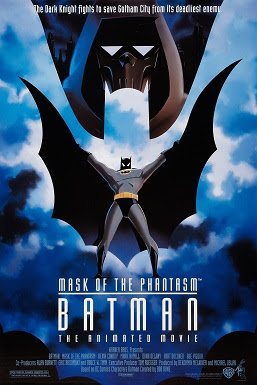
Batman: Mask of the Phantasm is rated PG for “animated violence.” Directed by Eric Radomski and Bruce Timm. Written by Alan Burnett, Paul Dini, Martin Pasko, and Michael Reaves. Based on the DC Comics. Starring Kevin Conroy, Dana Delaney, Hart Bochner, Stacy Keach, Abe Vigoda, Efrem Zimbalist Jr., and Mark Hamill.
Monday, February 27, 2023
Batman: Mask of the Phantasm (1993)
Batman: Mask of the Phantasm is rated PG for “animated violence.” Directed by Eric Radomski and Bruce Timm. Written by Alan Burnett, Paul Dini, Martin Pasko, and Michael Reaves. Based on the DC Comics. Starring Kevin Conroy, Dana Delaney, Hart Bochner, Stacy Keach, Abe Vigoda, Efrem Zimbalist Jr., and Mark Hamill.
Monday, February 20, 2023
Ant-Man and the Wasp: Quantumania (2023)
Ant-Man and the Wasp: Quantumania is rated PG-13 for “violence/action and language.” Directed by Peyton Reed. Written by Jeff Loveness. Based on the Marvel Comics. Starring Paul Rudd, Evangeline Lilly, Jonathan Majors, Kathryn Newton, Bill Murray, Michelle Pfeiffer, and Michael Douglas.
Monday, December 26, 2022
Babylon (2022)
I became a fan of Damien Chazelle almost overnight. I rented Whiplash, one of the only films ever to leave me physically shaking, shortly before seeing La La Land in theaters (twice) and breaking down in full sobs. First Man was an odd follow-up, a spaceman biopic after a big Hollywood musical, but Babylon feels a bit more a return to form. Again (and still), Chazelle is looking at what makes successful people tick, what pushes them to succeed beyond their comfort zones, and what price fame exacts on their souls.
Babylon is bigger and it is more boisterous, a three-hour version of Hail, Caesar! by way of Quentin Tarantino, which begins with a pachyderm’s diarrhea and concludes with a long montage that serves as – unsurprisingly, given his past work – Chazelle’s big love letter to the movies. For my money, it’s a grand success until that finale, which overinflates the point made by La La Land in a movie that is already perilously extravagant.
Babylon is a sprawling film epic in the tradition of, say, Once Upon a Time in Hollywood, featuring a bevy of characters bumping into each other on the way up the showbiz ladder: aspirant and ingenue Nellie LaRoy (Margot Robbie), whose dreams of stardom occlude the perils along her way; silent star Jack Conrad (Brad Pitt), who speaks bad Italian while proposing marriage to a different woman every other scene; accidental stagehand Manny Torres (Diego Calva); jazz trumpeter Sidney Palmer (Jovan Adepo); and gossip columnist Elinor St. John (Jean Smart), who sees all and writes even more.
I knew just from the runtime that the decadence of Babylon was going to be the point, that its sheer exorbitance would likely be a comment in itself. La La Land was a tight two hours, but it seems that three-hour runtimes are becoming the way of the future; James Cameron needed the full three to give us the next Avatar film, while Wakanda Forever landed only twenty minutes shy. After the aforementioned elephant sequence, Chazelle stages an exorbitant party sequence that would make Baz Luhrmann blush with envy. It’s The Great Gatsby times a million, and how our protagonists react to and inhabit it will set the course for the next two hours and change.
Chazelle is a confident filmmaker, and the vast majority of the film is leisurely world-building, episodic sequences that explore the consequences of Hollywood’s meteoric rise. In some such episodes, our protagonists are asked to make moral sacrifices in exchange for fortune and glory; in others, they voluntarily sacrifice their dignity or their physical well-being for a shot at the big time. To sustain this episodic structure, a storyteller must be supremely confident and adept in ferrying the audience along, and Chazelle is certainly that, but he’s helped ably by a terrific cast.
As Nellie LaRoy, Robbie is electrifying. I’m not sure if her performance is sufficiently different from, say, her Harley Quinn to land her an Oscar, though the idea is being bandied about; she’s certainly manic and magnetic, like a dark Judy Holliday. Her chemistry with Diego Calva’s Manny is supposed to be star-crossed, but I sense that only Manny feels that way, and that’s precisely the point. This is a far cry from Mia and Sebastian of La La Land, perhaps because Babylon is largely more cynical. Meanwhile, Pitt’s terrific, as he always is, though one may be wondering why Jean Smart was given a role as toothless as Elinor until the third act, when Smart – in her role as scribe, prophet, and gatekeeper – gets an incisive monologue that could very well crop up in an awards season sizzle reel. Indeed, Elinor’s big speech makes a better summation of the film than Chazelle’s ending proper, which leads me to my conflicted feelings about the film’s ending.
I was deliberately not looking at my watch throughout the film but felt it must surely be on its way toward denouement when Chazelle began to stage his final episode before the film’s coda. Nothing I had seen so far prepared me for a terrifying performance from Tobey Maguire as mobster James McKay. In the film’s final act, Chazelle ratchets up the tension until the film descends into its own version of Dante’s Inferno – itself a perfect inversion of Babylon’s opener – with the ghastly Maguire as Virgil, our sunken-eyed guide into the underbelly of Los Angeles. From there, the film wraps up by telling us who will and won’t change, just in time for an epilogue that puts a button on the story.
It’s almost as though Chazelle is in a rush to conclude the movie in time for his final sequence, which feels less like a satisfying and integrated climax and more like the final moments of Walt Disney World’s The Great Movie Ride. Without spoiling, Chazelle’s grand point had always been clear, and the extended conclusion feels like a less successful version of La La Land’s ending – which worked precisely because it was rooted in the characters. Here, though, Chazelle is making a broader point about the filmmaking industry, and when he acknowledges, for example, Singin’ in the Rain, he tips his hand, gilding the lily and unfortunately suggesting that Babylon has just been an R-rated remake of the 1952 classic.
Babylon isn’t Singin’ in the Rain, but nor is it La La Land, which I maintain is still Chazelle’s best. If there’s an issue with Babylon, it isn’t that it lacks restraint or focus – its madcap meandering is precisely the point – but if it’s a shaggy dog story, the punchline needs to be a little more substantive and personal than where Chazelle leaves it. I still don’t know if La La Land ends on a happy, sad, or wistful note, but Babylon closes with one foot firmly in treacle, which is a sentiment the movie never fully earns. If the film had ended ten minutes earlier, this might have been a different review, but Babylon trips over its own feet right at the finish line – but what a race up until that point.

Babylon is rated R for “strong and crude sexual content, graphic nudity, bloody violence, drug use, and pervasive language.” Written and directed by Damien Chazelle. Starring Brad Pitt, Margot Robbie, Diego Calva, Jean Smart, Jovan Adepo, Li Jun Li, Eric Roberts, Jeff Garlin, and Tobey Maguire.
Monday, December 19, 2022
Avatar: The Way of Water (2022)
It’s been several years since Jake Sully (Sam Worthington) “went native” and abandoned his human body for a Na’vi avatar; he’s started a family with Neytiri (Zoe Saldaña) and made a home in the forests of Pandora. But when the “sky people” return to the alien world, in search of profit and revenge, they’re accompanied by the impossibly-resurrected Colonel Miles Quaritch (Stephen Lang), who wants Sully’s blood for himself. To protect their Omatikaya tribe, Sully and his family flee their home and take refuge with the water-dwelling Metkayina Clan.
Let’s begin right off the bat with an admission that The Way of Water is loaded with some Grade-A nonsense, bordering on sheer balderdash. Even setting aside the bonkers reinclusion of Stephen Lang’s snarly villain, this is a three-hour movie where Sigourney Weaver also returns, but in the body of a blue teenager; where holding your breath is a pivotal plot point; and where crucial exposition is delivered by an immense telepathic whale. If you made it through that sentence without rolling your eyes, this might be the movie for you, but if not, your patience for sci-fi claptrap may wear thin long before the film’s three hours elapse.
And it is long, make no mistake about it. It’s three hours long, and it does feel it; though I’m not sure exactly what I would cut (because James Cameron seems never to have met a Chekhov’s gun he didn’t fire), the last twenty minutes feel like extended set-up for a third film. While things are always happening on screen, there’s a point about two hours in, just before the third act and all its 3D action begin, when one’s hindquarters may be falling asleep. I was never entirely bored, but I was growing restless. Put another way, The Way of Water never quite earns its runtime the way Avengers: Endgame did – which may say more about me than about either movie.
Part of the challenge is that The Way of Water is paper-thin. Its plotting is entirely unsubtle, its characterization never transcends the immediate needs of the plot, and the dialogue is in places ear-scrapingly direct. (“Who’s got the harpoon now?” one character sarcastically asks another after a third quite literally takes possession of a harpoon.) As far as the story goes, Cameron has never really scored points for originality. Indeed, after Black Panther: Wakanda Forever, he’s not even the first movie this winter about a lost civilization of underwater blue people at war with a technologically-advanced military. Like the first one, this Avatar is equal parts Pocahontas and Dances With Wolves, Ferngully and Smurfs in space, though The Way of Water is generously leavened with Free Willy and even a helping of Moby-Dick. We’ve seen all of this before, and most of it in the last Avatar film.
Yet I will give Cameron points for the film paying out like a slot machine in its third act. Nearly everything that’s been set up in the first two acts comes to bear in the grand finale, and I’d be lying if I didn’t admit that I too got swept along with the rest of my theater when the aforementioned giant whale returned to the plot and did its Tulkun thing all over the bad guys. Other plot threads resurface in surprising ways, including one especially gratifying amputation, and you do end up with a very satisfying conclusion – if you have the patience and the tolerance to get there.
I can grumble about the fact that the acting is a little wooden (especially and egregiously, Edie Falco, who seems to be reading her lines cold off a cue card) or that the storytelling is nothing new, but I don’t think anyone comes to a James Cameron film because he’s some sort of poet laureate. Rather, he’s an expert ringmaster in the circus of spectacle; we come to his movies to be entertained, to be dazzled by special effects and ultra-widescreen action. Things blow up in three pristine dimensions, and water has never looked this crystalline. You have to wade through storytelling that is less than inspired to get there, but the Cameron vibe has always been, “Trust me, this will be worth it.” No one came to Titanic for the greatest love story ever; we came to watch a big ship sink. Likewise, no one comes to The Way of Water because we can’t get enough of those Na’vi; we come to see motion-capture evolve, to see a world unlike ours, and if it feels a little like a nature documentary, so be it – The Way of Water has a mellow hang-out aura that verges on overstaying its welcome before hitting a rousing third act.
In terms of its narrative, The Way of Water is only as effective as it needs to be to serve that third act, and on an emotional level I’m not sure that we grow attached enough to the characters to feel the climax. But on the level of visual spectacle, there’s really nothing quite like an Avatar movie, and your ability to derive maximum enjoyment from the film really depends on how much you’re willing and able to silence your critic’s brain and just ride the waves. That’s, after all, the true way of water – go with the flow.
Avatar: The Way of Water is rated PG-13 for “sequences of strong violence and intense action, partial nudity, and some strong language.” Directed by James Cameron. Written by James Cameron, Rick Jaffa, Amanda Silver, Josh Friedman, and Shane Salerno. Starring Sam Worthington, Zoe Saldaña, Sigourney Weaver, Stephen Lang, and Kate Winslet.
Monday, November 14, 2022
Black Panther: Wakanda Forever (2022)
There’s a line from the original Black Panther film that seems to hang over its sequel, Wakanda Forever: King T’Challa sees his late father on the ancestral plane and admits tearfully, “I am not ready to be without you.” No one reprises the line in Wakanda Forever, though someone might as well have; the subtext of every scene (and, in many places, the literal text) is that no one is quite sure how to proceed in the absence of the late Chadwick Boseman, or even whether anyone should. In the course of processing the loss of his friend, director Ryan Coogler turns in an almost poetic elegy that manages nonetheless to close out Phase Four of the Marvel Cinematic Universe with dynamite action and somber grace.
A year after the passing of King T’Challa, his mother Queen Ramonda (Angela Bassett) has been protecting the throne in his absence while her daughter Shuri (Letitia Wright) grieves in her laboratory. The world thinks Wakanda is weak, and several attempts to steal vibranium bring the underwater king Namor (Tenoch Huerta Mejía) into conflict with the surface world. While Namor hopes for an allegiance with Wakanda, the African nation is not so sure that there can be peace.
It might have been easier to recast the role of T’Challa, carry on as though Wakanda hadn’t lost its king – and one has to imagine there was a corporate suit or two pushing for exactly that. But Coogler and crew have chosen the more difficult path, to make a film that confronts Boseman’s passing head on and to make the film into a kind of celebration of life. Each character feels T’Challa’s absence acutely, reacting multifariously to a world without him. In this way, the film reminds of the more tender scenes in The Rise of Skywalker, in which both audience and performers grappled with the loss of Carrie Fisher and the mournful directionlessness of grief. There’s a metafictional bent to sequences where you’re not sure whether the film is commenting on T’Challa, Boseman, or both, but it’s highly effective all around.
Wakanda Forever is emotionally weighty, but it’s also narratively dense, teeing up at least two Disney+ series as well as wherever Namor, sometimes-foe to the Fantastic Four, might turn up next. At two hours and forty-one minutes, there’s probably a joke to be made about Wakanda “Forever,” though I think the film might just as easily have been called “World of Wakanda” – in the sense of both the various factions within Wakanda and the reaction of the geopolitical world to the loss of T’Challa. If there’s anything to be cut, it’s the ties to the other projects: Martin Freeman reprises as Everett Ross, ahead of his turn on Secret Invasion; meanwhile, Dominique Thorne debuts as Riri “Ironheart” Williams, a spunky and precocious inventor who drives but never quite fits into the plot at large. Both are charming and affable presences, but they do more world-building than “World” building.
All of the performances in the film are exceptionally strong, almost certainly because of the powerfully true aspects of the story. Wright and Bassett are stellar as the royal family of Wakanda, but it’s a blessing to see Danai Gurira take center stage. Gurira had quietly stolen the show in the first Black Panther as General Okoye, a spirited and deadly warrior, and seeing her as arguably a co-lead is a terrific development. Huerta Mejía, however, is the latest Marvel “find” as Namor; he captures perfectly the character’s unique blend of romantic charm and arrogant swagger. What’s more, the film’s update on Namor, from Atlantean royalty to Mayan ex-pat, is roundly successful, especially in a dazzling sequence when Coogler takes the time to introduce us to his underwater kingdom, Talokan. (One wonders, though, what James Cameron makes of Wakanda Forever featuring blue-skinned ocean dwellers a full month before Avatar: The Way of Water.)
Wakanda Forever doesn’t appear that it’ll have the same seismic cultural impact as its predecessor, but then how could it? And isn’t that exactly the point? The film refers several times to a Wakandan mourning ritual, suggesting that the film itself is an extended period of grieving. Its solo mid-credits sequence isn’t a prologue to a new story, but it is the epilogue to this one, a hopeful moment that reminds us, as the Wakandans would say, “Death is not the end. It’s more of a stepping-off point.” And rather than being the end, Wakanda Forever is itself a kind of “stepping-off point” for its characters and for the World of Wakanda, an elegiac coda to what came before – but no less emotionally potent, particularly when the immortal salute “Wakanda forever!” is uttered at a climactic moment. It’s hard not to feel a thrill of excitement after going through the grieving process with this cast. Long live the king.
Black Panther: Wakanda Forever is rated PG-13 for “sequences of strong violence, action and some language.” Directed by Ryan Coogler. Written by Ryan Coogler and Joe Robert Cole. Based on the Marvel Comics. Starring Letitia Wright, Lupita Nyong’o, Danai Gurira, Winston Duke, Tenoch Huerta Mejía, Martin Freeman, and Angela Bassett.
Monday, October 24, 2022
Black Adam (2022)
Monday, August 15, 2022
Morbius (2022)
Comic book fans are completists, gluttons for punishment. As terrible as a comic book storyline might be, better to stick it out and suffer; the alternative is a gaping hole in your collection, an otherwise complete run that showcases your religious dedication to the totality. Even when the entire world warns you, even when its veritable terribleness is memed into existence so earnestly that it’s the only thing on which the entire internet agrees, completists like me still find themselves watching Morbius.
And it’s appallingly bad. Worse, though, it’s not as bad as I’d been led to believe. In its short existence, Morbius has already become shorthand for the very worst that the comic book movie has to offer. Yet I find myself wishing Morbius were as bad as all that; a true cinematic catastrophe might have been a little bit fun to watch, yet Morbius is almost aggressively mediocre and unspeakably dull. It’s too boring to be as bad as I’d hoped.
After inventing artificial blood, Dr. Michael Morbius (Jared Leto) uncovers a secret to the moribund malady that plagues him, concocted through experimentation on vampire bats. His human trials on himself, however, prove less than inspiring, transforming him into a living vampire of sorts, to the consternation of his lady friend Martine Bancroft (Adria Arjona), while piquing the interest of his childhood friend Lucien (Matt Smith), who suffers from the same illness as Morbius.
I watched Morbius as a completist, yes, dragging myself unwillingly through every piece of media tangentially related to the Marvel Cinematic Universe. Morbius is set in the same universe as the middling Venom duology, which has its own tenuous ties to Spider-Man, and the film closes with an infuriating post-credits scene tying Michael Keaton’s Vulture into the events of Spider-Man: No Way Home through the magic of corporate synergy. To see the whole, then, I had to agonize through the sum of its parts. But I also bit the bullet (no pun intended) and watched Morbius so that I’d have a bad review to write. I wanted to tear this thing apart, vivisect its exquisite corpse for a page and a half, and inveigle against a universe that conjured up a monstrosity as macabre as Morbius.
And yet Morbius is the second Marvel movie in a year to make me want to fall asleep. Like Black Widow before it, Morbius is entirely basic, carrying no thrills or surprises as it proceeds from plot point to editorially-mandated plot point. It makes only as much sense as it needs, its characters are thin and stereotypical, and it is exactly the movie you expect to see based on the first frames of the film, let alone the trailer. Morbius lacks only Florence Pugh to lend it a semblance of watchability; without her delightful enthusiasm, Morbius ends up being an altogether joyless affair.
At times the king of overacting, Leto is virtually sleepwalking through this franchise non-starter. His dialogue is drowsy, and the only interesting thing about his performance is the occasional CGI transition from his human face to a vampiric one. It’s got nothing to do with Leto, though, and everything to do with the fact that I would rather have been reading a comic book (or, as I reflected during some of the snoozier bits, rewatching the “Neogenic Nightmare” episodes of the mid-90s Spider-Man: The Animated Series). When he’s fighting as Morbius, Leto is passably more watchable, yet I’m certain that’s more to do with dangling a computer-generated shiny object in front of the primitive centers of my brain.
The rest of the cast are crowning achievements in forgettability. Adria Arjona is a snore as Morbius’s colleague-turned-love interest, an about-face that’s so uninspired that the abrupt kiss between them made me realize that I was supposed to mistake this lazy writing for character development. The only memorable moment in Arjona’s performance comes when she mispronounces the name of the “Nobel Prize,” calling it the “Noble Prize” twice in a row. Matt Smith’s antagonist is thinly written, not quite saved but placed on life support by Smith’s hammy fervor for the part; why he’s gone evil, or whether he’s been bad all along, is something about which the script doesn’t quite seem to care. Meanwhile, Tyrese Gibson is cast as a policeman tracking Morbius, who has no character development beyond being gruff and surly, and his periodic appearances serve to give the illusion of tension, as though any of us quite cares whether he’ll arrest Morbius or not.
Then there’s Jared Harris, who’s in the film for reasons I can’t quite fathom. He’s a doctor who runs an orphanage, who then pivots his career into becoming an overpaid home health aide, and he’s only around to deliver a bit of pointed exposition when the movie remembers that he’s on the payroll. I’d spoil where his character ends up if I had any sense that readers or screenwriters alike had a fraction of a care for his good doctor. He’s perhaps included to lend a bit of class to this dour proceeding, but he’s given nary an opportunity to do it. He is good talent squandered; imagine if he’d been given the room to work this role into something approximating an Alfred-level confidant.
Morbius is dismal, but it’s not unwatchable in any kind of a dynamic way. It’s unwatchable in the way that a static feed actively resists being viewed, tedious and monotonous for far too long, even at 100 minutes. I’m all the more offended by the fact that the film threatens us with a sequel – and pressgangs poor Michael Keaton into trying to trick us to tag along. His appearance here makes no sense, his ties to the plot of No Way Home defy any sort of logic, and his invitation to “team up” is nakedly corporate. Worst of all, I’m fairly certain I’ll end up seeing Morbius II (More-bius?) purely because I don’t have the willpower to say “no.” These stories have me hook, line, and super-sinker, and so perhaps, lacking the ability to listen to my own instincts, I deserve Morbius.
Morbius is rated PG-13 for “intense sequences of violence, some frightening images, and brief strong language.” Directed by Daniel Espinosa. Written by Matt Sazama and Burk Sharpless. Based on the Marvel Comics. Starring Jared Leto, Matt Smith, Adria Arjona, Jared Harris, Al Madrigal, and Tyrese Gibson.
Monday, July 11, 2022
Thor: Love and Thunder (2022)
There’s a point in Thor: Love and Thunder when Russell Crowe’s Zeus bemoans his circumstances, lamenting, “When did we become jokes?” I’m fairly certain that director and co-writer Taika Waititi didn’t intend for this line to be prescient – Zeus is meant to be both antagonist and figure of ridicule, to say nothing of Crowe’s outlandish attempt at a “Greek” accent – but it ends up being my chief complaint about Love and Thunder and about the current trend of insincere superhero movies writ large. Love and Thunder is all too disingenuous, at once lampooning the superhero genre while simultaneously begging us to accept its more outlandish trappings.
After defeating Thanos, Thor (Chris Hemsworth) has been traveling with the Guardians of the Galaxy (gang’s all here), blundering his way through heroic deeds until he learns that Gorr the God-Butcher (Christian Bale) has been slaughtering deities with his fearsome Necrosword. Thor sets off to defeat Gorr with Valkyrie (Tessa Thompson) by his side and, most improbably, his old love Jane Foster (Natalie Portman), who now wields the hammer Mjolnir as The Mighty Thor.
I rewatched Thor: Ragnarok the night before seeing Love and Thunder, even though the latter isn’t a direct sequel, and my estimation of Ragnarok had dropped in the intervening five years. Overly arch and ironic, Ragnarok is still entertaining enough, but it could do with about 25% less whimsy to be really successful. I’m not saying that superhero movies shouldn’t be fun, but the fun shouldn’t be at the expense of the characters, deflating tension or emotional weight with a self-referential one-liner. But Ragnarok made more than $850 million, and so the shackles are off; Waititi does his thing all over Love and Thunder, and now it’s about 65% too silly to be any good.
Color me old-fashioned, but I still prefer the straight-faced Shakespearean Thor (blond eyebrows notwithstanding). I’ve never been a big fan of the “himbo Thor” bequeathed to us by Waititi, and I still don’t buy that the character has changed personality so much just because he hangs out with wiseacres like Tony Stark. Indeed, if the upcoming Disney+ series Secret Invasion is to reveal that some familiar faces have been replaced by shape-shifting Skrulls, I vote we consign this Thor to history and get back to something a little more earnest. At least Chris Hemsworth seems to be having fun, even though he’s the butt of most of the jokes (and at one point, quite literally so). Though Thor is now, by default, the ersatz elder statesman of the Marvel Cinematic Universe, he’s treated like an abject buffoon, whose every scene might as well be subtitled, “Aren’t I an idiot?”
And yet Love and Thunder asks us to invest in the emotional depths of this demigod-child, presenting his long romantic history with Jane in the style of a montage that points a derisive finger at how silly it is to have feelings. “Muscle boy sad!” the film cries with all the grace of a schoolyard bully, yet then it tries to pivot into an unearned third act in which we’re suddenly asked to embrace the tragic pathos of Thor’s broken emotional core. Waititi wants to spoof his cake and eat it too, something that barely worked in Ragnarok before punting that subplot to the Russo Brothers in Avengers: Infinity War. If Thor has an arc in this film, I defy anyone to tell me what it is, because there’s a particular choice he makes at the end of the film that seems to come out of nowhere, teeing up a very bizarre status quo for the Asgardian corner of the MCU.
It might seem blasphemous to say, but there’s probably a much better version of this film that includes Hemsworth’s Thor not at all. Christian Bale is earning well-deserved accolades as one of the MCU’s better villains, with a solid backstory and bang-up visual design; one wishes, however, that his Gorr were a bit more ‘show’ and less ‘tell,’ since he doesn’t butcher all that many gods over the course of the film. Meanwhile, Natalie Portman is back after a brief hiatus, and her turn as Jane finally gets her in on the super-action. Her iteration of Thor positively sings, and the sequences reintroducing her are suitably effective, giving us the sense that Waititi can make a proper superhero film if he restrained himself. In fact, it’s a short putt to imagine a better Love and Thunder that only includes these two: Gorr the God-Butcher hunting the newly-minted Mighty Thor while Jane Foster reckons with what it means to be a god. (Keep the original Thor with the Guardians of the Galaxy, and let James Gunn deal with him.)
But instead of forging new territory in the heretofore directionless Phase Four of the MCU, Waititi is busy replaying his own greatest hits, dialing the idiocy up to eleven. There’s a reprise of the “Norse pageant” from Ragnarok, even though the joke doesn’t ring the same without a Loki to direct the reenactment; Korg turns up again and again, now lacking the novelty of a rock man with Waititi’s dulcet tones; and poor Tessa Thompson, such a bright light in Ragnarok, is relegated to a thankless turn as Asgard’s king until the movie nigh forgets about her. (Sign her up for a Disney+ series, please!)
I wouldn’t go quite as far as Mark Kermode, who said of the fourth Thor film that it was “genuinely, properly terrible,” but let’s be honest: Marvel’s Phase Four hasn’t exactly shined with the brightness of its predecessors, and Love and Thunder continues a strain of adequate-to-mediocre outings that suggest Marvel may have lost the plot in trying to serve fans and fan-favorites alike. Perhaps a better title would have been Thor: Sound and Fury, because it’s told by (and stars) a band of idiots, ultimately signifying nothing beyond a director’s postmodern self-indulgence. Forgive me, but I think superhero stories ought to be a little bit more than a vanity project that overstays its welcome.
Thor: Love and Thunder is rated PG-13 for “intense sequences of sci-fi violence and action, language, some suggestive material, and partial nudity.” Directed by Taika Waititi. Written by Taika Waititi and Jennifer Kaytin Robinson. Based on the Marvel Comics. Starring Chris Hemsworth, Christian Bale, Tessa Thompson, Taika Waititi, Russell Crowe, and Natalie Portman.
Tuesday, May 17, 2022
Take Two Tuesday: Spider-Man: No Way Home (2021) ... or, look out, here comes (another) Spider-Man
I’ve seen Spider-Man: No Way Home twice now on home video. With a 93% score on Rotten Tomatoes, nearly $2 billion in worldwide box office, and legions of fans declaring that it’s the best Marvel movie ever, Spider-Man: No Way Home isn’t actually very good. It’s entertaining enough, with flashes of brilliance, but it’s over-reliant on nostalgia with a story that doesn’t hang together. And were it not for the pure unadulterated charisma of its leading performers, No Way Home would be an unabashed flop.
You’re going to need to have seen the film for me to talk about why it doesn’t work, so spoilers follow for No Way Home (and, really, every Spider-Man film that came before it). I compared No Way Home to Avengers: Endgame, in that “No Way Home finds itself as the unlikely apogee of the eight Spider-Man films that preceded it.” And I’ve thought about this idea a lot over the last five months, mulling the difference between Endgame (which was built as a climax) and No Way Home (which is merely masquerading as one). I think No Way Home tries very hard to be the next Endgame, especially if you’ve seen every Spider-Man movie in the last twenty years.
Monday, May 16, 2022
Doctor Strange in the Multiverse of Madness (2022)
Doctor Strange in the Multiverse of Madness is rated PG-13 for “intense sequences of violence and action, frightening images and some language.” Directed by Sam Raimi. Written by Michael Waldron. Based on the Marvel Comics. Starring Benedict Cumberbatch, Elizabeth Olsen, Chiwetel Ejiofor, Benedict Wong, Xochitl Gomez, and Rachel McAdams.