Monday, March 31, 2014

Noah (2014)

Abandon all hope, ye who anticipate a Biblically accurate adaptation of the flood narrative.  This here’s Aronofsky territory.  The same uber-metaphorical lens through which Black Swan regards Tchaikovsky’s “Swan Lake” gets applied here to Genesis, resulting in a film that is often uncannily strange but never less than engaging.

Russell Crowe stars as the Scriptural patriarch who gathers his family and two-of-every-kind in a colossal ark after a vision from The Creator informs him that the world is about to perish in a flood.  As he gathers his family (wife Jennifer Connelly, sons including Logan Lerman, and daughter-in-law Emma Watson), Noah incurs the wrath of local warlord Tubal-cain (Ray Winstone), who refuses to believe that God has not spoken to him too.  Postscript – check out Anthony Hopkins as a berry-gathering Methuselah, doing that wise old man act he’s perfected by now.

Let’s set aside the religious debate right off the bat.  The film doesn’t purport Biblical accuracy; in fact, director Darren Aronofsky disavows any such intention.  Consequently, I think Noah ought to be measured by the same standards as any other film adaptation of a major mythic narrative, in the vein of superhero or Hercules movies.  And there’s nothing in Noah that constitutes an unequivocal betrayal of the source material, nothing incompatible with the core of the original story.

As an interpretive adaptation, then, Noah is mostly successful, though it borders every so often on the bizarre.  The film is fortunately anchored by a very compelling and very human performance from Crowe, who imbues Noah with a deeper humanity than most interpretations. Rather than present Noah as a stoic “true believer,” Crowe gives him his moments of doubt, his misinterpretations of the message, and his post-flood uncertainty.  (Plus, after this and Man of Steel, Crowe has the market cornered on “dads who put their sons in arks.”)

Aronofsky does some visually clever stuff when he introduces Noah’s visions from The Creator as slideshow dream sequences, working in a nifty sample of the overlap between creationism and evolution.  But then the film gets really weird, and by weird I mean “rock people help build the ark.”  There’s a bit of murky theology in these rock people being fallen angels who help mankind, and their bids for forgiveness play up a side of Old Testament God that isn’t seen too often.  In a movie that otherwise immerses you in a specific time period in antiquity, though, living rocks strain credulity.

The other major subplot Aronofsky introduces is the presence of a tribal chief who goes to war for a spot on the ark.  It’s a plausible addition that Noah’s neighbors might have been a bit jealous, and Winstone is wholly engaging as Noah’s foil.  Aronofsky uses these villains, though, to posit an underlying vegans-versus-carnivores message that ultimately confounds more than it proselytizes.  (Some are reading it as anti-industrialist, though that may be a bridge too far.)  It’s fine for establishing a contrast between Noah and the sinners, but it raises major ethical questions:  Noah kills three hunters to avenge their killing of an animal for food, but he turns a blind eye to the rape and pillage of actual humans next door.  I see what Aronofsky is doing, adding an earthy and spiritual element to Noah’s communion with The Creator, but it’s more distracting than it should be precisely because the logic doesn’t hold up.

All told, though, Noah ends up an engaging film, a successful spectacle – which is, at the end of the day, all I ask of a movie.  It’s far from patently offensive, and the parts in the film that work do work very well.  Aside from a few silly bits, Noah is big-budget pageantry at its most watchable, put forward by a powerful lead performance and directed by a man with an unmistakable (if punctuated by logical error) directorial vision.

Noah is rated PG-13 for “violence, disturbing images and brief suggestive content.”  Aside from the whole exterminating flood, there are a few scenes of bloody combat, other scenes of animals being killed in gory fashion, and a bit of bare-shouldered friskiness from the cast’s younger group.

Next week, something we haven’t done in a very long while – two reviews on the same day. Hint:  what’s the big release this Friday?  And when is the Double-Oh-Seventh of this month?  Put another way, when is an American icon like a British agent?  When they’re both reviewed here, that is!  See you next week!

Monday, March 24, 2014

Monday at the Movies - March 24, 2014

Welcome to another edition of “Monday at the Movies.” This week, a less than unfortunate flick.

Lemony Snickey’s A Series of Unfortunate Events (2004) – Midway through my recent binge-reading (can this be a thing?) of the thirteen books in the series, I stepped aside for a few hours with the film, which loosely adapts the first three books (The Bad Beginning, The Reptile Room, and The Wide Window).  The film and its source material find the Baudelaire orphans (Emily Browning as inventive Violet, Liam Aiken as bookish Klaus, and their baby sister Sunny) bounced from guardian to guardian after their parents perish in a fire.  The first guardian, Count Olaf (Jim Carrey), turns out to be a cad of many costumes; the third, Aunt Josephine (Meryl Streep) is a paranoid whackadoo ruled by her fears.  In between is the kind herpetologist Uncle Monty (Billy Connolly), a character who gets far too little screen time in contrast to his zanier counterparts.  The elephant in the room is Carrey; he’s at his best when he’s restrained (as in The Truman Show), but here his penchant for plasticity plays well with the character’s own fondness for disguises.  Each disguise Count Olaf dons is transparent, but it’s fun to see Carrey step behind Olaf’s theatricality and inhabit these alternate takes on the character (i.e., the meek Stephano or the gruff Captain Sham).  The three Baudelaires are mostly fine, though the film curiously steps away from Violet’s distinctive hair ribbon and Klaus’s definitive glasses.  But one of the most fun bits in the film is what I’ve always held as the cinephile’s true delight – a cast of celebrity cameos, including Streep and Connolly, of course, but also Timothy Spall, Craig Ferguson, and Dustin Hoffman doing his best Stan Lee impression.  Ultimately, the film feels a lot like a Tim Burton film – the best way, I suppose, to describe Snicket’s distinctive prose voice – but as a Burton fan and an admirer of the books, Lemony Snicket’s was engaging enough.  If only the film told us who Beatrice was!

That does it for this week’s edition of “Monday at the Movies.” We’ll see you here next week!

Thursday, March 20, 2014

Mr. Peabody & Sherman (2014)

It’s the classic story of a dog and his boy traveling through time, and while I haven’t had great things to say about DreamWorks animation in the past, I had more fun than I was expecting with Mr. Peabody & Sherman, a delightful kid’s movie with as much if not more to offer older audience members.

Mr. Peabody (voiced by Ty Burrell), having conquered every field of knowledge known to man, adopts a boy named Sherman (Max Charles) and builds a time machine called the WABAC (way-back) Machine.  Not bad for a talking dog, eh?  Mr. Peabody’s greatest challenge, though, comes when Sherman is bullied at school, and a reconciliatory dinner party with the bully Penny (Ariel Winter) and her parents goes awry.  Mr. Peabody, Sherman, and Penny end up bouncing through time, where/when they meet King Tut, Leonardo da Vinci (Stanley Tucci), and – on the eve of the Trojan War – Agamemnon (Patrick Warburton).

Mr. Peabody & Sherman is roundly the most enjoyable film adapted from The Rocky and Bullwinkle Show.  It succeeds where its predecessors – Boris and Natasha, Dudley Do-Right, and The Adventures of Rocky and Bullwinkle – failed because it attempts to be neither too zany nor too self-aware.  Instead of banking entirely on nostalgia or on excessively cartoonizing reality, Mr. Peabody & Sherman creates its own world with its own rules and briskly justifies its own existence with a series of quick jokes about a genius talking dog.

I’ve seen Mr. Peabody and Sherman referred to as “Dogtor Who,” and it’s an exceptionally apt comparison – one I wish I’d thought of, to be honest.  Like Doctor Who, this film carries an infectious exuberance about the opportunities afforded by time travel, the sense of limitless adventures to be had by slipping through the timestream.  At the heart of it all is a refreshing optimism about humanity, the idea that we could all be a little better if we surrender to the search for knowledge and compassion.  But both Peabody and Who perform that critical function of any work targeted to younger audiences; that is, they both work on multiple levels for varying audiences.  There are jokes in Peabody that the kiddies simply won’t get – the implications of Bill Clinton’s “I’ve done worse” or the potential awkwardness if one accepts Oedipus’s invitation to holiday dinner – and that’s fine.  In fact, it’s great; it ensures the adults will be guffawing just as loudly at the asides as the young’uns at the word “doody.”

I concede that I had my doubts about this film, particularly after hearing that Robert Downey, Jr. wasn’t playing Mr. Peabody.  After all, he’d have been a perfect match for Bill Scott’s pointed delivery on the original series.  But the greatest compliment I can pay Ty Burrell – other than to say that his Phil Dunphy on Modern Family never fails to split my sides – is that I forgot all about RDJ as a Peabody candidate and found Burrell a creditable Peabody.  Burrell manages to weave Peabody’s exceptional intellect with his unique pun-based sense of humor and of course his “deep regard” for his adoptive son Sherman, giving a performance that is both clever and affective.  The rest of the voice cast is strong as well, particularly Stanley Tucci as a put-upon if caricatured da Vinci, but it’s undeniably Burrell’s show.

Mr. Peabody & Sherman could have pandered to an audience of children, but instead the filmmakers have turned in a movie that can be enjoyed by just about anyone.  Mr. Peabody & Sherman is so much more clever than it could have been, and as a result I found myself having a fantastic time in the theater – which in the end is all I ever ask from a film.  No need to go back in time to un-see this one; if I could, I’d see it all over again.  Until then, I’ll tide myself over with the original clips on YouTube.

Mr. Peabody & Sherman is rated PG “for some mild action and brief rude humor.”  This movie is soundly appropriate for children who can handle a bit of light swordfighting, standard chase sequences, and the occasional flatulence humor.  Oh, and one scene of biting.

Monday, March 17, 2014

Non-Stop (2014)

Mark Kermode, a British film critic with whom I find myself agreeing more often than not, said of Taken, “It is the kind of movie that used to be the second-bill on a kind of junky double-bill at a drive-in and now somehow has managed to make it to the big screen with a big name.”  Indeed, that big name, Liam Neeson, has made a career of elevating otherwise B-movie action films.  Why Kermode doesn’t chalk up to Neeson the victories of Taken and its children is anyone’s guess, because it’s the clearest reason for Non-Stop to exist, let alone to succeed.

Neeson stars as federal air marshal Bill Marks (a name you won’t forget because of the way it’s growled throughout) on a red-eye transatlantic flight.  Midway over the ocean, Marks receives a series of texts from a terrorist who promises to kill a passenger every twenty minutes – and, we soon learn, frame Marks in the process.  But we know it’s not all as easy as that, and Neeson does not disappoint in his resilience, very nearly hijacking the flight in an attempt to clear his name.

Let’s establish one thing straightaway – Non-Stop is not Taken.  It’s a far cry from Pierre Morel’s masterful action film, which still manages to thrill after all these years.  In fact, I might be more generous toward Non-Stop precisely because its star makes some of the script’s sins forgivable, or at least bearable.  Neeson is as always a stalwart and reliable action star, gravelly and determined.  He communicates both desperation and dedication in equal parts, allowing us to feel the urgency without fully doubting his abilities.

Bill Marks may share a set of initials with Taken’s Bryan Mills, but he lacks that critical “set of skills” with which the latter might have quickly resolved the crisis.  Instead, the script saddles him with textbook substance abuse and past family trauma, but it’s to Neeson’s credit that he pulls off these rather generic gestures toward characterization and pulls in a convincing portrait of a troubled man pushed to his limits.

Where Non-Stop misses the bar set by Taken is largely everywhere else in its filmmaking.  At 110 minutes, the film feels longer than it needed to be, in part because Bill Marks is air-marshaling aboard a flight chock overfull of narrative detours.  One even suspects that Julianne Moore was cast because of her hair color as a literal personified red herring.  The problem is that the film’s reliance on the classic locked-room formula means that Bill’s initial hunches are necessarily wrong; this puts the audience in the position of being fully aware of the misdirections at work, and the film never really tries to counteract our sense of those sleights of hand.  Consequently, the film feels in a bit of a holding pattern while the intuitive audience members look for the real clues behind the foreground.  Neeson’s performance is compelling, very much enough to hold your attention, but on reflection it’s very much a B-movie superstructure.

The film is, however, at its best when it surrenders to what might be considered the “dumb fun” action of the third reel, when the story takes on a ticking plot twist and a spiraling set of revelations.  Non-Stop does suffer from exposition-heavy villain monologuing, but it counterbalances with flashy fistfights and even a bit of high-altitude/high-stakes gunplay.  Ultimately, then, Non-Stop succeeds or fails based on how highly you value the screen presence of Liam Neeson.  For this filmgoer, it’s a fun enough diversion though not a close contender for greatness.

Non-Stop is rated PG-13 “for intense sequences of action and violence, some language, sensuality and drug references.”  There are a few deaths on the plane as the terrorist makes good on the every-twenty-minutes threat.  A younger passenger is seen flirting with two older men, and IMDb reports two F-words (only one of which I recall).

While The Cinema King enjoys spring break, it’s the perfect opportunity for multiple reviews.  So come back on Thursday for my take on Mr. Peabody & Sherman!

Monday, March 10, 2014

Monday at the Movies - March 10, 2014

Welcome to another edition of “Monday at the Movies.” This week, the next best thing to seeing a play.

Who’s Afraid of Virginia Woolf? (1966) – I only recently encountered Edward Albee’s play of the same name and knew immediately I had to see Mike Nichols’s well-regarded film adaptation (his cinematic directorial debut).  Fortunately, Nichols’s film version avoids the trap that most filmings of plays tend to encounter; where some films rely too much on the power of the dialogue itself, what ends up emerging is an uncinematic talkfest slavishly devoted to the play text.  In the case of Virginia Woolf, though, Albee’s words are brought to life by two powerhouse performances.  Richard Burton and Elizabeth Taylor star as George and Martha, a beleaguered history professor and his browbeating wife.  Even if you don’t view the film as a side narrative to the real-life relationship between Liz and Dick, their work here is electrifying, the repartee arcing off each other in rapid-fire bursts of emasculating zingers and biting droll humor.  A part of me will always wonder what could have been if James Mason and Bette Davis had been cast (as Albee hoped), but there’s no doubt that Burton and Taylor are first-rate as George and Martha.  The film finds them at a late-night party with a new biology professor and his wife, played by George Segal and Sandy Dennis.  Segal and Dennis are suitable enough (though I’m surprised Dennis won the Best Supporting Actress Oscar), but their bigger strength is in knowing not to attempt to upstage Burton and Taylor.  And the black-and-white cinematography is a stroke of inspiration, allowing nothing to distract from the top-notch performances before us.  And for what it’s worth, just last year the Library of Congress identified this film for preservation.

That does it for this week’s edition of “Monday at the Movies.” We’ll see you here next week!

Friday, March 7, 2014

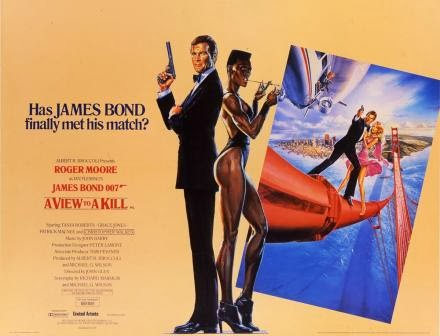
A View to a Kill (1985)

We’ve really had just about enough of Roger Moore around these parts.  From boring to offensively bad, Roger Moore’s tenure as James Bond has really disappointed after the initial promise he showed in Live and Let Die and The Man with the Golden Gun. After seven films and twelve years, A View to a Kill marks Moore’s last outing as 007, and it’s mixed feelings all around.  The film itself isn’t bad, but one gets the feeling that Moore has wasted too much time getting here.

After uncovering something to do with a computer chip, James Bond (Moore) seeks out the chip’s manufacturer, cyber-wunderkind Max Zorin (Christopher Walken).  Bond poses as an equestrian, then a journalist, to uncover the truth about Zorin’s mad scheme.  Along the way Bond is aided by fellow agent Godfrey Tibbett (Patrick Macnee) and heiress Stacey Sutton (Tanya Roberts) and foiled by Zorin’s Amazonian bodyguard May Day (Grace Jones).

A View to a Kill has a poor reputation among the Bond canon, though I don’t think the film is irredeemable.  I’m a fan of films where Bond has to put clues together to uncover a case, and this film plays that up quite well with a number of seemingly disparate plot threads – computer circuitry, illegal horse breeding, Nazi eugenics – that all come together with a satisfying cohesion.  It’s especially fun to see Moore puzzle through the matter with Macnee, the original John Steed, by his side; the two do a neat kind of “Grumpy Old Men” routine that riffs nicely on the shared espionage background between the two.

Having said that, Moore is really just too old to keep doing this sort of thing.  It’s clever when the film attempts to confront it, but once Macnee leaves the plot we’re asked to forget Moore’s age and regard him once more as the spry agent Bond ought to be.  But it’s a brutally unsuccessful move, made all the more apparent by how clearly youthful both Roberts and Jones are.  When Moore’s Bond beds both, it’s like catching a lusty grandfather in bed with a cheerleader; it feels both wrong and uncomfortable.  The other type of physical scenes also flounder due to his age, especially the ones involving complex stunts like another ski jump.  (You were right, Spy Who Loved Me:  nobody does it better.)

Fortunately, the film has an amazing antagonist in Christopher Walken.  Let that sink in:  Christopher Walken is a Bond villain, and it’s everything you’d expect from that sentence.  Walken is at his mid-80s nuttiest here, emphasizing all the wrong syllables and cocking his head at peculiar angles to give his character a fully off-kilter vibe.  Though the film relies on a clue-based structure, there’s no question that Walken, with his albino afro and shifty-eyed glances – is the villain, which allows him to surrender entirely to the character’s hammy quirks.  Best of all, Walken funnels that goofiness into full-blown psychosis; where some Bond villains have trouble toeing that line, Walken makes Zorin both engaging and terrifying, even without that curious subplot where (spoilers?) he’s revealed to be a Nazi test tube baby.

Perhaps even more than Walken’s performance, what helps A View to a Kill is its uncanny and unmistakable resemblance to the franchise’s finest hour – Goldfinger.  The basic plot outline is the same:  mad billionaire with lethal sidekick cooks up scheme to destroy resource and increase his own wealth.  While A View to a Kill never makes the connection explicit, with nary a reference in sight, reappropriating the successful formula carries with it a tried-and-true aspect that isn’t very surprising.  That is, it already worked in Goldfinger, so A View to a Kill doesn’t see a need to reinvent the wheel.  It’s ironic that we saw the same thing happen with Never Say Never Again, which rebranded Thunderball, though View to a Kill takes the remake angle a step further and at least does more than merely change the scenery.

And honestly, after all the missteps we’ve seen in the Roger Moore era, it’s subconsciously refreshing to be reminded of Goldfinger, arguably Connery’s and the franchise’s gold standard.  We’ve been through so much with Moore that I almost forgive the sin of uncreativity because it means we’re moving on to something new and different.  Plus, tell me the idea of Goldfinger starring Christopher Walken isn’t tempting.

A View to a Kill is rated PG.  There are several scenes of implied nudity (bare shoulders and backs), and in one scene a man machine-guns a crowd while another character is killed by an explosive.

Roger Moore may be out, but James Bond and The Cinema King will return in a review of The Living Daylights (1987) on April 7, 2014!

Monday, March 3, 2014

Monday at the Movies - March 3, 2014

Welcome to another edition of “Monday at the Movies.” This week, a movie brutally snubbed at last night’s Oscars.

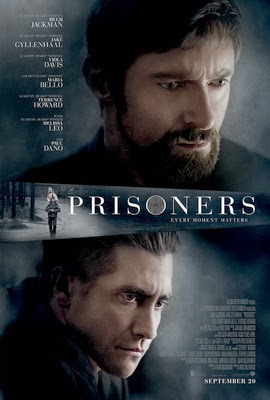
Prisoners (2013) – I could fill this review with 250 adjectives – breathless, intense, suffocating – but they all add up to one word.  Prisoners is fantastic, much darker and more intricate than the torture porn promised by the film’s one-note marketing.  Hugh Jackman and Terrence Howard star as fathers whose daughters disappear one Thanksgiving; displeased with the methods of Detective Loki (Jake Gyllenhaal), Jackman takes hostage a mentally challenged man (Paul Dano) who he believes abducted the girls.  Prisoners, though, is much more elaborate than that initial synopsis posits, weaving a number of plot threads together in unexpected ways that are best experienced as the film unfolds – especially because some of the most insignificant details acquire astonishing relevance in the third act.  I’d never heard of director Denis Villeneuve before, but he’s certainly on my watchlist now.  There are moments in Prisoners that recall the best scenes in David Fincher’s Zodiac, moments of intense claustrophobia that have little to do with the actual set design and much more to do with the sense that the plot is rapidly closing in on itself, that events are spiraling beyond the control of the protagonists.  (Jackman’s continual reminders of how long the girls have been missing further add a real-world tenseness to the proceedings.)  Though all in the cast do fantastic work, including Maria Bello and Viola Davis as the beleaguered mothers, a special tip of the hat goes to Paul Dano, who really deserved a Supporting Actor nod.  As the disabled Alex Jones, Dano masters the mental handicap without overplaying it and subtly convinces us that something is quite wrong about Alex even if we don’t know exactly what it is (and he keeps us guessing, too).  Disappointingly, Prisoners seemed to fall off the radar once it debuted in theaters – a real shame, since it’s one of the most gripping films I’ve seen in recent memory.

That does it for this week’s edition of “Monday at the Movies.” We’ll see you here next week, and don’t forget that this Friday is the Double-Oh-Seventh of the month (and Roger Moore’s swan song as James Bond)!

Monday, February 24, 2014

Monday at the Movies - February 24, 2014

Welcome to another edition of “Monday at the Movies.” This week, we’re back to what we do best – reviewing comic book movies.

Justice League: War (2014) – Based on the revisionist New 52 incarnation of the Justice League, War gets the band back together again for the first time to repel the invading Darkseid, the literal god of evil.  Where the New 52 comics rebooted the DC Universe back to a publishing line of first issues, War is a reboot for the animated movie universe and – more notably – its prominent and quite popular stable of voice actors.  Gone are Tim Daly and Kevin Conroy; in are Alan Tudyk and Jason O’Mara as Superman and Batman, respectively.  Tudyk is mostly unremarkable as Superman, capturing this incarnation’s cockiness. O’Mara, meanwhile, is the more controversial choice, as Conroy’s an incredibly tough act to follow; O’Mara does lack Conroy’s bass-heavy gravitas, but he brings the Bat into a gruffer territory a la Harrison Ford.  So count me among the pro-O’Mara camp for now.  The big success in the casting, though, comes from Justin Kirk’s turn as Green Lantern.  Kirk gives the role all the braggadocio that forms the core of Hal Jordan, a swaggering portrait of masculinity that gets destabilized in a great “death wish” moment.  (It’s almost a shame he’s not playing Guy Gardner.)  We also get a comparable triumph with Wonder Woman, who's played by Michelle Monaghan as a hack-and-slash newcomer to man's world; this portrayal should appeal to audiences who want a strong female character without that being her defining attribute.  (Keep your eyes out for the foreshadowing of a romantic relationship with Superman.)  While the apocalyptic threat of Darkseid never quite carries the full weight of the comic’s incarnation (or Michael Ironside’s earlier voicework), it fulfills the plot function of “big enough threat” to get the Justice League to unite.  Indeed, the film’s great success is in introducing each Leaguer individually and positing a threat large enough for these disparate elements to join together.  If the rumors about the Man of Steel sequel are true, perhaps this is a good model for how to bring many big figures together without prior solo films.  In this respect, Justice League: War is the other side of the Avengers coin, but it works as well as DC’s other animated successes.  Except, of course, Mask of the Phantasm, which remains the gold standard.

That does it for this week’s edition of “Monday at the Movies.” We’ll see you here next week (and again when Jason O’Mara stars in Son of Batman, which adapts Grant Morrison’s popular “Batman and Son” plotline)!

Monday, February 17, 2014

The Lego Movie (2014)

It’d be a very short putt to brush off The Lego Movie as an extended toy commercial, but it would have been even easier to make that version of the film.  Instead, and fortunately for moviegoers, The Lego Movie more than lives up to its theme tune, “Everything Is Awesome,” by being exuberantly fun, deliciously creative, and containing a whopper of an important message.

Emmet Brickowski (Chris Pratt) is your average-joe Lego minifigure, indistinct in every way until he finds the Piece of Resistance, an object which freedom fighter Wyldstyle (Elizabeth Banks) and wizard Vitruvius (Morgan Freeman) tell him is the key to saving the Lego universe from the dastardly plans of President Business (Will Ferrell).  Emmet joins the other Master Builders – including spaceman Benny (Charlie Day), Unikitty (Alison Brie) and Batman (Will Arnett) – to discover his awesome destiny.

Critical approval of The Lego Movie is currently holding at 96% over on that tomato-based review site, and it’s no wonder.  Rather than pander to what we’d expect from a film based on a toy (looking at you, Transformers), The Lego Movie does some very creative things while building that creativity into the very fabric of the narrative, literalizing what amounts to a cogent critique of the current state of cinema.  The dystopia of The Lego Movie is the consequence of a cultural apathy for innovation, a contentment to follow instructions, ingest empty pop music, and consume expensive coffee.  The Lego builders rely on old formulas, stable sets of instructions to shape their world.

As a remedy for the plight of creativity, Emmet learns to build outside the box, without the crutch of directions.  Like the rest of the Master Builders, Emmet has to think in new ways, assembling extant pieces into original and fantastic shapes, utilizing the old forms only when absolutely necessary.  It’s a wonderful commentary on Hollywood’s remake-happy philosophy; rather than give moviegoers something they’ve never seen before (Emmet’s double-decker couch), filmmakers are all too reliant on proven formulas (cars with a wheel... and three other wheels).

It’s perhaps ironic that Batman is included in the Master Builders in the film, as he’s one of the most frequently deployed “pieces” in Hollywood’s toybox.  But even in the case of Batman, The Lego Movie proves its point.  We’ve seen possibly every incarnation of Batman on the silver screen – a deliberately campy one in 1966, Tim Burton’s comic-booky version, Schumacher’s homoerotic-inflected hero, and back to Nolan’s ultra-gritty realism – but The Lego Movie avoids falling into the stereotype of any of the previous incarnations by taking Batman in a new direction, guided by Arnett’s perfect voiceover work.  Taking a satirical bent on the “Dark Knight” and all his grim trappings, Arnett’s Batman is performative and growly, but it’s moments like Batman’s hatred of rainbows that add something new to the character.  Taking the pieces that filmmakers have already used, The Lego Movie shows us how to be creative by reinterpreting and revising (emphasis on “vision”).  Take note, Zack Snyder!

The Lego Movie is so delightfully self-aware, casting Morgan Freeman as an omniscient sorcerer but continually undercutting the character with delightful one-liners.  The film is full of surprises, best experienced and not spoiled, so I’ll refrain from my usual litany of review bullet points and conclude by saying that The Lego Movie is, simply put, awesome.

The Lego Movie is rated PG “for mild action and rude humor.”  Really, the movie is quite tame, and were it not for a scene or two where Lego figures are threatened with being melted, it’s entirely appropriate for all audiences.  I mean, my goodness – the characters won’t even say “gosh” as a swear word (Emmet spells it out to avoid speaking it).

Monday, February 10, 2014

Monday at the Movies - February 10, 2014

Welcome to another edition of “Monday at the Movies.” We’ve got another musical on the docket, but how does it compare to High School Musical 2?

Moulin Rouge (2001) – I’m really not the target audience for this. I’m quite certain of that. Having said that, my reaction to Moulin Rouge is really quite lukewarm. In Moulin Rouge Baz Luhrmann invents the velvet-vomit aesthetic with a rock opera take on fin-de-siècle Paris starring Ewan McGregor as an aspiring playwright and Nicole Kidman as the cabaret courtesan who loves him. The film might have made a bigger impact had I seen it earlier; thirteen years after its release, it feels like a lot of what I’ve already seen, especially in the wake of Luhrmann’s The Great Gatsby (about which I felt similarly ambivalent). Both films opened with their protagonist/narrator on a typewriter, the words zooming across the screen. As for the central conceit, the gimmicky pastiche of pop tunes and prewar visuals, it’s clever initially, and the use of Elton John’s “Your Song” is actually quite perfect for a romantic film. After a while, though, it gets tedious and at one point – the moment at which Jim Broadbent, otherwise engaging in the movie, is forced to sing Madonna’s “Like a Virgin” – quite demoralizing. Throw in John Leguizamo’s brutal caricature of Toulouse-Lautrec and a runtime that feels much longer than its two hours, and Moulin Rouge will have you seeing red. Unless of course you’re into this sort of thing. If you surrender to the chemistry Kidman and McGregor clearly have between themselves and overlook the fact that the film tries to compensate for its lack of substance with an overabundance of style, you’ll have yourself a blast. As for me, I’ll be over here with the more convincing flicks.

That does it for this week’s edition of “Monday at the Movies.” We’ll see you here next week!